Case Study: Accelerating Software Architecture Documentation with VPasCode – A Diagram-as-Code Revolution

Case Study: Accelerating Software Architecture Documentation with VPasCode – A Diagram-as-Code Revolution

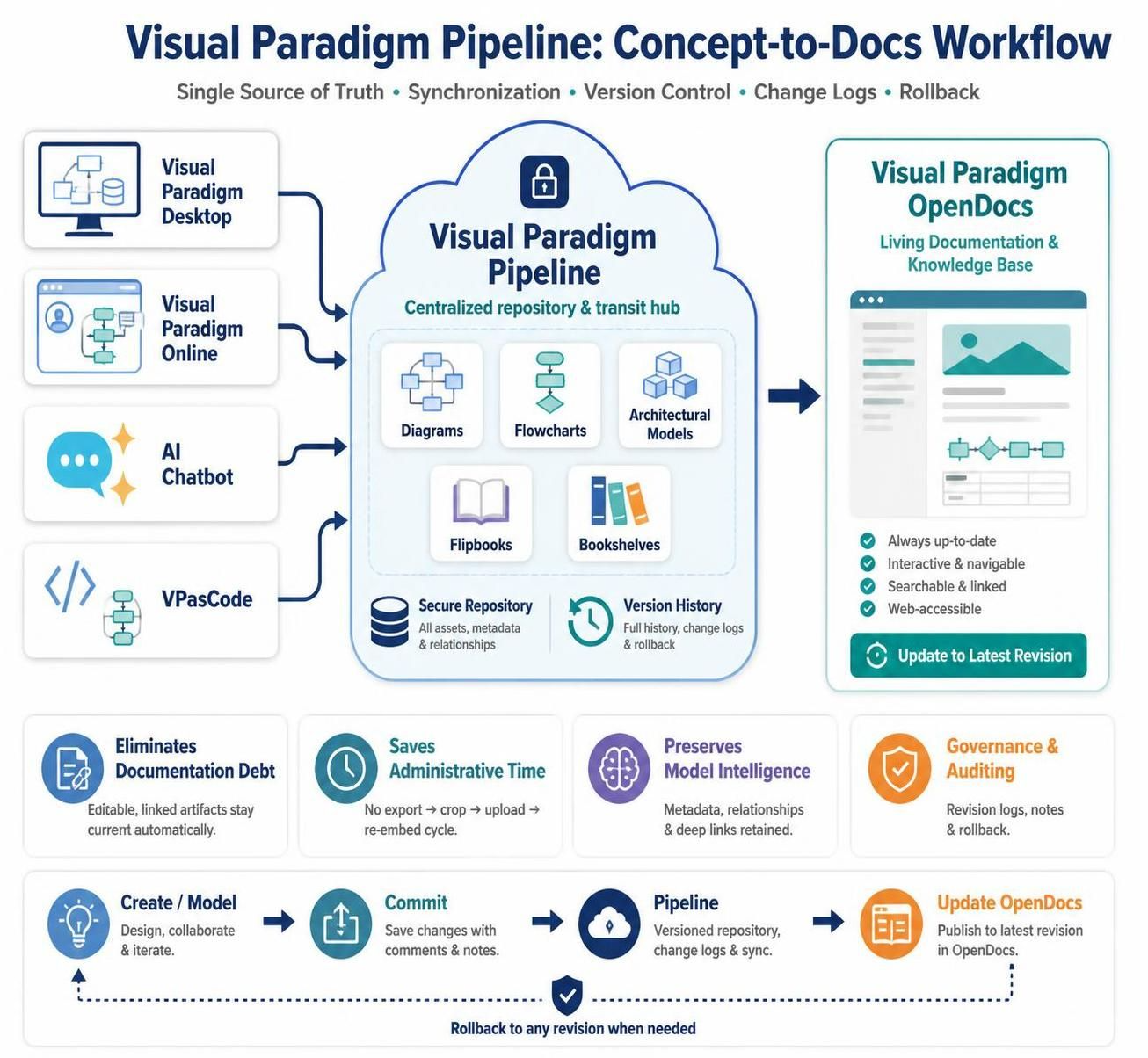
Suggested Article Title: "From Text to Vision: How VPasCode Transforms Diagram-as-Code Workflows for Modern Engineering Teams" Introduction: The Documentation Gap in Modern Software Development In today's fast-paced engineering environments, software architecture evolves at the same velocity as source code. Yet, a persistent challenge remains: keeping architectural documentation synchronized with implementation. Traditional visual modeling tools, while powerful, often create friction—they live outside the codebase, require manual updates, and struggle to integrate with version control and CI/CD pipelines. Enter VPasCode, Visual Paradigm's unified Diagram-as-Code (DaC) platform. By shifting diagram creation into the text editor—where developers already spend their…continue reading →
From Concept to Code: A Comprehensive UML Class Diagram Guide & Case Study

From Concept to Code: A Comprehensive UML Class Diagram Guide & Case Study

Introduction Unified Modeling Language (UML) Class Diagrams serve as the blueprint for software architecture, bridging the gap between abstract requirements and concrete code implementation. By visualizing the structure of a system—its classes, attributes, operations, and the relationships among them—developers can ensure robust design before writing a single line of code. This guide dissects the essential syntax of UML Class Diagrams using a comprehensive cheatsheet and applies these concepts to a real-world scenario: The Unified Food Delivery Platform. By the end of this article, you will understand how to model complex systems involving inheritance,…continue reading →
Mastering Object-Oriented Design: A Practical Case Study in Order Processing Systems Using UML Class Diagrams

Mastering Object-Oriented Design: A Practical Case Study in Order Processing Systems Using UML Class Diagrams

Introduction In today's rapidly evolving software development landscape, the ability to translate complex business requirements into robust, maintainable software systems remains a critical skill. Unified Modeling Language (UML) class diagrams serve as the cornerstone of object-oriented design, providing developers and stakeholders with a visual blueprint of system architecture. This case study explores the practical application of UML class diagrams through the development of a comprehensive order processing system, demonstrating how proper modeling techniques can bridge the gap between business needs and technical implementation. By examining a real-world scenario, we'll uncover the essential principles…continue reading →
The Complete Guide to Self-Hosted Flipbooks: Take Full Control of Your Digital Publications

The Complete Guide to Self-Hosted Flipbooks: Take Full Control of Your Digital Publications

Introduction In today's digital-first world, presenting content in an engaging, interactive format is no longer a luxury—it's a necessity. Flipbooks transform static PDFs, presentations, and documents into dynamic, page-turning experiences that captivate readers and elevate brand perception. But what if you could take this powerful format and host it entirely on your own terms? Self-hosted flipbooks offer the perfect blend of visual appeal and complete autonomy. Whether you're a corporate communicator, educator, creative professional, or small business owner, hosting your flipbooks on your own server puts you in the driver's seat—ensuring your content…continue reading →

A Comprehensive Case Study on Fliplify’s Interactive Flipbook Platform: Transforming Digital Publishing

Introduction In today's rapidly evolving digital landscape, static PDFs and traditional document formats are no longer sufficient to capture audience attention or deliver memorable brand experiences. Organizations, educators, marketers, and creative professionals increasingly seek dynamic, interactive solutions that combine the familiarity of print with the engagement potential of digital media. Enter Fliplify by Visual Paradigm—a powerful, cloud-based flipbook creation platform that transforms ordinary documents into immersive, page-turning digital experiences. This case study explores how Fliplify empowers users to create, customize, and distribute professional-quality flipbooks for catalogs, eBooks, portfolios, training manuals, marketing materials, and…continue reading →
Architecting with Clarity: A Comprehensive Case Study on UML Building Blocks

Architecting with Clarity: A Comprehensive Case Study on UML Building Blocks

Introduction Modern software systems are inherently complex, composed of hundreds of interacting components, concurrent processes, and intricate data flows. Bridging the gap between abstract business requirements and concrete technical implementation requires a standardized, unambiguous medium of communication. The Unified Modeling Language (UML) serves as that universal blueprint, providing a visual vocabulary that developers, architects, and stakeholders can share across disciplines. While theoretical knowledge of UML syntax is valuable, true mastery emerges when these concepts are applied to a cohesive, real-world scenario. This case study demonstrates how the three foundational building blocks of UML—Things, Relationships,…continue reading →
Building Maintainable Systems: A Hands-On Guide to OOA/D

Building Maintainable Systems: A Hands-On Guide to OOA/D

Introduction In modern software engineering, the distance between a business problem and its technical implementation is often the primary source of project failure, scope creep, and unmaintainable code. Object-Oriented Analysis and Design (OOA/D) emerged as a disciplined methodology to bridge this divide, translating complex real-world processes into structured, modular, and scalable software architectures. Rather than jumping straight into coding, OOA/D mandates a systematic progression from understanding user intent to modeling conceptual domains, mapping dynamic interactions, and finally drafting static blueprints. This case study explores the complete OOA/D lifecycle through a tangible, real-world scenario:…continue reading →

Architecting Systems with UML: A Comprehensive Case Study in Modern Engineering

Introduction In contemporary software engineering, the gap between abstract business requirements and deployable, scalable code is often bridged by a single, standardized notation: the Unified Modeling Language (UML). As systems grow in complexity, distributed architecture, and cross-functional dependency, relying on informal sketches or isolated codebases introduces unacceptable risk. UML resolves this by providing a semantically rigorous, graphical language that transcends programming paradigms and development methodologies. This case study examines how a modern engineering team applied UML across the full development lifecycle of an enterprise-grade system, demonstrating how visualization, specification, construction, and documentation converge…continue reading →
Bridging Vision and Execution: A Case Study in Mastering Use Case Descriptions

Bridging Vision and Execution: A Case Study in Mastering Use Case Descriptions

Introduction In modern software engineering, misaligned requirements remain one of the leading causes of project delays, scope creep, and stakeholder dissatisfaction. While visual modeling techniques like Use Case Diagrams effectively illustrate system boundaries, actors, and high-level goals, they inherently lack the granular detail required for development, testing, and quality assurance. This is where Use Case Descriptions become indispensable. A well-crafted use case narrative transforms abstract system goals into actionable, step-by-step specifications. By documenting precise interactions, decision points, and error-handling pathways, teams establish a single source of truth that aligns product owners, developers, testers, and business…continue reading →
Structuring System Behavior: A Practical Guide to UML Use Case Relationships

Structuring System Behavior: A Practical Guide to UML Use Case Relationships

Introduction In modern software engineering, use case diagrams are frequently misunderstood as mere feature inventories or high-level project roadmaps. In reality, they serve as architectural scaffolding. When applied correctly, use case relationships do not simply list what a system should do; they actively decompose complex behaviors into manageable, reusable, and logically coherent modules. This structural clarity bridges the gap between stakeholder expectations and development execution, ensuring that detailed design documentation remains maintainable, unambiguous, and aligned with actual runtime behavior. This case study explores how to leverage the three core UML 2.0 use case relationships—<<include>>,…continue reading →