




掌握UML类图:使用PlantUML进行系统设计的实战案例研究
引言
在当今复杂的软件开发环境中,清晰的沟通和精确的系统建模对于项目成功至关重要。在软件架构师的工具箱中,最强大的工具之一是UML类图——一种可视化语言,能够弥合抽象需求与具体实现之间的鸿沟。
本案例研究探讨了类图如何作为面向对象设计的核心,使团队能够建模系统的静态结构,定义实体之间的关系,并为开发建立明确的契约。通过一个实际的电子商务订单管理系统示例,我们将展示如何在概念、规范和实现三个开发视角下逐步优化类图,同时利用PlantUML来生成可执行且版本可控的文档。
无论你是业务分析师在建模领域概念,开发者在设计API,还是团队负责人确保架构一致性,本指南都提供了切实可行的见解,帮助你创建能够提升清晰度、减少歧义并加速交付的类图。
理解类图:核心概念回顾
(源自基础知识的精炼)
一个类图在UML中是一种静态结构图,用于可视化:
-
类:定义对象的蓝图,包含属性(状态)和操作(行为)
-
关系:继承、关联、聚合、组合和依赖
-
约束:可见性(
+,-,#,~),多重性(1,0..*,1..5),以及可导航性
关键符号元素
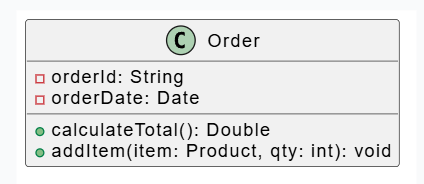
@startuml
class Order {
  -orderId: String
  -orderDate: Date
  +calculateTotal(): Double
  +addItem(item: Product, qty: int): void
}
@enduml
关系类型快速参考
| 类型 | 符号 | 含义 | 示例 |
|---|---|---|---|
| 继承 | `– | >` | “是-a” |
| 关联 | -- |
结构链接 | Order -- Customer |
| 聚合 | o-- |
“有-a”(弱) | Warehouse o-- Product |
| 组合 | *-- |
“拥有-a”(强) | Order *-- OrderItem |
| 依赖 | ..> |
“使用”(临时) | PaymentService ..> Logger |
案例研究:电子商务订单管理系统
业务需求
一家在线零售商需要一个系统来:
-
管理客户、产品和订单
-
支持带有数量和价格的订单项
-
处理多种支付方式
-
通过生命周期跟踪订单状态
-
允许产品属于类别
-
支持游客结账(可选的客户关联)
第一阶段:概念模型(领域视角)
与语言无关,专注于现实世界的概念
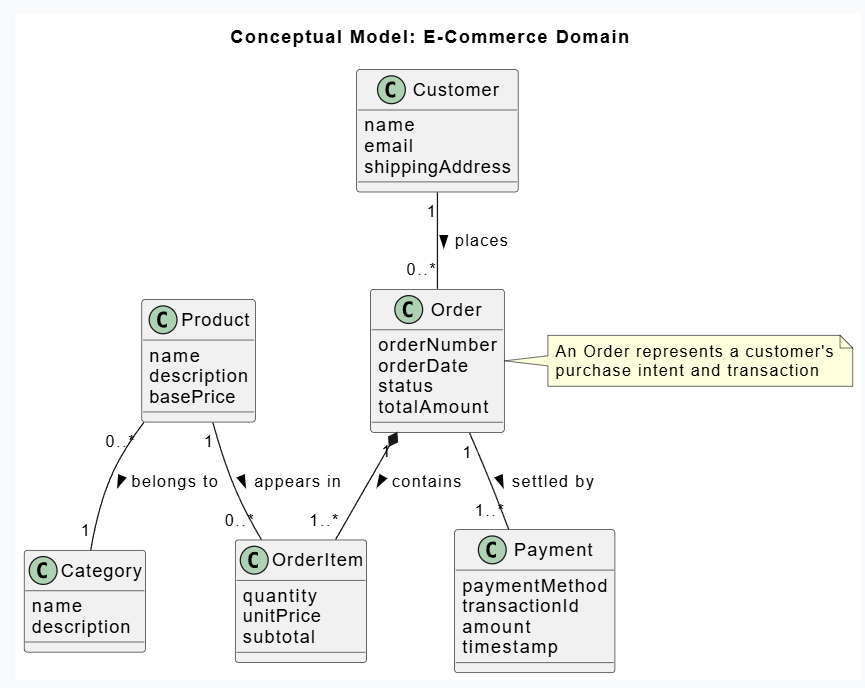
@startuml
title 概念模型:电子商务领域

class Customer {
  name
  email
  shippingAddress
}

class Product {
  name
  description
  basePrice
}

class Category {
  name
  description
}

class Order {
  orderNumber
  orderDate
  status
  totalAmount
}

class OrderItem {
  quantity
  unitPrice
  subtotal
}

class Payment {
  paymentMethod
  transactionId
  amount
  timestamp
}

' 关系
Customer "1" -- "0..*" Order : 提出 >
Order "1" *-- "1..*" OrderItem : 包含 >
Product "1" -- "0..*" OrderItem : 出现在 >
Product "0..*" -- "1" Category : 属于 >
Order "1" -- "1..*" Payment : 由...结算 >

note right of Order
  订单代表客户的
  购买意图和交易
end note

@enduml
关键设计决策:
-
组合(
*--)之间订单和订单项:订单项不能脱离订单而存在 -
之间关联
产品和类别: 产品可以重新分类 -
多重性
0..*用于客户订单:支持访客结账
阶段2:规范模型(接口视角)
关注软件契约,隐藏实现细节
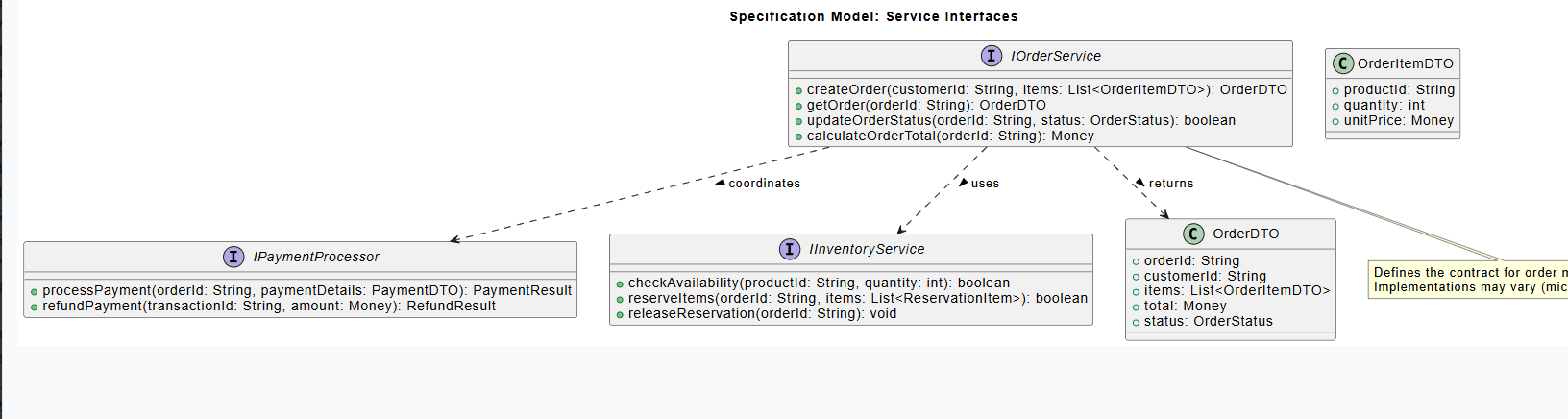
@startuml
title 规范模型:服务接口

interface IOrderService {
  +createOrder(customerId: String, items: List<OrderItemDTO>): OrderDTO
  +getOrder(orderId: String): OrderDTO
  +updateOrderStatus(orderId: String, status: OrderStatus): boolean
  +calculateOrderTotal(orderId: String): Money
}

interface IPaymentProcessor {
  +processPayment(orderId: String, paymentDetails: PaymentDTO): PaymentResult
  +refundPayment(transactionId: String, amount: Money): RefundResult
}

interface IInventoryService {
  +checkAvailability(productId: String, quantity: int): boolean
  +reserveItems(orderId: String, items: List<ReservationItem>): boolean
  +releaseReservation(orderId: String): void
}

class OrderDTO {
  +orderId: String
  +customerId: String
  +items: List<OrderItemDTO>
  +total: Money
  +status: OrderStatus
}

class OrderItemDTO {
  +productId: String
  +quantity: int
  +unitPrice: Money
}

' 依赖关系
IOrderService ..> IInventoryService : 使用 >
IOrderService ..> IPaymentProcessor : 协调 >
IOrderService ..> OrderDTO : 返回 >

note bottom of IOrderService
  定义订单管理的契约。
  实现方式可能不同(微服务、单体等)
end note

@enduml
架构优势:
-
接口隔离支持独立部署
-
DTOs 将内部模型与API契约解耦
-
依赖关系清晰地展示了微服务的服务边界
阶段3:实现模型(代码视角)
Java/Spring Boot实现的技术特定细节
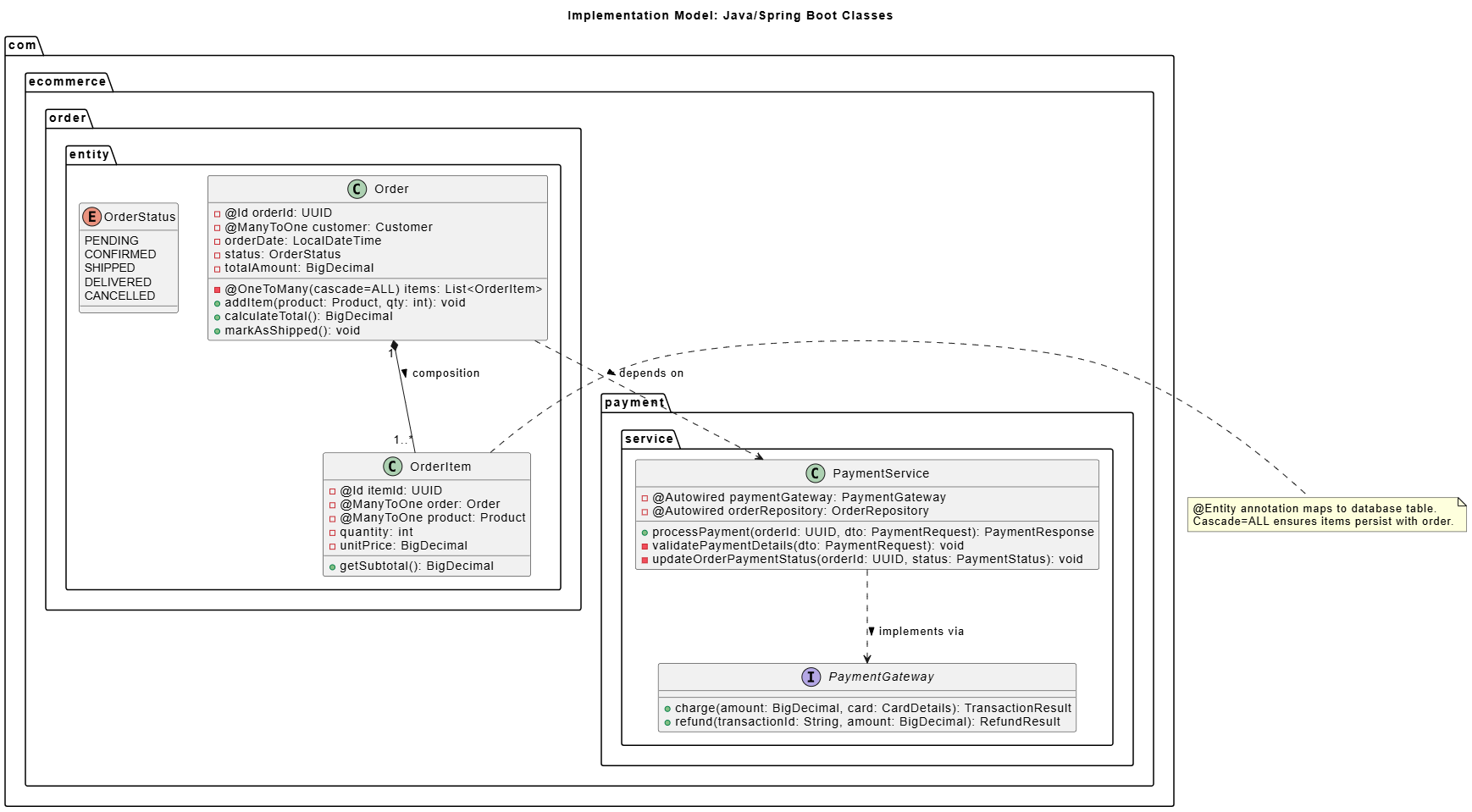
@startuml
title 实现模型:Java/Spring Boot类

package com.ecommerce.order.entity {
  class Order {
    -@Id orderId: UUID
    -@ManyToOne customer: Customer
    -@OneToMany(cascade=ALL) items: List<OrderItem>
    -orderDate: LocalDateTime
    -status: OrderStatus
    -totalAmount: BigDecimal

    +addItem(product: Product, qty: int): void
    +calculateTotal(): BigDecimal
    +markAsShipped(): void
  }

  class OrderItem {
    -@Id itemId: UUID
    -@ManyToOne order: Order
    -@ManyToOne product: Product
    -quantity: int
    -unitPrice: BigDecimal

    +getSubtotal(): BigDecimal
  }

  enum OrderStatus {
    PENDING
    CONFIRMED
    SHIPPED
    DELIVERED
    CANCELLED
  }
}

package com.ecommerce.payment.service {
  class PaymentService {
    -@Autowired paymentGateway: PaymentGateway
    -@Autowired orderRepository: OrderRepository

    +processPayment(orderId: UUID, dto: PaymentRequest): PaymentResponse
    -validatePaymentDetails(dto: PaymentRequest): void
    -updateOrderPaymentStatus(orderId: UUID, status: PaymentStatus): void
  }

  interface PaymentGateway {
    +charge(amount: BigDecimal, card: CardDetails): TransactionResult
    +refund(transactionId: String, amount: BigDecimal): RefundResult
  }
}

' 关系
Order "1" *-- "1..*" OrderItem : 组合 >
Order ..> PaymentService : 依赖于 >
PaymentService ..> PaymentGateway : 通过实现 >

note right of OrderItem
  @Entity 注解映射到数据库表。
  Cascade=ALL 确保项目随订单一起持久化。
end note

@enduml
实现亮点:
-
JPA注解(
@Entity,@ManyToOne)用于ORM映射 -
依赖注入(
@Autowired)用于松耦合 -
用于类型安全订单状态管理的枚举
-
私有辅助方法(
-验证支付详情)封装逻辑
高级模式与最佳实践
1. 处理可见性与封装
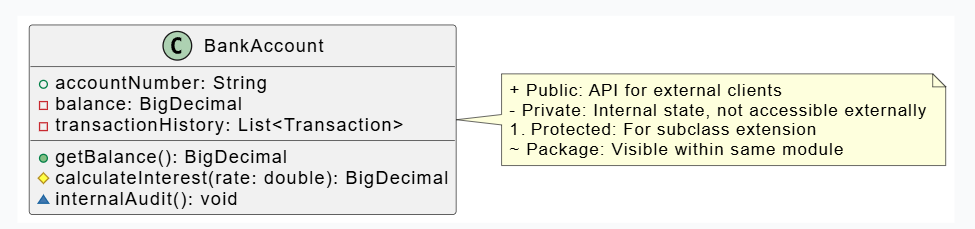
@startuml
class BankAccount {
  +accountNumber: String
  +getBalance(): BigDecimal
  -balance: BigDecimal
  -transactionHistory: List<Transaction>
  #calculateInterest(rate: double): BigDecimal
  ~internalAudit(): void
}

note right of BankAccount
  + 公共:外部客户端的 API
  - 私有:内部状态,外部不可访问
  # 受保护:用于子类扩展
  ~ 包:在同一模块内可见
end note
@enduml
2. 现实场景中的多重性
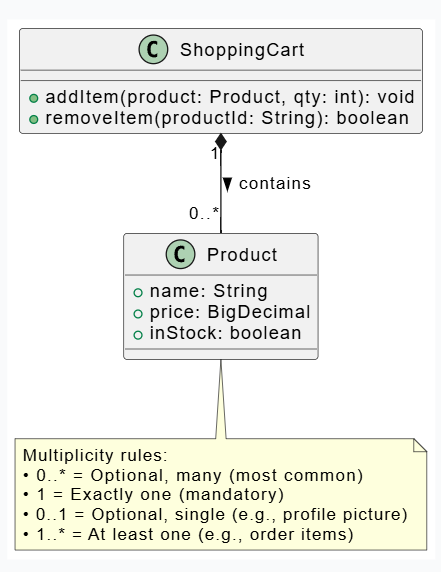
@startuml
class ShoppingCart {
  +addItem(product: Product, qty: int): void
  +removeItem(productId: String): boolean
}

class Product {
  +name: String
  +price: BigDecimal
  +inStock: boolean
}

' 购物车可以包含 0 到多个商品
' 每个商品都恰好引用一个产品
ShoppingCart "1" *-- "0..*" Product : 包含 >

note bottom
  多重性规则:
  • 0..* = 可选,多个(最常见)
  • 1 = 恰好一个(必需)
  • 0..1 = 可选,单个(例如,个人资料图片)
  • 1..* = 至少一个(例如,订单项)
end note
@enduml
3. 抽象类与接口
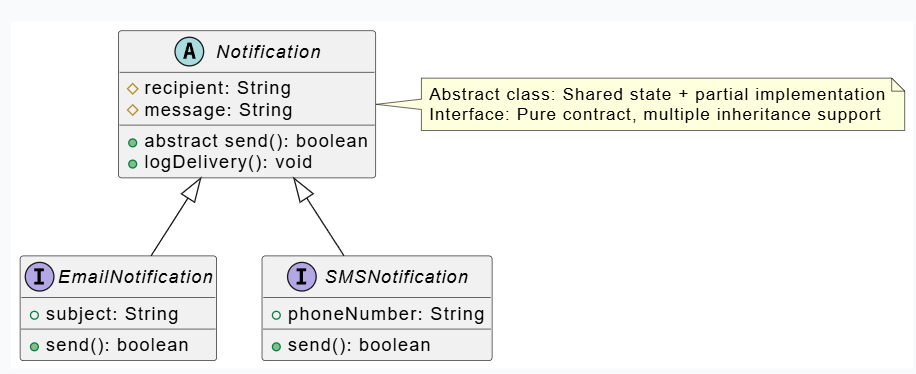
@startuml
abstract class Notification {
  #recipient: String
  #message: String
  +abstract send(): boolean
  +logDelivery(): void
}

interface EmailNotification {
  +subject: String
  +send(): boolean
}

interface SMSNotification {
  +phoneNumber: String
  +send(): boolean
}

Notification <|-- EmailNotification
Notification <|-- SMSNotification

note right of Notification
  抽象类:共享状态 + 部分实现
  接口:纯粹契约,支持多重继承
end note
@enduml
常见陷阱及避免方法
| 陷阱 | 症状 | 解决方案 |
|---|---|---|
| 过度设计 | 包含 50 个以上类的图表,难以阅读 | 从概念模型开始;按有界上下文拆分为多个图表 |
| 混淆聚合/组合 | 对象生命周期管理不清晰 | 提问:“如果整体被销毁,部分是否仍然存在?”如果否 → 使用组合(*--) |
| 忽略可导航性 | 到处都是双向箭头 | 仅在代码中需要遍历时才添加可导航性箭头 |
| 抽象层次混杂 | DTO与实体类混合在同一张图中 | 按视角(概念/规范/实现)分离图表 |
| 忽视版本控制 | 图表变得过时 | 在Git中使用PlantUML文本文件;在CI/CD流水线中生成图像 |
工具推荐:为什么选择PlantUML?
对于上述案例,PlantUML被选中是因为它:
✅ 基于文本:图表即代码——可版本化、可对比、可审查
✅ 可移植:可在本地或通过云服务渲染;与Confluence、GitHub、VS Code集成
✅ 可维护:更新图表逻辑而无需重新绘制框体
✅ 协作性:非设计师可通过简单语法参与
示例工作流程:
# 1. 将图表以文本形式编写
echo '@startumlnclass User { +name: String }n@enduml' > UserDiagram.puml

# 2. 生成PNG/SVG
plantuml -tpng UserDiagram.puml

# 3. 将.puml文件和生成的图像都提交到Git
git add UserDiagram.puml UserDiagram.png
结论
类图远不止是学术练习——它们是动态的产物,能够促进各方对齐、减少技术债务,并在整个软件开发生命周期中加速新成员的入职。正如我们在电子商务案例研究中所展示的,类图的真正力量在于它们通过三个关键视角不断演进:
🔹 概念层面:让利益相关者建立对共同领域知识的共识
🔹 规范层面:为模块化架构定义清晰的接口
🔹 实现层面:通过精确且具备技术意识的蓝图指导开发者
通过采用PlantUML通过采用PlantUML实现图示即代码的实践,团队能够获得敏捷性,使设计与代码同步迭代,确保文档不会落后于实现。请记住:最好的类图并非最详尽的,而是能在恰当时间向其受众回答恰当问题的那一个。
最终启示:从简单开始,与利益相关者验证,逐步优化,并始终将图示元素与实际业务价值联系起来。当类图从交付成果转变为协作工具时,它们便从负担转变为推动软件质量提升的催化剂。
