




Mastering UML Class Diagrams: A Practical Case Study in System Design with PlantUML
Introduction
In today’s complex software development landscape, clear communication and precise system modeling are paramount to project success. Among the most powerful tools in a software architect’s toolkit is the UML Class Diagram—a visual language that bridges the gap between abstract requirements and concrete implementation.
This case study explores how class diagrams serve as the backbone of object-oriented design, enabling teams to model static system structure, define relationships between entities, and establish clear contracts for development. Through a practical e-commerce order management system example, we’ll demonstrate how to progressively refine class diagrams across three development perspectives—conceptual, specification, and implementation—while leveraging PlantUML for executable, version-controlled documentation.
Whether you’re a business analyst modeling domain concepts, a developer designing APIs, or a team lead ensuring architectural consistency, this guide provides actionable insights for creating class diagrams that drive clarity, reduce ambiguity, and accelerate delivery.
Understanding Class Diagrams: Core Concepts Recap
(Condensed from foundational knowledge)
A Class Diagram in UML is a static structure diagram that visualizes:
-
Classes: Blueprints defining objects with attributes (state) and operations (behavior)
-
Relationships: Inheritance, association, aggregation, composition, and dependency
-
Constraints: Visibility (
+,-,#,~), multiplicity (1,0..*,1..5), and navigability
Key Notation Elements
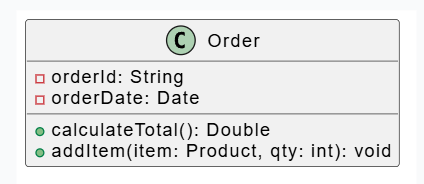
@startuml
class Order {
  -orderId: String
  -orderDate: Date
  +calculateTotal(): Double
  +addItem(item: Product, qty: int): void
}
@enduml
Relationship Types Quick Reference
| Type | Symbol | Meaning | Example |
|---|---|---|---|
| Inheritance | `– | >` | “is-a” |
| Association | -- |
Structural link | Order -- Customer |
| Aggregation | o-- |
“has-a” (weak) | Warehouse o-- Product |
| Composition | *-- |
“owns-a” (strong) | Order *-- OrderItem |
| Dependency | ..> |
“uses” (temporary) | PaymentService ..> Logger |
Case Study: E-Commerce Order Management System
Business Requirements
An online retailer needs a system to:
-
Manage customers, products, and orders
-
Support order items with quantities and pricing
-
Handle multiple payment methods
-
Track order status through a lifecycle
-
Allow products to belong to categories
-
Support guest checkout (optional customer association)
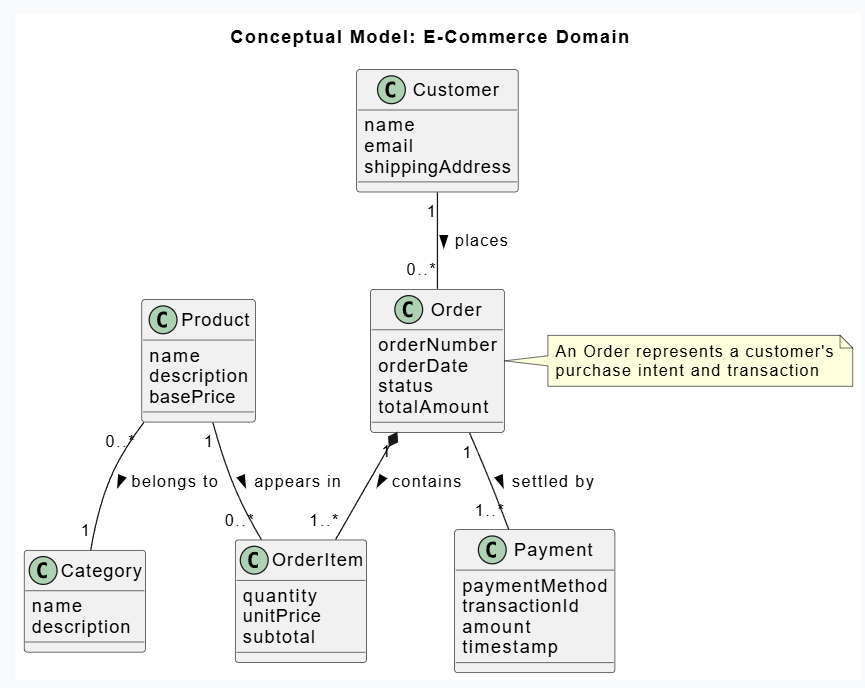
Phase 1: Conceptual Model (Domain Perspective)
Language-independent, focusing on real-world concepts
@startuml
title Conceptual Model: E-Commerce Domain

class Customer {
  name
  email
  shippingAddress
}

class Product {
  name
  description
  basePrice
}

class Category {
  name
  description
}

class Order {
  orderNumber
  orderDate
  status
  totalAmount
}

class OrderItem {
  quantity
  unitPrice
  subtotal
}

class Payment {
  paymentMethod
  transactionId
  amount
  timestamp
}

' Relationships
Customer "1" -- "0..*" Order : places >
Order "1" *-- "1..*" OrderItem : contains >
Product "1" -- "0..*" OrderItem : appears in >
Product "0..*" -- "1" Category : belongs to >
Order "1" -- "1..*" Payment : settled by >

note right of Order
  An Order represents a customer's
  purchase intent and transaction
end note

@enduml
Key Design Decisions:
-
Composition (
*--) betweenOrderandOrderItem: Items cannot exist without an order -
Association between
ProductandCategory: Products can be recategorized -
Multiplicity
0..*for Customer-Order: Supports guest checkout
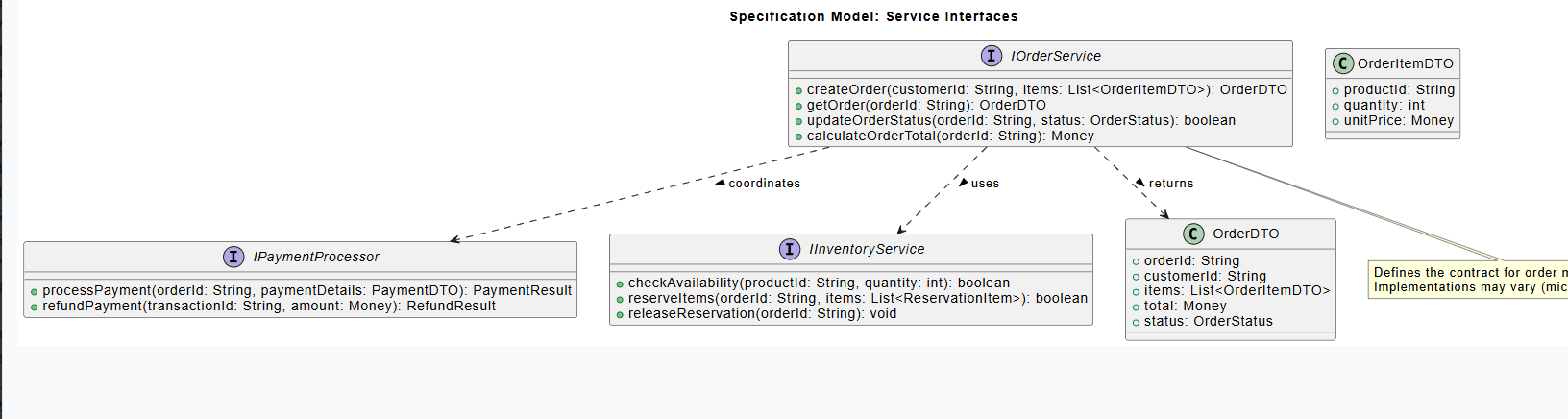
Phase 2: Specification Model (Interface Perspective)
Focus on software contracts, hiding implementation details
@startuml
title Specification Model: Service Interfaces

interface IOrderService {
  +createOrder(customerId: String, items: List<OrderItemDTO>): OrderDTO
  +getOrder(orderId: String): OrderDTO
  +updateOrderStatus(orderId: String, status: OrderStatus): boolean
  +calculateOrderTotal(orderId: String): Money
}

interface IPaymentProcessor {
  +processPayment(orderId: String, paymentDetails: PaymentDTO): PaymentResult
  +refundPayment(transactionId: String, amount: Money): RefundResult
}

interface IInventoryService {
  +checkAvailability(productId: String, quantity: int): boolean
  +reserveItems(orderId: String, items: List<ReservationItem>): boolean
  +releaseReservation(orderId: String): void
}

class OrderDTO {
  +orderId: String
  +customerId: String
  +items: List<OrderItemDTO>
  +total: Money
  +status: OrderStatus
}

class OrderItemDTO {
  +productId: String
  +quantity: int
  +unitPrice: Money
}

' Dependencies
IOrderService ..> IInventoryService : uses >
IOrderService ..> IPaymentProcessor : coordinates >
IOrderService ..> OrderDTO : returns >

note bottom of IOrderService
  Defines the contract for order management.
  Implementations may vary (microservice, monolith, etc.)
end note

@enduml
Architectural Benefits:
-
Interface segregation enables independent deployment
-
DTOs decouple internal models from API contracts
-
Dependencies clearly show service boundaries for microservices
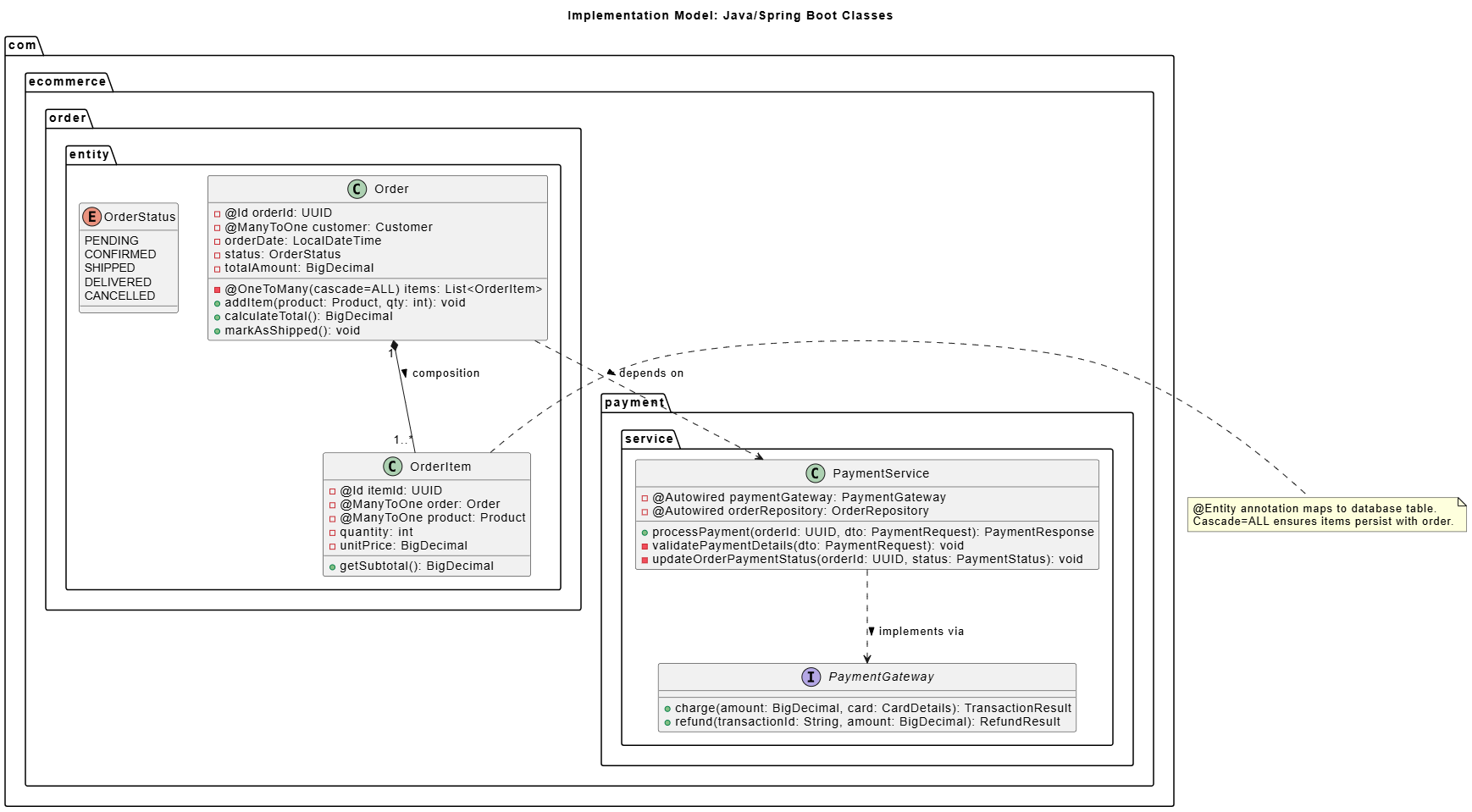
Phase 3: Implementation Model (Code Perspective)
Technology-specific details for Java/Spring Boot implementation
@startuml
title Implementation Model: Java/Spring Boot Classes

package com.ecommerce.order.entity {
  class Order {
    -@Id orderId: UUID
    -@ManyToOne customer: Customer
    -@OneToMany(cascade=ALL) items: List<OrderItem>
    -orderDate: LocalDateTime
    -status: OrderStatus
    -totalAmount: BigDecimal

    +addItem(product: Product, qty: int): void
    +calculateTotal(): BigDecimal
    +markAsShipped(): void
  }

  class OrderItem {
    -@Id itemId: UUID
    -@ManyToOne order: Order
    -@ManyToOne product: Product
    -quantity: int
    -unitPrice: BigDecimal

    +getSubtotal(): BigDecimal
  }

  enum OrderStatus {
    PENDING
    CONFIRMED
    SHIPPED
    DELIVERED
    CANCELLED
  }
}

package com.ecommerce.payment.service {
  class PaymentService {
    -@Autowired paymentGateway: PaymentGateway
    -@Autowired orderRepository: OrderRepository

    +processPayment(orderId: UUID, dto: PaymentRequest): PaymentResponse
    -validatePaymentDetails(dto: PaymentRequest): void
    -updateOrderPaymentStatus(orderId: UUID, status: PaymentStatus): void
  }

  interface PaymentGateway {
    +charge(amount: BigDecimal, card: CardDetails): TransactionResult
    +refund(transactionId: String, amount: BigDecimal): RefundResult
  }
}

' Relationships
Order "1" *-- "1..*" OrderItem : composition >
Order ..> PaymentService : depends on >
PaymentService ..> PaymentGateway : implements via >

note right of OrderItem
  @Entity annotation maps to database table.
  Cascade=ALL ensures items persist with order.
end note

@enduml
Implementation Highlights:
-
JPA annotations (
@Entity,@ManyToOne) for ORM mapping -
Dependency injection (
@Autowired) for loose coupling -
Enum for type-safe order status management
-
Private helper methods (
-validatePaymentDetails) encapsulate logic
Advanced Patterns & Best Practices
1. Handling Visibility and Encapsulation
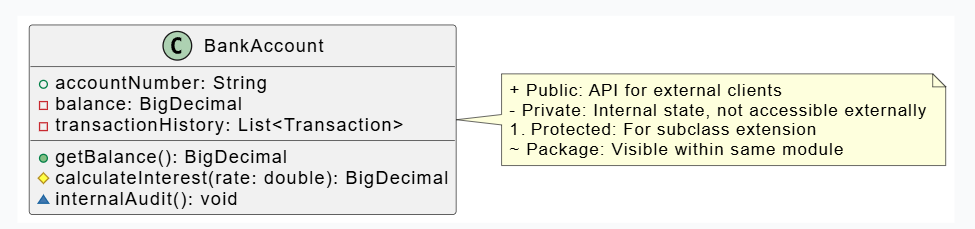
@startuml
class BankAccount {
  +accountNumber: String
  +getBalance(): BigDecimal
  -balance: BigDecimal
  -transactionHistory: List<Transaction>
  #calculateInterest(rate: double): BigDecimal
  ~internalAudit(): void
}

note right of BankAccount
  + Public: API for external clients
  - Private: Internal state, not accessible externally
  # Protected: For subclass extension
  ~ Package: Visible within same module
end note
@enduml
2. Multiplicity in Real-World Scenarios
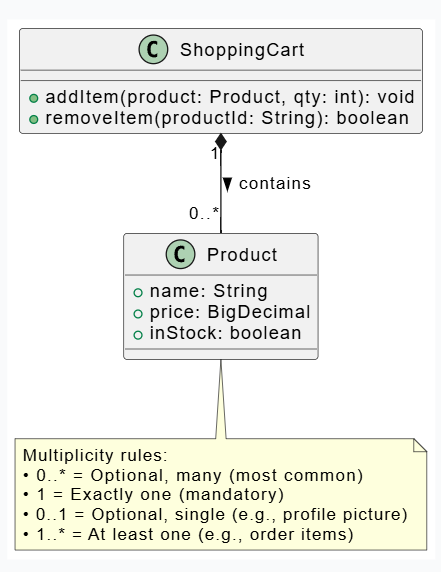
@startuml
class ShoppingCart {
  +addItem(product: Product, qty: int): void
  +removeItem(productId: String): boolean
}

class Product {
  +name: String
  +price: BigDecimal
  +inStock: boolean
}

' A cart can have 0 to many items
' Each item references exactly 1 product
ShoppingCart "1" *-- "0..*" Product : contains >

note bottom
  Multiplicity rules:
  • 0..* = Optional, many (most common)
  • 1 = Exactly one (mandatory)
  • 0..1 = Optional, single (e.g., profile picture)
  • 1..* = At least one (e.g., order items)
end note
@enduml
3. Abstract Classes vs. Interfaces
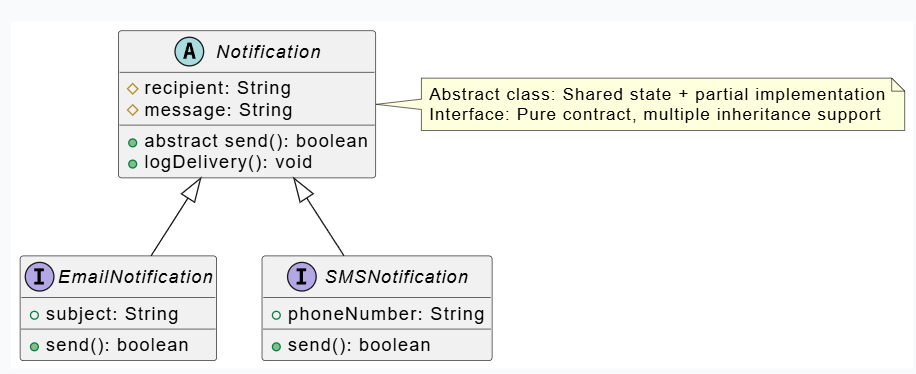
@startuml
abstract class Notification {
  #recipient: String
  #message: String
  +abstract send(): boolean
  +logDelivery(): void
}

interface EmailNotification {
  +subject: String
  +send(): boolean
}

interface SMSNotification {
  +phoneNumber: String
  +send(): boolean
}

Notification <|-- EmailNotification
Notification <|-- SMSNotification

note right of Notification
  Abstract class: Shared state + partial implementation
  Interface: Pure contract, multiple inheritance support
end note
@enduml
Common Pitfalls & How to Avoid Them
| Pitfall | Symptom | Solution |
|---|---|---|
| Over-engineering | Diagrams with 50+ classes, hard to read | Start with conceptual model; split into multiple diagrams by bounded context |
| Confusing aggregation/composition | Unclear object lifecycle management | Ask: “If the whole is destroyed, do parts survive?” If no → use composition (*--) |
| Ignoring navigability | Bidirectional arrows everywhere | Only add navigability arrows where traversal is needed in code |
| Mixing abstraction levels | DTOs mixed with entity classes in same diagram | Separate diagrams by perspective (conceptual/specification/implementation) |
| Neglecting version control | Diagrams become outdated | Use PlantUML text files in Git; generate images in CI/CD pipeline |
Tooling Recommendation: Why PlantUML?
For the case study above, PlantUML was chosen because it:
✅ Text-based: Diagrams are code—versionable, diffable, reviewable
✅ Portable: Renders locally or via cloud service; integrates with Confluence, GitHub, VS Code
✅ Maintainable: Update diagram logic without redrawing boxes
✅ Collaborative: Non-designers can contribute via simple syntax
Sample Workflow:
# 1. Write diagram as text
echo '@startuml\nclass User { +name: String }\n@enduml' > UserDiagram.puml

# 2. Generate PNG/SVG
plantuml -tpng UserDiagram.puml

# 3. Commit both .puml and generated image to Git
git add UserDiagram.puml UserDiagram.png
Conclusion
Class diagrams are far more than academic exercises—they are living artifacts that drive alignment, reduce technical debt, and accelerate onboarding across the software development lifecycle. As demonstrated in our e-commerce case study, the true power of class diagrams emerges when they evolve through three critical perspectives:
🔹 Conceptual: Ground stakeholders in shared domain understanding
🔹 Specification: Define clean interfaces for modular architecture
🔹 Implementation: Guide developers with precise, technology-aware blueprints
By adopting PlantUML for diagram-as-code practices, teams gain the agility to iterate designs alongside code, ensuring documentation never lags behind implementation. Remember: the best class diagram isn’t the most detailed—it’s the one that answers the right questions for its audience at the right time.
Final Takeaway: Start simple, validate with stakeholders, refine incrementally, and always tie diagram elements back to tangible business value. When class diagrams become collaborative tools rather than deliverables, they transform from overhead into catalysts for better software.
This post is also available in Deutsche, Español, فارسی, Français, English, Bahasa Indonesia, 日本語, Polski, Portuguese, Ру́сский, Việt Nam, 简体中文 and 繁體中文.
