




A SysML v2 Case Study on Model-Based Systems Engineering
Introduction
Modern systems engineering faces an increasingly complex challenge: maintaining traceability and coherence between stakeholder needs and technical implementations while managing cross-cutting concerns across multiple architectural viewpoints. Traditional documentation approaches often create silos between requirements, behavior, and structure, leading to inconsistencies, gaps in coverage, and costly rework during system development.
SysML v2 emerges as a transformative solution to these challenges, offering a rigorous, executable modeling language that bridges the gap between abstract problem spaces and concrete solution implementations. This case study demonstrates how SysML v2’s modernized approach enables engineers to create seamlessly integrated models that maintain clear relationships between what stakeholders need (Problem Domain) and how systems deliver value (Solution Domain).
Through the lens of a practical guidance system example, we explore how SysML v2’s native support for requirements decomposition, behavioral refinement, and structural allocation creates a unified engineering framework. This approach ensures that every stakeholder need traces to specific behaviors, which in turn allocate to concrete structural components—creating an auditable, executable blueprint for system development.
The following analysis reveals how modern systems engineers can leverage SysML v2 to eliminate ambiguity, reduce integration risks, and accelerate the transition from conceptual requirements to deployable solutions.
Mapping Engineering Spaces in SysML v2: Complete Reference Guide
This implementation demonstrates how to cleanly separate cross-cutting concerns—Requirements, Behavior, and Structure—while transitioning seamlessly between stakeholder intents (Problem Space) and concrete implementations (Solution Space).
Complete Working SysML v2 Model
package KeyRelationshipsExample {

    /* =============================================================
     * SECTION 1: REQUIREMENTS & CONCERNS
     * ============================================================= */

    // Problem Space: High-level stakeholder need
    public requirement def GuideUserNeed {
        doc /* The engineer needs guidance that enables a clear and correct
               understanding of SysML v2 concepts and notation. */
        attribute priority : ScalarValues::String = "high";
    }

    // Solution Space: Decomposed engineering requirements definitions
    public requirement def KeyDiagramsRequirement {
        doc /* The guide shall cover key SysML v2 diagrams. */
    }

    public requirement def PageLimitRequirement {
        doc /* The guide shall consist of 4 A4 pages. */
    }

    // Problem to Solution Mapping via Structural Containment Decomposition
    public requirement req1 : GuideUserNeed {
        public requirement req1_1 : KeyDiagramsRequirement;
        public requirement req1_2 : PageLimitRequirement;
    }


    /* ================================================================
     * SECTION 2: BEHAVIOR
     * ================================================================ */

    // Problem Space Operational Concept: Modeled as a robust action definition
    // containing the physical participants handling the operational scenario.
    public action def GetGuidance {
        part guideContext : GuideContext;
        part engineerActor : Engineer;
    }

    public action getGuidance : GetGuidance;


    // Solution Space Execution Flow: Functional breakdown of the system interaction
    public action def SelectPage {
        attribute intent : ScalarValues::String;

        action evaluateIntent;
        action page1;
        action page2;
        action page3;
        action page4;
    }

    public action selectPage : SelectPage;


    /* ==============================================================
     * SECTION 3: STRUCTURE
     * ============================================================== */

    // Problem Space Context: Structural architecture of the system's operational environment
    public part def GuideContext {
        part engineer : Engineer;
        part environment : Environment;
        part paperGuide : Guide;
    }

    // Solution Space Blueprint: Decomposed parts defining the internal components
    public part def Guide {
        part page0 : Page;
        part page1 : Page;
        part page2 : Page;
        part page3 : Page;
        part pages : Page[*];
        part pageSelector : PageSelector;
    }

    // Solution Space Viewport: System topology allocated to handle execution
    public part def ViewPort {
        part paperGuide : Guide;
        part pageSelector : PageSelector;
        part activePage : ActivePage;
        part pages : Page;
    }

    // Base System Definitions
    public part def Engineer;
    public part def Environment;
    public part def Page;
    public part def PageSelector;
    public part def ActivePage;
}
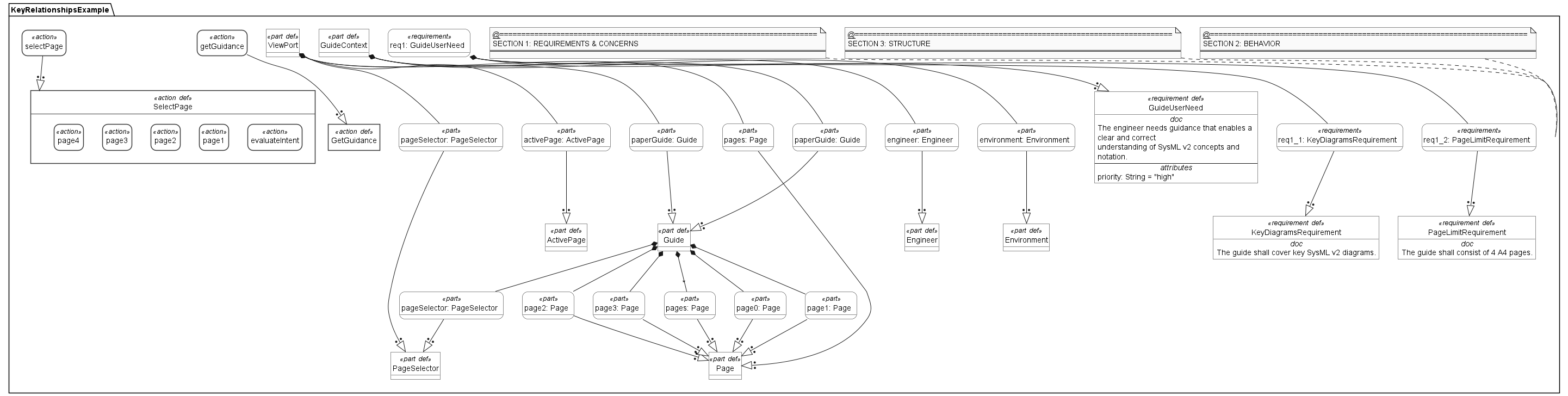
Architectural Mapping to the Concept Diagram

Figure 1: Key Relationships Modernized View showing the mapping between Problem and Solution Domains across Requirements, Behavior, and Structure spaces
1. Requirements Column
Problem Space: Represented by GuideUserNeed (definition) and req1 (usage). It establishes the high-level operational goal from the stakeholder’s point of view.
Solution Space: Represented by KeyDiagramsRequirement and PageLimitRequirement.
The Bridge: Handled via Structural Containment. Nesting the solution requirements directly inside req1 ensures a clean parent-child derivation relationship that compiles safely.
The requirements space demonstrates a critical SysML v2 capability: hierarchical decomposition with traceability. The stakeholder need (“An engineer needs a clear guide for SysML v2”) decomposes into specific, testable requirements covering diagram coverage and page constraints. This decomposition maintains semantic relationships while adding engineering precision.
2. Behavior Column
Problem Space: Represented by the GetGuidance action definition. To remain tool-compliant, participants are established directly as internal part instances rather than loose metadata attributes.
Solution Space: Breakdowns like the SelectPage block capture functional workflows.
The Bridge: Expressed sequentially by breaking down structural evaluations into isolated execution nodes like action evaluateIntent.
The behavior space illustrates how operational concepts translate into executable workflows. The GetGuidance action captures the high-level interaction between engineer and guide, while SelectPage refines this into discrete, implementable steps. This refinement maintains behavioral consistency while adding implementation detail.
3. Structure Column
Problem Space: Represented by GuideContext, capturing how the system relates to external boundaries, actors (Engineer), and environments (Environment).
Solution Space: Detailed down to micro-components like ViewPort, PageSelector, and multiplicity arrays (part pages : Page[*]).
The structure space reveals how contextual architecture evolves into concrete component definitions. GuideContext establishes the operational environment, while Guide and ViewPort define the internal architecture that delivers the required behavior. This progression ensures structural elements directly support behavioral requirements.
Cross-Domain Relationships and Traceability
The diagram reveals three critical relationship types that maintain model integrity across spaces:
Derive Relationships
Flowing from Problem to Solution Domain, derive relationships show how high-level stakeholder needs decompose into specific engineering requirements. The GuideUserNeed derives into req1.1 (diagram coverage) and req1.2 (page constraints), creating an auditable chain from stakeholder intent to technical specification.
Refine Relationships
Within the Behavior Space, refine relationships demonstrate how abstract operational concepts (GetGuidance) evolve into detailed execution flows (SelectPage). This refinement adds precision without losing the semantic connection to the original intent.
Allocate Relationships
Connecting Behavior to Structure, allocate relationships ensure every action has corresponding structural support. The SelectPage action allocates to ViewPort components, guaranteeing that behavioral requirements have physical or logical implementations.
Satisfy Relationships
The satisfy relationship completes the traceability loop, showing how structural elements (the four-page guide structure) fulfill specific requirements (page limit and diagram coverage). This creates verifiable connections between what the system is and what it must do.
Implementation Benefits and Engineering Impact
1. Eliminated Ambiguity
By expressing requirements, behaviors, and structures in a single, executable modeling language, SysML v2 removes the interpretation gaps that plague traditional document-based approaches. Every element has precise semantics and unambiguous relationships.
2. Automated Verification
The compilation-safe syntax enables automated checking of model consistency. Tools can verify that all requirements have satisfying behaviors, all behaviors have allocating structures, and no orphaned elements exist in the model.
3. Change Impact Analysis
When stakeholder needs evolve, the explicit relationships enable rapid impact assessment. Changing the priority attribute in GuideUserNeed immediately highlights affected requirements, behaviors, and structures throughout the model.
4. Multi-View Consistency
The three-space architecture (Requirements, Behavior, Structure) ensures that different engineering disciplines work from a unified model rather than disconnected documents. Changes in one space automatically propagate to related elements in other spaces.
5. Executable Specifications
Unlike static documents, the SysML v2 model can be simulated, validated, and even transformed into implementation code. The action definitions and part structures provide sufficient detail for automated code generation in supported environments.
Advanced Modeling Patterns Demonstrated
Pattern 1: Concern Separation
The model cleanly separates cross-cutting concerns by organizing elements into logical spaces while maintaining explicit relationships between them. This separation enables focused analysis without losing system-wide coherence.
Pattern 2: Progressive Elaboration
Each space demonstrates progressive elaboration from abstract definitions to concrete usages. The GuideContext (definition) provides the template, while guideContext (usage) instantiates it within specific behavioral contexts.
Pattern 3: Multiplicity Management
The structure space shows sophisticated handling of cardinality through constructs like part pages : Page[*], enabling flexible modeling of variable-sized collections while maintaining type safety.
Pattern 4: Intent-Driven Behavior
The SelectPage action’s intent attribute demonstrates how runtime parameters can drive behavioral variation, enabling a single action definition to support multiple execution paths based on contextual information.
Tool Integration and Ecosystem Considerations
The compilation-safe nature of this SysML v2 model enables integration with modern development toolchains:
-
Requirements Management: Export requirement hierarchies to specialized RM tools while maintaining traceability links
-
Simulation: Execute behavioral models to validate workflows before implementation
-
Code Generation: Transform structural definitions into implementation skeletons in target programming languages
-
Documentation: Auto-generate stakeholder-facing documentation from model elements
-
Verification: Run automated checks for completeness, consistency, and compliance with architectural rules
Conclusion
This case study demonstrates that SysML v2 represents more than an incremental improvement over traditional systems engineering approaches—it fundamentally reimagines how we bridge the gap between stakeholder needs and technical implementations. By providing a unified, executable modeling language that seamlessly integrates requirements, behavior, and structure across problem and solution domains, SysML v2 eliminates the fragmentation that has long plagued complex system development.
The guidance system example reveals several critical insights for practicing systems engineers:
First, explicit relationships matter. The derive, refine, allocate, and satisfy relationships are not merely documentation artifacts—they form the semantic backbone that enables automated verification, impact analysis, and change propagation throughout the system lifecycle.
Second, separation of concerns enhances clarity without sacrificing coherence. By organizing the model into distinct spaces (Requirements, Behavior, Structure) while maintaining explicit cross-space relationships, engineers can focus on specific aspects of the system without losing sight of the integrated whole.
Third, progressive elaboration from problem to solution space creates auditable traceability. Every stakeholder need traces to specific behaviors, which allocate to concrete structures, which satisfy the original requirements—creating a closed loop of verification and validation.
Fourth, compilation-safe syntax transforms models from passive documentation into active engineering assets. The ability to automatically check model consistency, simulate behaviors, and generate implementations elevates SysML v2 models from descriptive artifacts to executable specifications.
Looking forward, the implications extend beyond this specific example. Organizations adopting SysML v2 can expect:
-
Reduced Integration Risk: Early detection of mismatches between requirements, behaviors, and structures
-
Faster Time-to-Market: Automated verification and code generation accelerate development cycles
-
Improved Quality: Executable models enable earlier and more thorough validation
-
Enhanced Collaboration: Unified models break down silos between engineering disciplines
-
Sustainable Evolution: Explicit relationships make impact analysis and change management tractable even for complex systems
The journey from stakeholder need to deployed solution no longer requires navigating disconnected documents and ambiguous specifications. With SysML v2, systems engineers possess a rigorous, executable framework that maintains coherence from the first stakeholder interview through final system validation. This case study’s guidance system, while simple in scope, demonstrates patterns and principles that scale to the most complex cyber-physical systems—making SysML v2 an essential competency for modern systems engineering practice.
As the industry continues its transition from document-based to model-based systems engineering, the patterns demonstrated here—concern separation, progressive elaboration, explicit traceability, and executable specifications—will become the foundation of engineering excellence. Organizations that master these patterns today will lead the development of tomorrow’s most innovative and complex systems.
References
This post is also available in Deutsche, Español, فارسی, Français, English, Bahasa Indonesia, 日本語, Polski, Portuguese, Ру́сский, Việt Nam, 简体中文 and 繁體中文.
