From Strategy to Execution: Accelerating Enterprise Architecture with AI-Powered ArchiMate Modeling

Introduction In today's rapidly evolving digital landscape, organizations face unprecedented complexity in aligning business strategy with technology execution. Enterprise Architecture (EA) has emerged as a critical discipline for navigating this complexity, providing the frameworks and tools needed to visualize, analyze, and communicate how different organizational domains interconnect. At the heart of modern EA practice lies ArchiMate—the open, vendor-independent modeling language standardized by The Open Group. This case study explores how ArchiMate, particularly when empowered by AI-driven tooling like Visual Paradigm, transforms enterprise architecture from a theoretical exercise into a dynamic, actionable practice. We…continue reading →
From Text to Architecture: Accelerating UML Modeling with Visual Paradigm’s Generative AI

From Text to Architecture: Accelerating UML Modeling with Visual Paradigm’s Generative AI

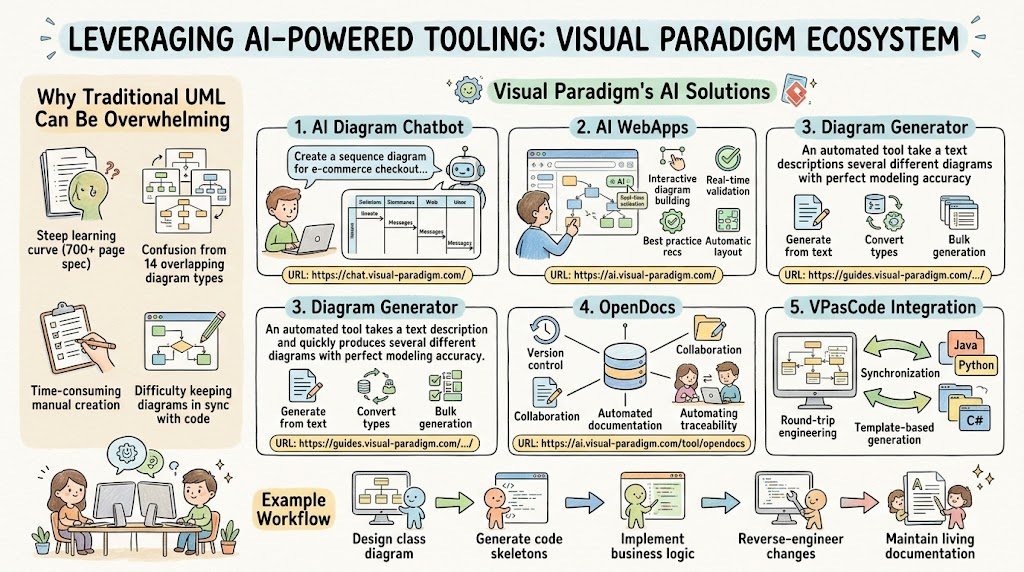
Introduction In the rapidly evolving landscape of software engineering, the gap between conceptual requirements and technical implementation remains a significant bottleneck. Traditional Unified Modeling Language (UML) creation often involves tedious manual drag-and-drop mechanics, requiring architects and engineers to spend hours formatting nodes and aligning connectors rather than focusing on system logic. As development cycles shorten and agile methodologies demand faster iteration, the need for intelligent automation in architectural design has become critical. Visual Paradigm addresses this challenge by embedding Generative AI directly into its core visual modeling tools. This integration transforms natural language…continue reading →

From Static Snapshots to Living Knowledge: Unifying Documentation and Modeling with Visual Paradigm OpenDocs

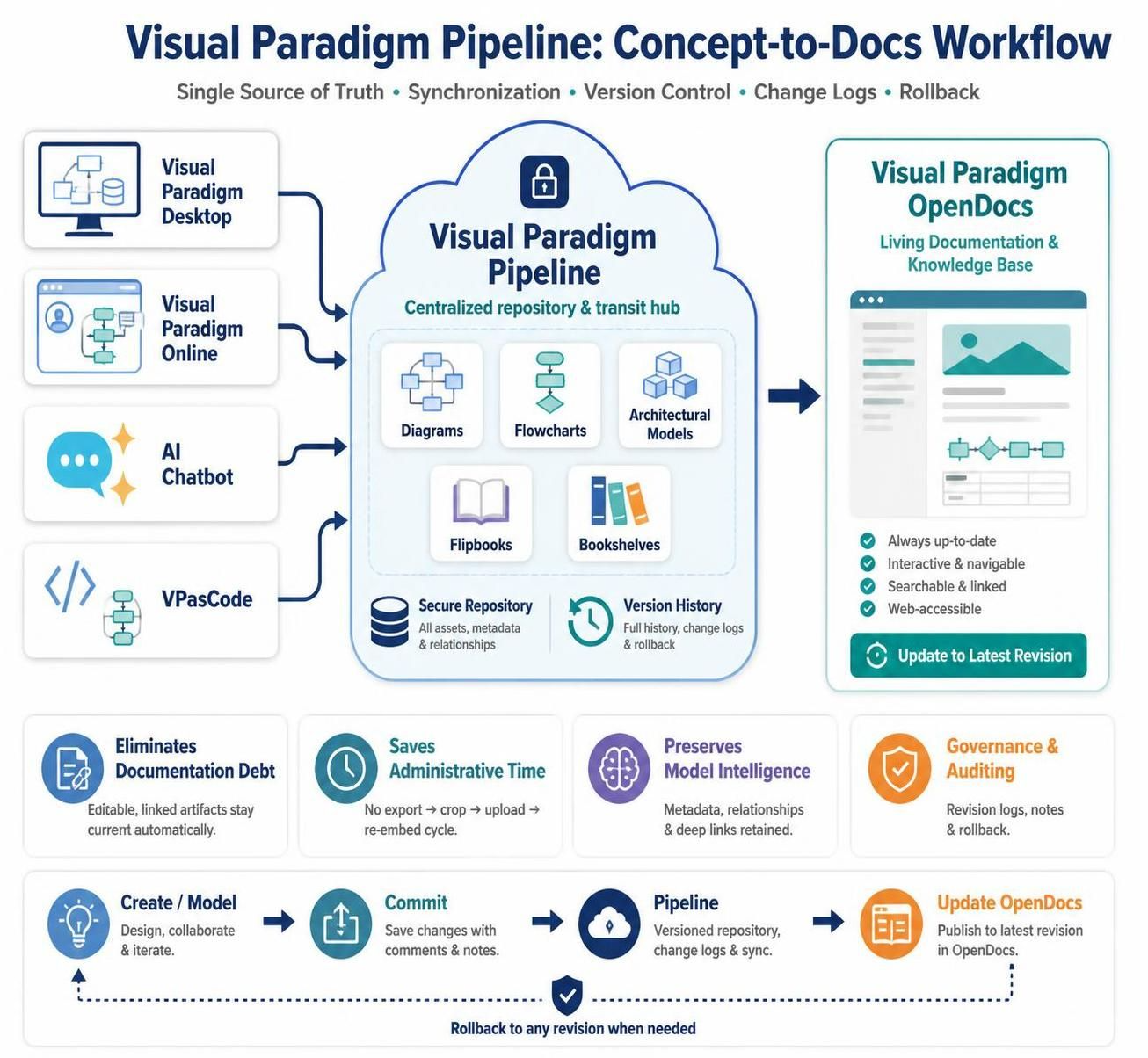
Introduction In the rapidly evolving landscape of software development and enterprise architecture, the gap between technical documentation and visual modeling has long been a source of friction. Traditional knowledge management platforms treat diagrams as static images—snapshots that quickly become obsolete as systems evolve. This disconnect leads to documentation drift, where written specifications no longer match the actual system design, creating confusion, inefficiency, and risk. Visual Paradigm OpenDocs emerges as a transformative solution to this challenge. As an AI-powered, web-based knowledge management platform, it unifies technical documentation with visual modeling and diagramming into a…continue reading →

Agile Modeling in Action: Accelerating Sprints with Just-in-Time Use Cases

Introduction In the fast-paced world of Agile software development, teams constantly navigate the delicate balance between thorough planning and rapid execution. A common misconception persists that formal modeling and documentation inherently slow down development velocity. However, forward-thinking teams are discovering that when modeling is applied strategically—specifically through a Just-in-Time (JIT) approach—it becomes a powerful accelerator rather than a bottleneck. This case study explores how JIT modeling transforms use cases from heavyweight compliance artifacts into lightweight, collaborative tools that enhance clarity, reduce rework, and improve team alignment. By examining real-world applications and practical techniques,…continue reading →
From Stories to Systems: Mastering Use-Case 2.0 for Agile and AI-Driven Development

From Stories to Systems: Mastering Use-Case 2.0 for Agile and AI-Driven Development

Introduction In the rapidly evolving landscape of software development, the tension between agility and structure has long been a central challenge. For decades, teams have oscillated between heavyweight documentation that ensures completeness but stifles speed, and lightweight user stories that promote velocity but often sacrifice context. As systems grow in complexity and the demand for rapid delivery intensifies, neither extreme alone suffices. Enter Use-Case 2.0: a modern evolution of requirements engineering that bridges this gap. Born from the foundational principles of traditional use cases but reimagined through the lens of Agile methodologies like Scrum…continue reading →
AI-Powered Use Case Modeling: Accelerating Agile Discovery with Visual Paradigm

AI-Powered Use Case Modeling: Accelerating Agile Discovery with Visual Paradigm

In Agile development, speed and adaptability are paramount. Teams need to discover, document, and validate requirements rapidly while maintaining the flexibility to respond to change. Traditional use case modeling—while valuable—has often been perceived as too heavyweight for Agile contexts. But what if you could generate a complete, professionally structured use case model in seconds, simply by describing your system in plain English? Visual Paradigm's AI-Powered Use Case Modeling Studio fundamentally transforms how Agile teams approach requirements discovery. By combining human insight with intelligent automation, it eliminates the friction that has historically made use…continue reading →
From User Stories to Use Cases: Bridging Agile Requirements with Visual Modeling

From User Stories to Use Cases: Bridging Agile Requirements with Visual Modeling

Agile development methodologies have revolutionized how software teams approach requirements, championing user stories as the primary tool for capturing functionality from a user's perspective. While user stories are effective for their simplicity and focus on value, they can sometimes lack the broader context needed for complex systems. This is where use case modeling steps in—not as a replacement for user stories, but as a powerful complement that bridges the gap between high-level Agile requirements and detailed system understanding. https://youtu.be/0NST4ZzEtDY Use case modeling helps capture, document, and communicate software requirements from a user's perspective.…continue reading →

Mastering UML Class Diagrams: A Practical Case Study in System Design with PlantUML

Introduction In today's complex software development landscape, clear communication and precise system modeling are paramount to project success. Among the most powerful tools in a software architect's toolkit is the UML Class Diagram—a visual language that bridges the gap between abstract requirements and concrete implementation. This case study explores how class diagrams serve as the backbone of object-oriented design, enabling teams to model static system structure, define relationships between entities, and establish clear contracts for development. Through a practical e-commerce order management system example, we'll demonstrate how to progressively refine class diagrams across three…continue reading →

A SysML v2 Case Study on Model-Based Systems Engineering

Introduction Modern systems engineering faces an increasingly complex challenge: maintaining traceability and coherence between stakeholder needs and technical implementations while managing cross-cutting concerns across multiple architectural viewpoints. Traditional documentation approaches often create silos between requirements, behavior, and structure, leading to inconsistencies, gaps in coverage, and costly rework during system development. SysML v2 emerges as a transformative solution to these challenges, offering a rigorous, executable modeling language that bridges the gap between abstract problem spaces and concrete solution implementations. This case study demonstrates how SysML v2's modernized approach enables engineers to create seamlessly integrated…continue reading →
The Definitive Guide to SysML v2 Textual Notation

The Definitive Guide to SysML v2 Textual Notation

Systems Modeling Language version 2 (SysML v2) marks a massive shift in systems engineering. By moving away from the rigid, UML-based graphical constraints of SysML v1, SysML v2 introduces a language-driven, textual syntax. This syntax treats structure, behavior, requirements, and analysis as deeply integrated text elements. This comprehensive guide breaks down the core pillars, concepts, and syntax of SysML v2 using a concrete AutonomousDrone design example. 1. The Core Paradigm: Definitions vs. Usages The single most important architectural concept in SysML v2 is the strict separation between Definitions (blueprints) and Usages (contextual instances). The def Keyword: Indicates a reusable definition, type, or element…continue reading →