The Complete UML Reference: Structural and Behavioral Diagrams Explained with PlantUML and Visual Paradigm AI

The Complete UML Reference: Structural and Behavioral Diagrams Explained with PlantUML and Visual Paradigm AI

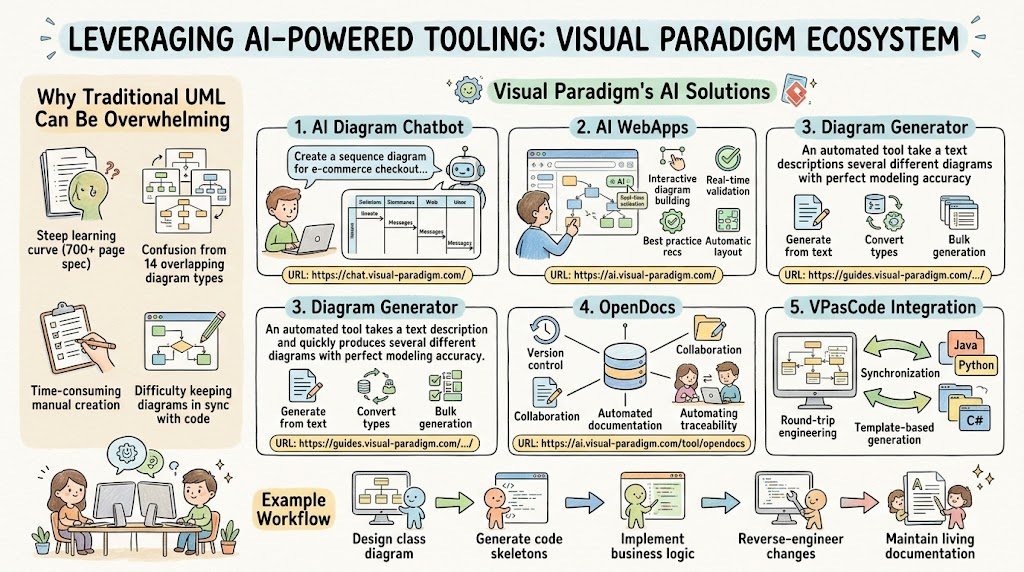
Introduction The Unified Modeling Language (UML) stands as the de facto industry standard for visualizing, specifying, constructing, and documenting software-intensive systems. Managed by the Object Management Group (OMG), UML provides a rich set of graphic notation techniques that enable developers, architects, and stakeholders to communicate complex system designs effectively. With UML 2.2 introducing 14 distinct diagram types and specifications spanning over 700 pages, many practitioners find UML overwhelming and complex. However, as Grady Booch—one of UML's primary creators—wisely noted: "For 80% of all software, only 20% of UML is needed." This comprehensive guide demystifies all 14…continue reading →
Mastering Data Flow Diagrams: A Comprehensive Guide to AI-Assisted Top-Down Decomposition with Visual Paradigm

Mastering Data Flow Diagrams: A Comprehensive Guide to AI-Assisted Top-Down Decomposition with Visual Paradigm

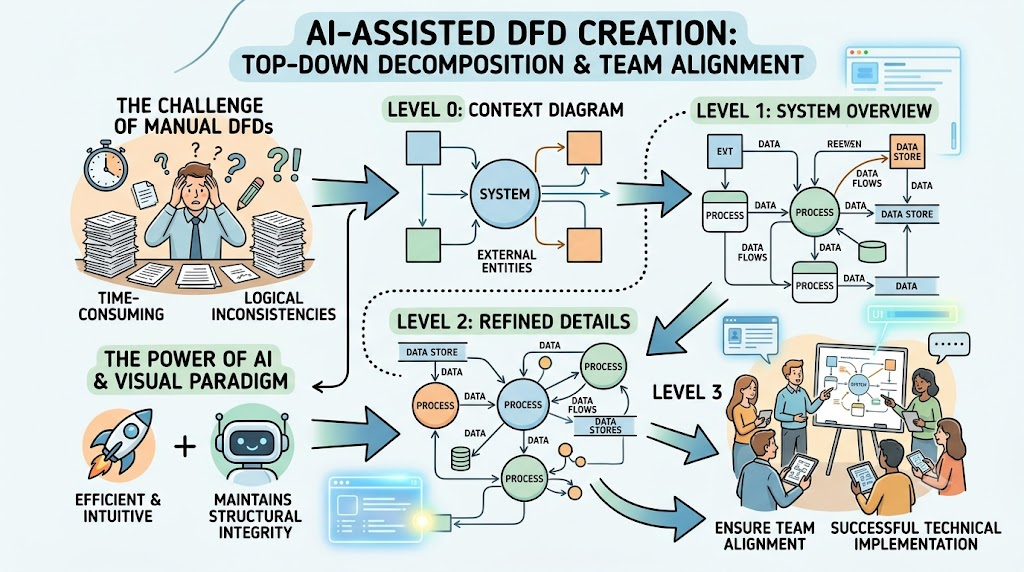
Introduction In the realm of complex system design and product management, clear data visualization is paramount for ensuring team alignment and successful technical implementation. Data Flow Diagrams (DFDs) serve as a cornerstone tool for system analysts and product managers, providing a graphical representation of how data moves through an information system. However, manually creating detailed, multi-level DFDs is often time-consuming and prone to logical inconsistencies across different hierarchy levels. With the advent of AI-assisted modeling tools like the Visual Paradigm (VP) AI Chatbot, this process has become significantly more efficient and intuitive. This guide combines…continue reading →

Mastering Apache ECharts in Visual Paradigm: From AI Prompt to Final Asset

Introduction In the modern data-driven landscape, creating compelling and interactive data visualizations is essential for effective storytelling and decision-making. Apache ECharts is a powerful tool for this purpose, but manually constructing its complex JSON configurations from scratch can be a daunting and time-consuming task. Visual Paradigm solves this challenge by bridging the gap between natural language ideation and precise code customization. By integrating an intelligent AI Chatbot with VPasCode (Visual Paradigm as Code), users can now generate, fine-tune, and publish interactive ECharts seamlessly. This comprehensive guide walks you through the complete three-phase workflow, demonstrating how to transform…continue reading →

Mastering XML Visualization in VPasCode: A Comprehensive Guide to Transforming Complex Data into Clear Diagram

Introduction XML (Extensible Markup Language) remains a cornerstone format for data exchange, configuration files, RSS feeds, and web services. However, reading raw, deeply nested XML files can often be tedious, visually overwhelming, and error-prone. With the latest update to VPasCode, developers, architects, and technical writers can now effortlessly visualize hierarchical XML structures alongside a feature-rich, free XML editor. This guide explores how to transform complex, nested data into clear, interactive diagrams to streamline debugging and documentation. How XML Visualization Works in VPasCode Using the XML visualizer is as straightforward as any other format…continue reading →

BPMN Tutorial: Visual Paradigm Tooling, AI Chatbot & Ecosystem

This guide provides a comprehensive overview of Business Process Model and Notation (BPMN), focusing on the Visual Paradigm ecosystem, its AI-powered chatbot capabilities, and practical modeling techniques. Key Concepts 1. BPMN Basics and Core Elements BPMN is a graphical standard for specifying business processes, developed by the Business Process Management Initiative (BPMI) and later adopted by the Object Management Group (OMG) [1]. Its primary goal is to provide a notation understandable by business users while supporting complex technical implementation [2]. The core elements of BPMN are categorized into four groups: Flow Objects: Events, Activities,…continue reading →
From Static Snapshots to Living Knowledge: Unifying Documentation and Modeling with Visual Paradigm OpenDocs

Introduction In the rapidly evolving landscape of software development and enterprise architecture, the gap between technical documentation and visual modeling has long been a source of friction. Traditional knowledge management platforms treat diagrams as static images—snapshots that quickly become obsolete as systems evolve. This disconnect leads to documentation drift, where written specifications no longer match the actual system design, creating confusion, inefficiency, and risk. Visual Paradigm OpenDocs emerges as a transformative solution to this challenge. As an AI-powered, web-based knowledge management platform, it unifies technical documentation with visual modeling and diagramming into a…continue reading →

AI Chatbot: A Comprehensive Guide to Visual Modeling

Introduction The world of software engineering, system architecture, and business process management has traditionally relied on time-consuming manual processes to create professional visual models. Diagrams like UML, BPMN, and ArchiMate are essential for visualizing complex systems, yet creating them has often meant hours of dragging, dropping, and aligning shapes. Enter the Visual Paradigm AI Chatbot. This tool represents a fundamental shift in the paradigm. By combining natural language processing with robust modeling engines, it transforms plain-text requirements into professional, standardized diagrams in seconds. Whether you are a seasoned architect or a beginner learning UML,…continue reading →

Comprehensive Guide to BPMN, Visual Paradigm Tooling, AI, and Ecosystem

This guide provides a complete overview of Business Process Model and Notation (BPMN) within the Visual Paradigm ecosystem. It covers fundamental concepts, practical examples of AI-driven generation, and the tools available for modeling, collaboration, and optimization. 1. Introduction to BPMN and the Visual Paradigm Ecosystem BPMN (Business Process Model and Notation) 2.0 is the global standard for visualizing, documenting, and analyzing business processes. It serves as a universal language that bridges the gap between business strategy and technical implementation. Visual Paradigm offers a comprehensive ecosystem that integrates BPMN with advanced AI capabilities, allowing…continue reading →
From Text to Architecture: Accelerating UML Modeling with Visual Paradigm’s Generative AI

From Text to Architecture: Accelerating UML Modeling with Visual Paradigm’s Generative AI

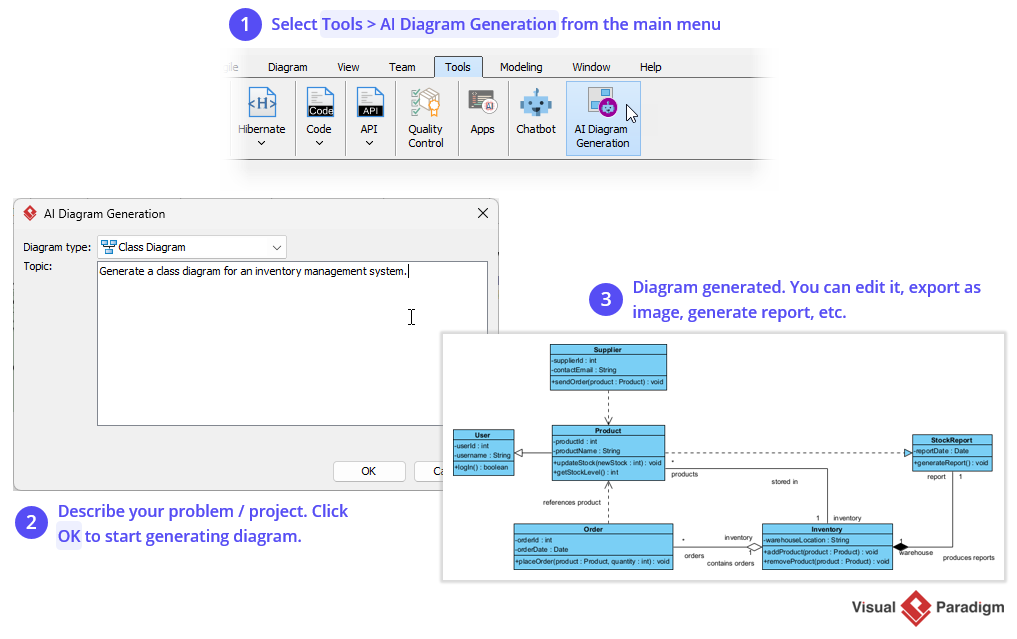
Introduction In the rapidly evolving landscape of software engineering, the gap between conceptual requirements and technical implementation remains a significant bottleneck. Traditional Unified Modeling Language (UML) creation often involves tedious manual drag-and-drop mechanics, requiring architects and engineers to spend hours formatting nodes and aligning connectors rather than focusing on system logic. As development cycles shorten and agile methodologies demand faster iteration, the need for intelligent automation in architectural design has become critical. Visual Paradigm addresses this challenge by embedding Generative AI directly into its core visual modeling tools. This integration transforms natural language…continue reading →
Beyond Pretty Pictures: A Modern Guide to Analysis and Design with AI, Diagram-as-Code, and Visual Paradigm

Beyond Pretty Pictures: A Modern Guide to Analysis and Design with AI, Diagram-as-Code, and Visual Paradigm

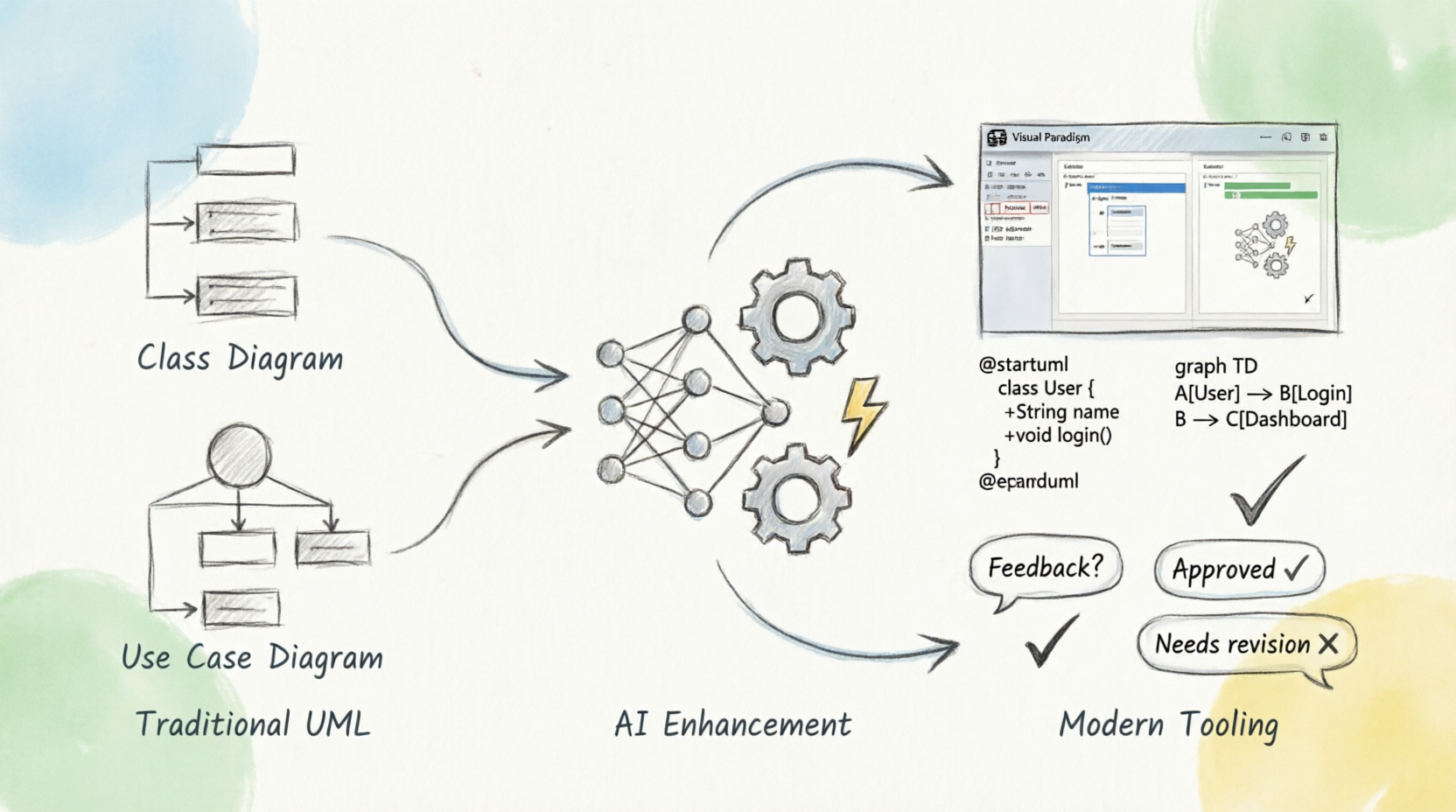
Introduction In the fast-paced world of software development, there’s a persistent myth that diagrams are merely decorative artifacts—"pretty pictures" that distract from the real work of writing code. This perspective overlooks a fundamental truth: software development is as much about communication and understanding as it is about implementation. The Unified Modeling Language (UML) and related modeling techniques serve as critical bridges between abstract ideas and concrete implementations. They help teams navigate complexity, align stakeholders, and build systems that truly meet user needs. However, the landscape of analysis and design has evolved significantly since traditional…continue reading →