



From Analysis to Action: Mastering Strategic Planning with SWOT and TOWS
Introduction
In the dynamic landscape of modern business, strategic planning is not just a luxury—it’s a necessity. Organizations constantly face internal challenges and external pressures that can make or break their success. Two of the most widely used frameworks for navigating this complexity are SWOT and TOWS analysis.
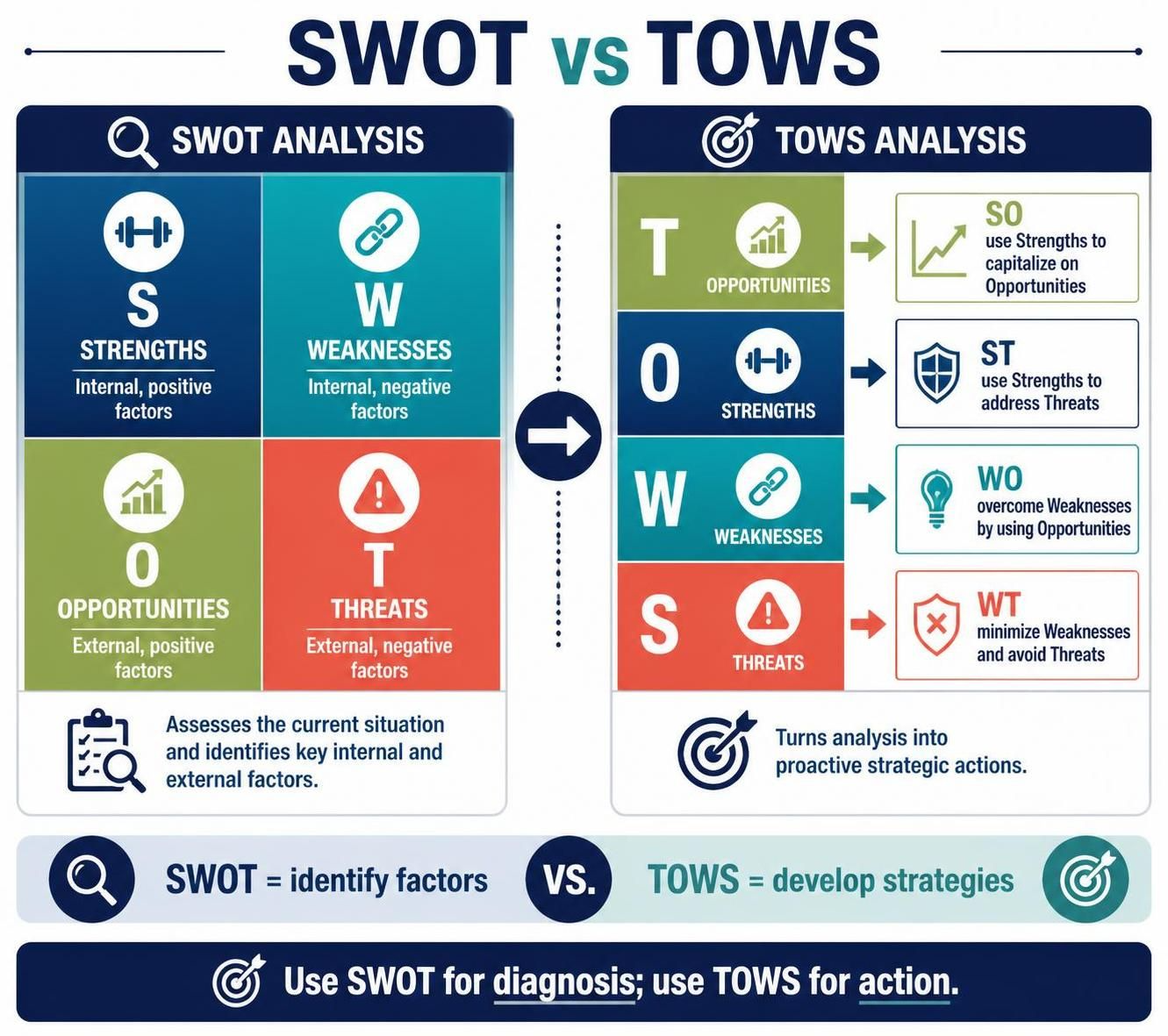
While often mentioned in the same breath, these tools serve distinct purposes. SWOT provides a foundational snapshot of where a business stands today, while TOWS transforms that snapshot into a roadmap for future action. This guide explores the nuances of both frameworks, highlighting how they complement each other to create a robust strategic planning process. Whether you’re a product manager like Angus looking to refine roadmaps, or a business leader seeking clarity on market positioning, understanding the interplay between SWOT and TOWS can significantly enhance your decision-making capabilities.
Part 1: Understanding SWOT Analysis
What is SWOT?
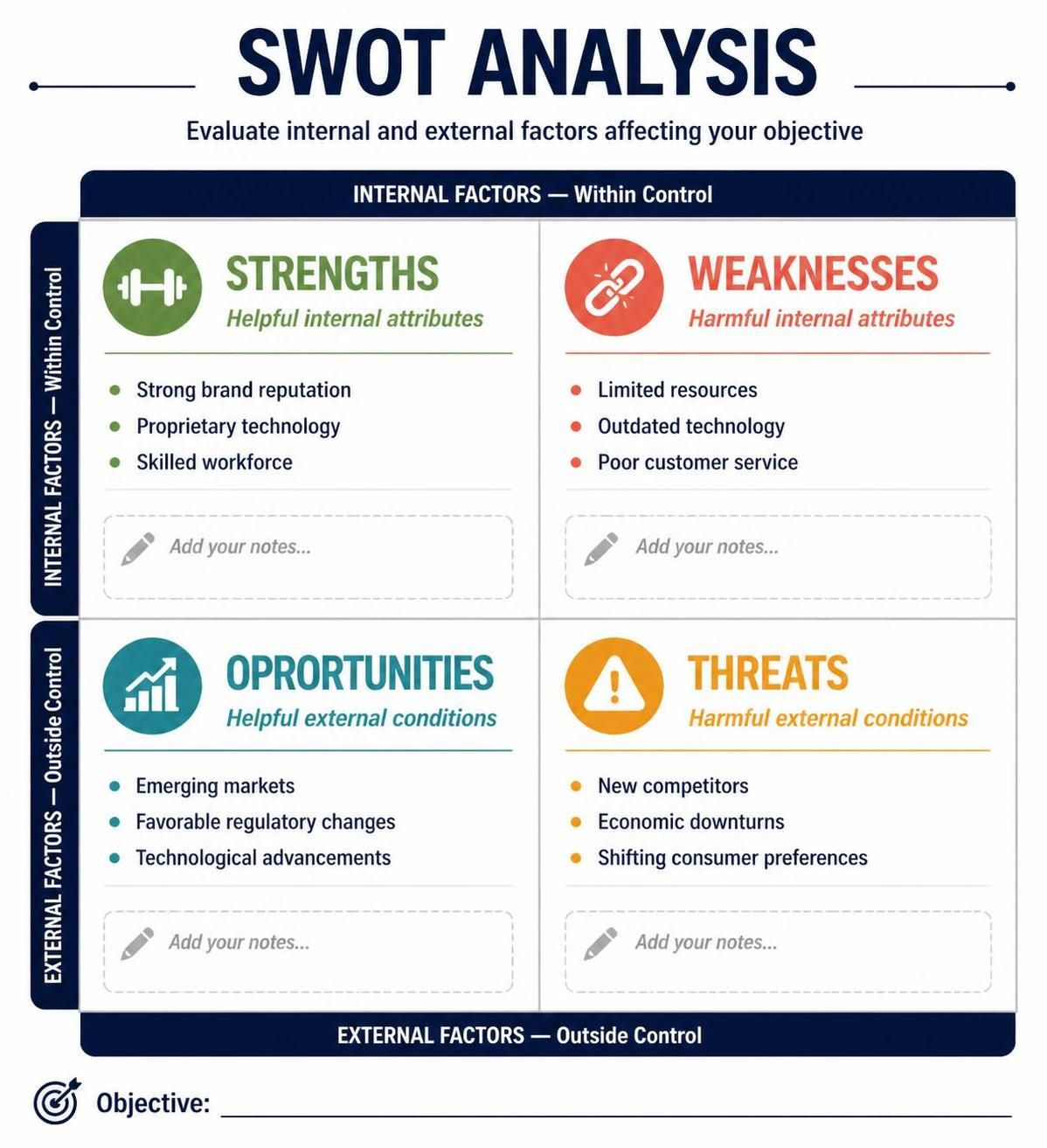
SWOT stands for Strengths, Weaknesses, Opportunities, and Threats. It is a foundational strategic planning tool used to evaluate these four elements of a project, business venture, or organization.
-
Internal Factors (Within Control):
-
Strengths: Attributes of the organization that are helpful to achieving the objective. Examples include strong brand reputation, proprietary technology, or skilled workforce.
-
Weaknesses: Attributes of the organization that are harmful to achieving the objective. Examples include limited resources, outdated technology, or poor customer service.
-
-
External Factors (Outside Control):
-
Opportunities: External conditions that are helpful to achieving the objective. Examples include emerging markets, favorable regulatory changes, or technological advancements.
-
Threats: External conditions which could do damage to the objective. Examples include new competitors, economic downturns, or shifting consumer preferences.
-
Key Concepts of SWOT
-
Simplicity: SWOT is easy to understand and requires no specialized training to begin.
-
Holistic View: It forces teams to look at both internal capabilities and external realities.
-
Static Snapshot: SWOT primarily identifies what exists at a given moment, rather than prescribing how to act on it.
Example: A Cloud Software Company
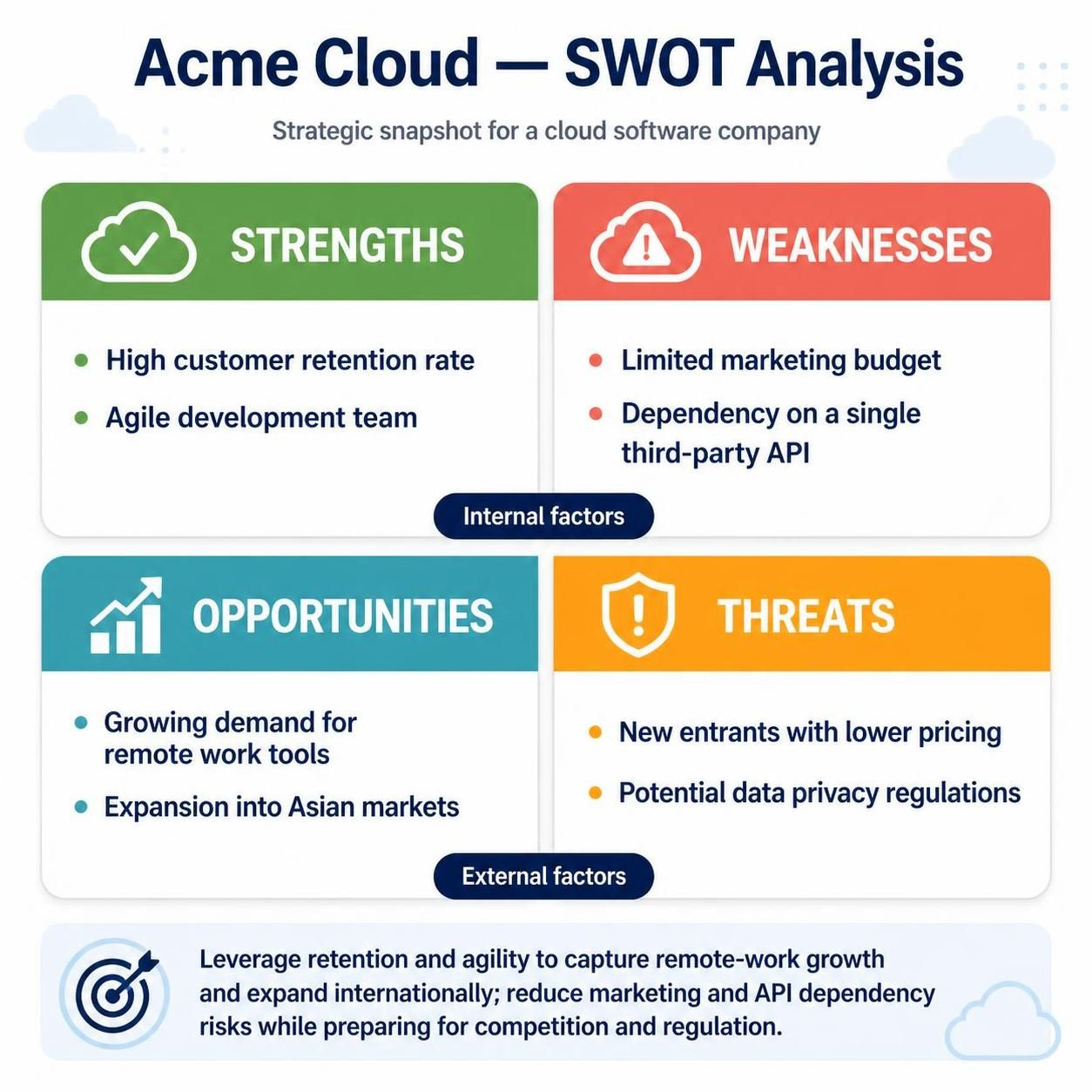
Imagine a mid-sized cloud software company (“Acme Cloud”) conducting a SWOT analysis:
-
Strengths: High customer retention rate, agile development team.
-
Weaknesses: Limited marketing budget, dependency on a single third-party API.
-
Opportunities: Growing demand for remote work tools, expansion into Asian markets.
-
Threats: New entrants with lower pricing, potential data privacy regulations.
(Note: In a full visual presentation, this would be represented as a 2×2 matrix.)
Part 2: Understanding TOWS Analysis
What is TOWS?
TOWS is often described as the “action-oriented” extension of SWOT. While the components are identical, the order of analysis and the intent differ significantly. TOWS stands for Threats, Opportunities, Weaknesses, and Strengths.
The core philosophy of TOWS is to move beyond identification to strategy formulation. It explicitly asks: How can we use our strengths to capitalize on opportunities? How can we use our strengths to mitigate threats?
The Four Strategic Quadrants of TOWS
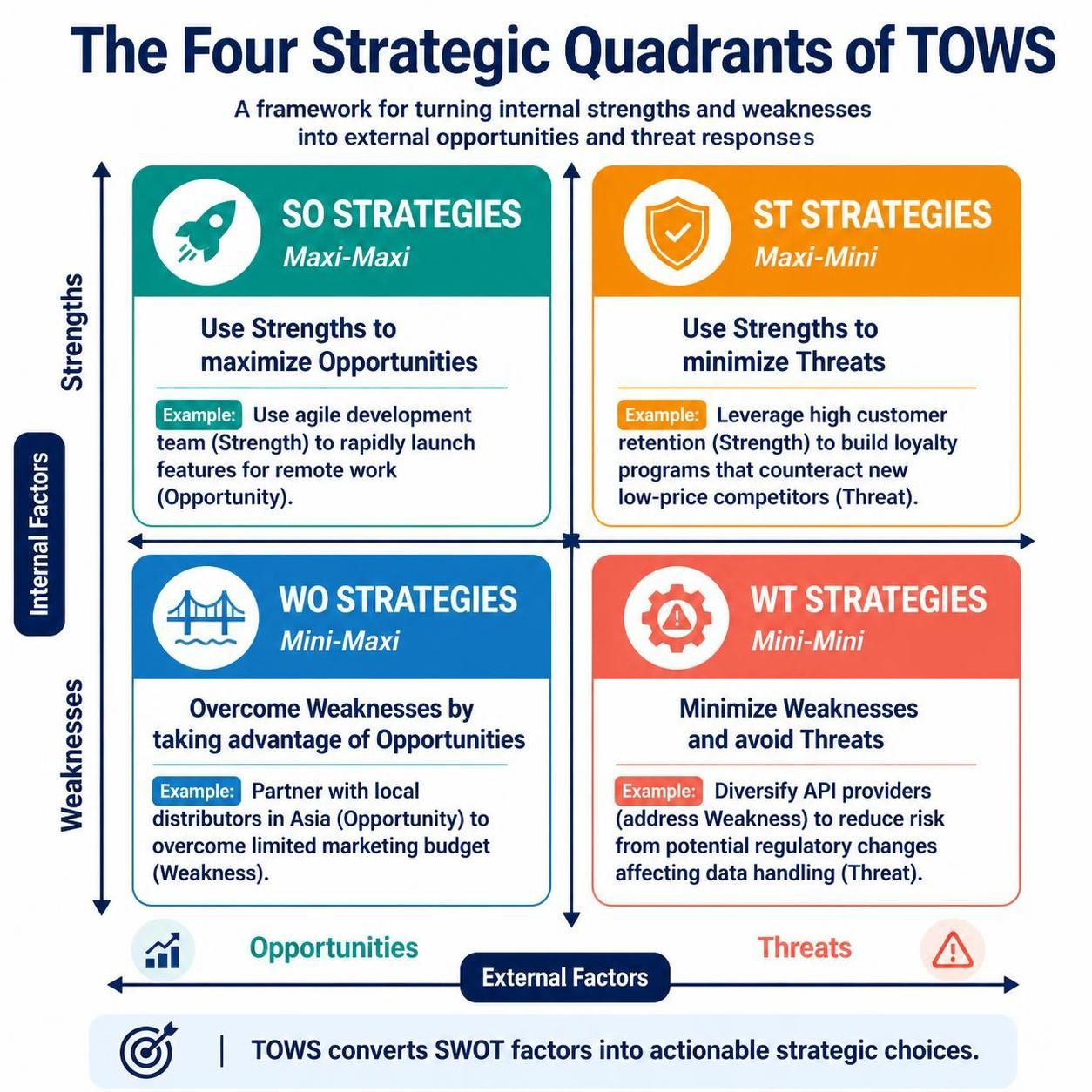
TOWS analysis generates four specific types of strategies by crossing internal and external factors:
-
SO Strategies (Maxi-Maxi): Use Strengths to maximize Opportunities.
-
Example: Use agile development team (Strength) to rapidly launch features for remote work (Opportunity).
-
-
WO Strategies (Mini-Maxi): Overcome Weaknesses by taking advantage of Opportunities.
-
Example: Partner with local distributors in Asia (Opportunity) to overcome limited marketing budget (Weakness).
-
-
ST Strategies (Maxi-Mini): Use Strengths to minimize Threats.
-
Example: Leverage high customer retention (Strength) to build loyalty programs that counteract new low-price competitors (Threat).
-
-
WT Strategies (Mini-Mini): Minimize Weaknesses and avoid Threats.
-
Example: Diversify API providers (address Weakness) to reduce risk from potential regulatory changes affecting data handling (Threat).
-
Key Concepts of TOWS
-
Proactive Approach: TOWS focuses on generating actionable strategies rather than just listing factors.
-
Interconnectivity: It emphasizes the relationships between internal and external factors.
-
Strategic Depth: It helps prioritize which weaknesses to fix and which opportunities to pursue based on available strengths.
Part 3: SWOT vs. TOWS – Key Differences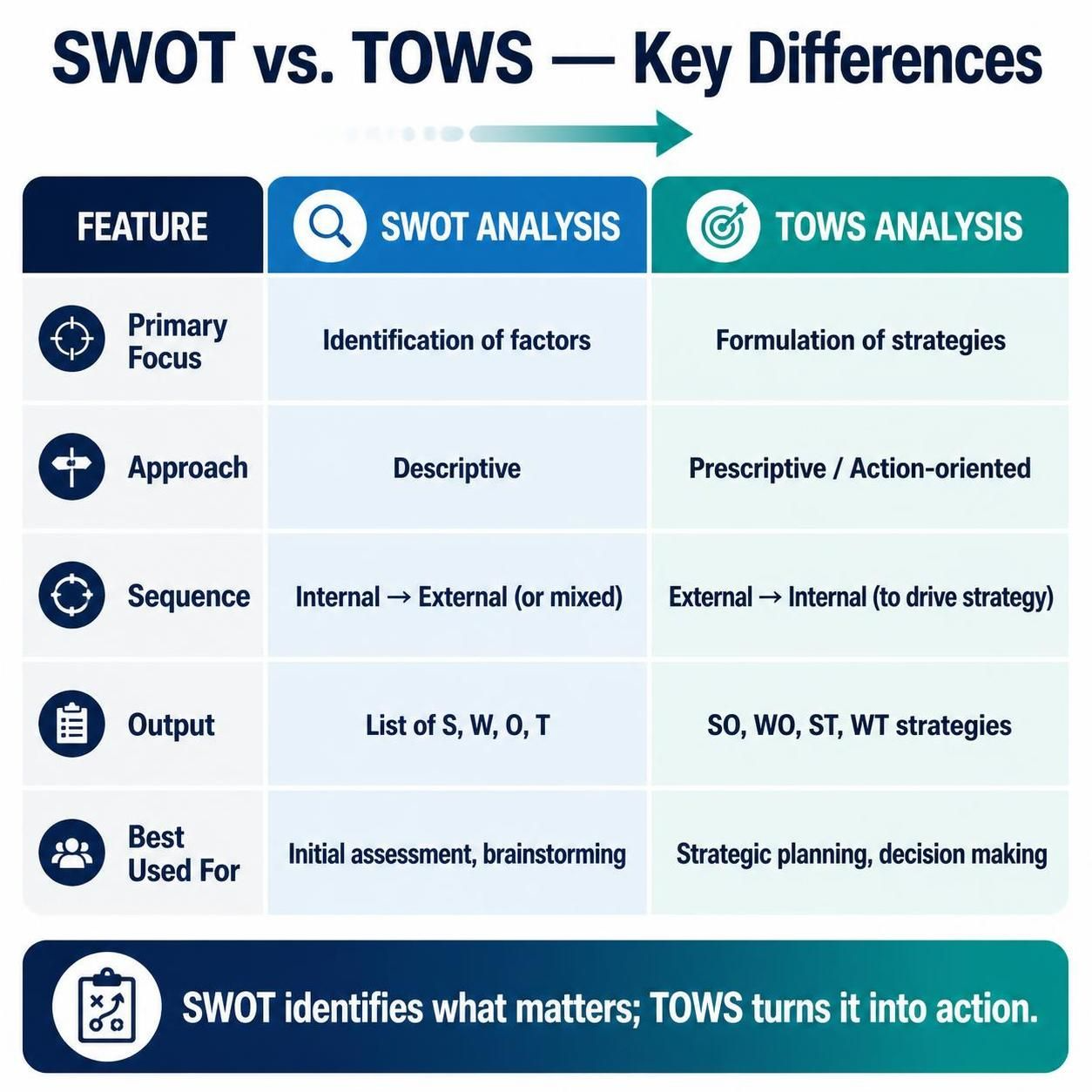
| Feature | SWOT Analysis | TOWS Analysis |
|---|---|---|
| Primary Focus | Identification of factors | Formulation of strategies |
| Approach | Descriptive | Prescriptive/Action-oriented |
| Sequence | Internal → External (or mixed) | External → Internal (to drive strategy) |
| Output | List of S, W, O, T | SO, WO, ST, WT Strategies |
| Best Used For | Initial assessment, brainstorming | Strategic planning, decision making |
Why Use Both?
SWOT and TOWS are not mutually exclusive; they are sequential.
-
Start with SWOT to gather comprehensive data and ensure no critical factor is overlooked.
-
Move to TOWS to synthesize that data into concrete strategic initiatives.
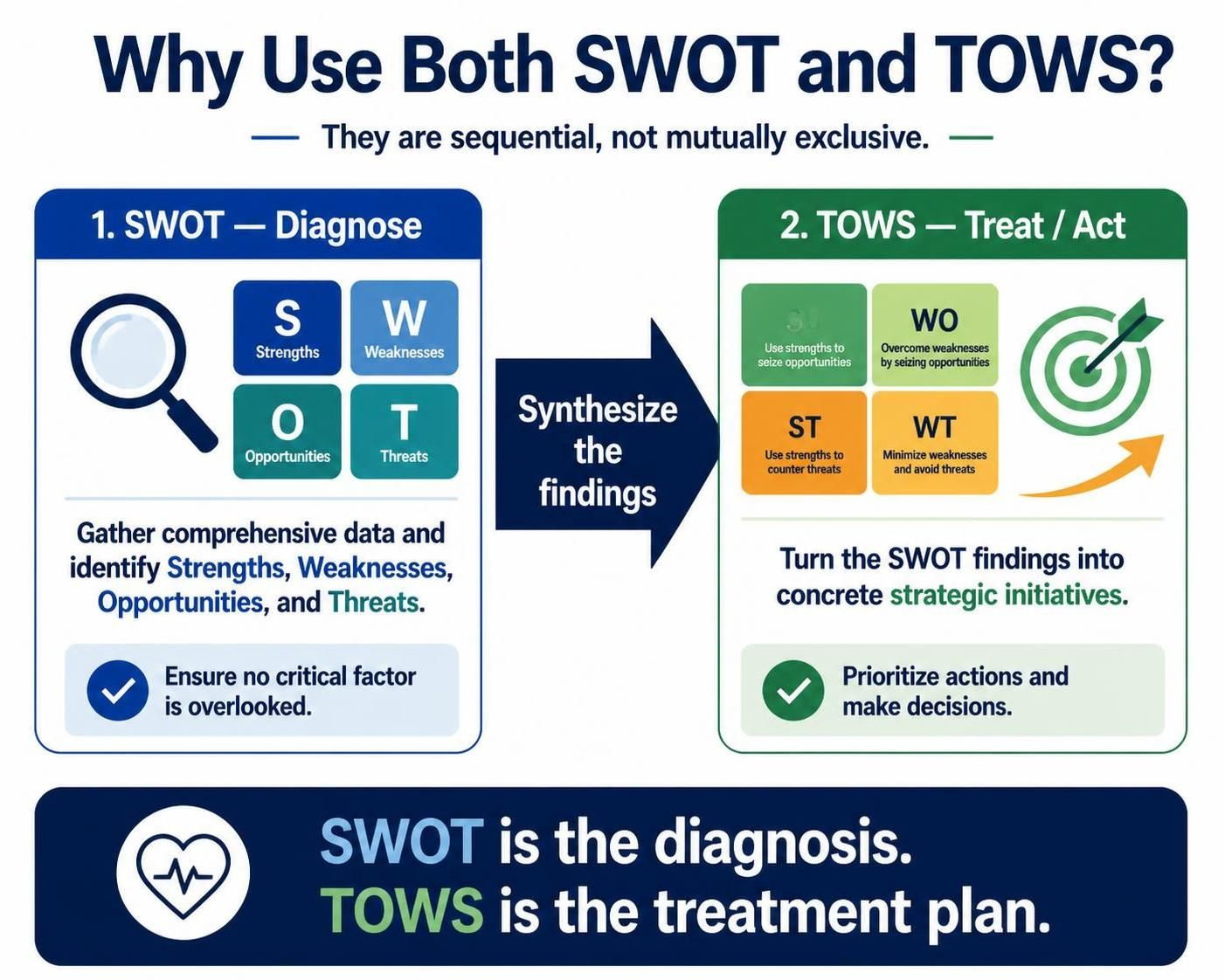
Think of SWOT as the diagnosis and TOWS as the treatment plan.
Part 4: Tooling – Using Visual Paradigm for Strategic Analysis
To effectively conduct SWOT and TOWS analyses, visualization is key. Visual Paradigm is a powerful tool that supports both frameworks through intuitive diagramming features.
How to Use Visual Paradigm for SWOT/TOWS
-
Create a SWOT Matrix:
-
Open Visual Paradigm and select the “SWOT Analysis” template.
-
Input your identified Strengths, Weaknesses, Opportunities, and Threats into the respective quadrants.
-
Use color coding to highlight critical items.
-
-
Transition to TOWS:
-
Use the “TOWS Matrix” template in Visual Paradigm.
-
Link the factors from your SWOT analysis to generate strategic options.
-
Create connections between specific Strengths and Opportunities to visualize SO strategies.
-
-
Collaborate and Refine:
-
Visual Paradigm allows team collaboration, enabling stakeholders like product managers, executives, and marketing teams to contribute insights in real-time.
-
Use the commenting feature to discuss the feasibility of each TOWS strategy.
-
(Note: Screenshots of Visual Paradigm interfaces showing SWOT and TOWS matrices would typically be included here to illustrate the ease of use.)
Conclusion
Strategic planning is not a one-step process but a journey from understanding to action. SWOT analysis provides the essential foundation by helping organizations clearly identify their internal capabilities and external environment. However, without a mechanism to translate these insights into action, SWOT can remain an academic exercise.
This is where TOWS analysis shines. By systematically crossing internal and external factors, TOWS transforms static data into dynamic strategies—SO, WO, ST, and WT—that guide decision-making. When used together, supported by robust tooling like Visual Paradigm, these frameworks empower businesses to not only see their current position but also chart a clear path forward.
For professionals like Angus, who balance product roadmapping with strategic oversight, mastering the transition from SWOT to TOWS can mean the difference between reacting to market changes and proactively shaping them.
Reference
-
Step-by-Step Guide 2026: A comprehensive 6-step workflow guide covering AI-powered SWOT generation, editing factors, building TOWS strategies, and exporting final reports.
-
Free AI SWOT & TOWS Analysis Tool: Official product update introducing the free AI-powered tool that guides users from passive analysis to actionable strategy through a structured wizard.
-
Free AI SWOT & TOWS Analysis Tool: English-language release notes explaining how the tool connects SWOT analysis to strategic action using the TOWS framework with AI brainstorming capabilities.
-
Develop SWOT Analysis Using Mind Map: Explains how to use Visual Paradigm mind maps for SWOT analysis, highlighting benefits like non-linear brainstorming and improved visual clarity.
-
Visual Paradigm PEST SWOT Integration: Advanced workflow guide for modeling PEST and SWOT together in a single project, with data linking and integrated reporting features.
