Mastering Apache ECharts in Visual Paradigm: From AI Prompt to Final Asset

Introduction In the modern data-driven landscape, creating compelling and interactive data visualizations is essential for effective storytelling and decision-making. Apache ECharts is a powerful tool for this purpose, but manually constructing its complex JSON configurations from scratch can be a daunting and time-consuming task. Visual Paradigm solves this challenge by bridging the gap between natural language ideation and precise code customization. By integrating an intelligent AI Chatbot with VPasCode (Visual Paradigm as Code), users can now generate, fine-tune, and publish interactive ECharts seamlessly. This comprehensive guide walks you through the complete three-phase workflow, demonstrating how to transform…continue reading →

Mastering XML Visualization in VPasCode: A Comprehensive Guide to Transforming Complex Data into Clear Diagram

Introduction XML (Extensible Markup Language) remains a cornerstone format for data exchange, configuration files, RSS feeds, and web services. However, reading raw, deeply nested XML files can often be tedious, visually overwhelming, and error-prone. With the latest update to VPasCode, developers, architects, and technical writers can now effortlessly visualize hierarchical XML structures alongside a feature-rich, free XML editor. This guide explores how to transform complex, nested data into clear, interactive diagrams to streamline debugging and documentation. How XML Visualization Works in VPasCode Using the XML visualizer is as straightforward as any other format…continue reading →
The Ultimate Text-Based UML Tool: How VPasCode is Redefining Diagram as Code in 2026

The Ultimate Text-Based UML Tool: How VPasCode is Redefining Diagram as Code in 2026

In the modern software development lifecycle, documentation is no longer an afterthought. It is a critical component of system architecture and team alignment. However, maintaining accurate, up-to-date diagrams has traditionally been a painful bottleneck. Engineers often face a frustrating choice: spend hours manually dragging and dropping shapes in visual editors that quickly become outdated, or wrestle with complex syntax in diagram as code tools where a single missing bracket can halt progress entirely. This friction leads to "documentation drift," where architectural diagrams fall out of sync with the actual codebase, reducing their value…continue reading →
Beyond UML: Every Architecture and Data Diagram You Can Edit as Code in VPasCode

Beyond UML: Every Architecture and Data Diagram You Can Edit as Code in VPasCode

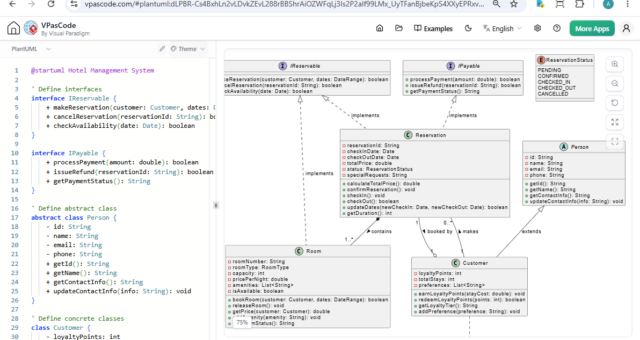
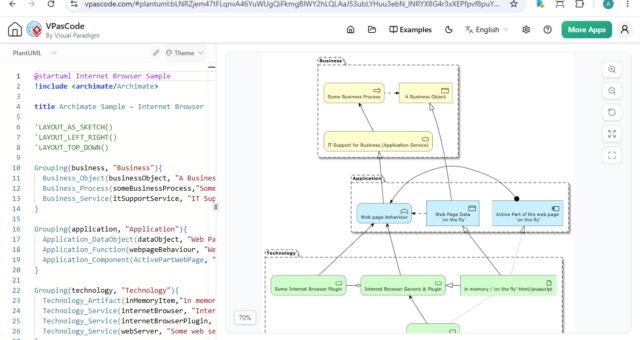
Looking for a diagram as code tool that does more than basic flowcharts? Discover how VPasCode supports C4, ArchiMate, ERDs, DFDs, Gantt charts, and standard UML. When teams adopt a diagram as code platform, they often hit a wall. Most open-source code-rendering tools handle basic flowcharts well, but fail completely when asked to render enterprise-grade IT architectures, database schemas, or project roadmaps.You shouldn’t have to compromise on your modeling standards just to get the speed of a text-based UML tool.VPasCode goes far beyond traditional code-based diagramming software. By uniting engines like PlantUML, Mermaid,…continue reading →
From Big Picture to Code: A Beginner’s Guide to Visualizing Software Architecture with the C4 Model

From Big Picture to Code: A Beginner’s Guide to Visualizing Software Architecture with the C4 Model

Introduction Software architecture documentation often feels overwhelming. Developers either create overly complex diagrams that nobody understands or skip documentation entirely, leaving teams lost in a maze of code. Enter the C4 model—a simple, hierarchical approach to software architecture visualization created by Simon Brown. Think of it as Google Maps for your software: you start with a world view and progressively zoom in until you see individual streets and buildings. This tutorial will walk you through all four levels of the C4 model with practical examples, PlantUML code snippets, and guidance on using modern tools…continue reading →
VPasCode Deep Dive: Unifying Mermaid, PlantUML, and AI in One Platform

VPasCode Deep Dive: Unifying Mermaid, PlantUML, and AI in One Platform

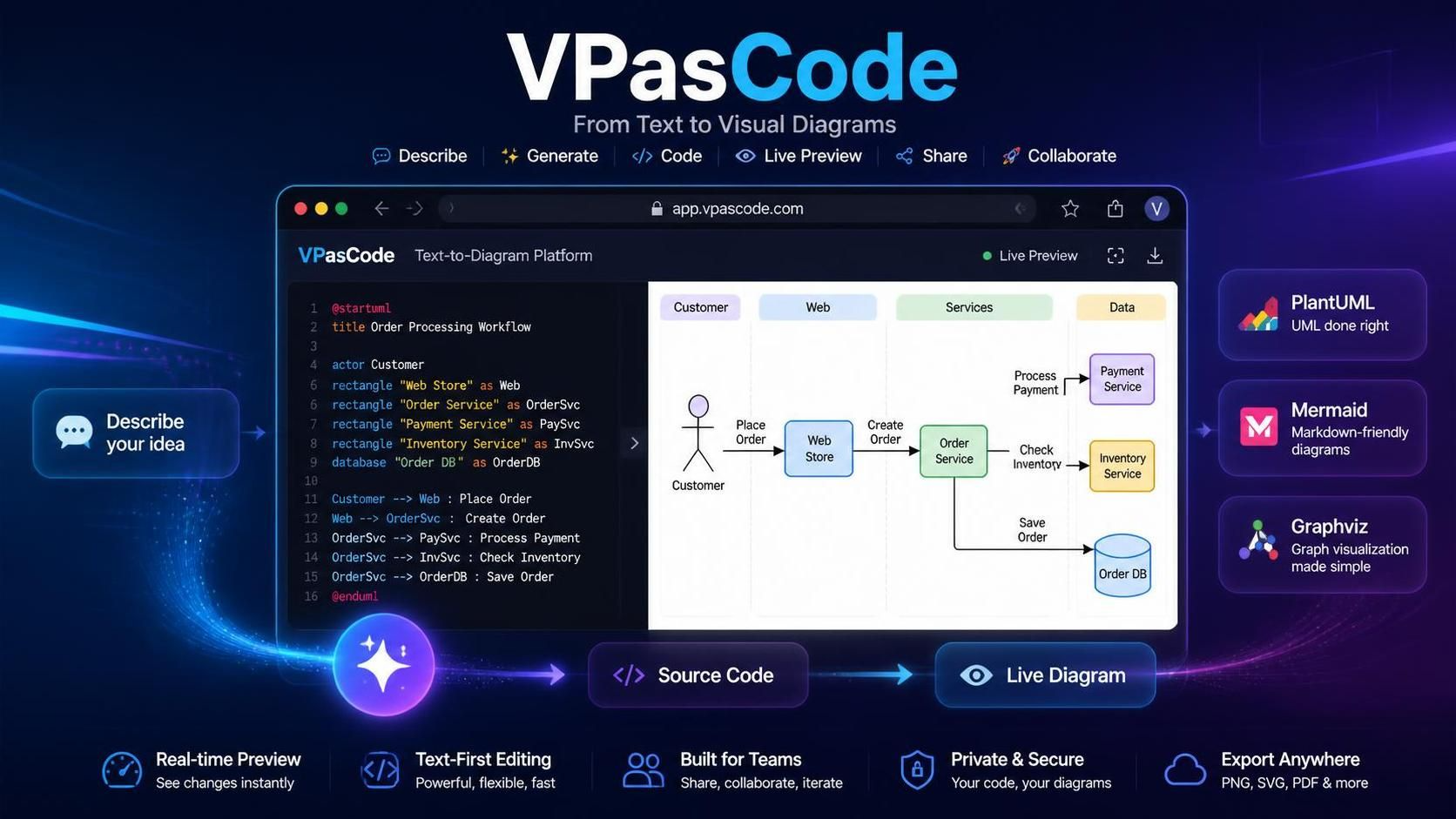
In the world of technical documentation, "Diagram as Code" has moved from a niche developer practice to an industry-standard approach. But for teams juggling multiple diagram types—flowcharts, sequence diagrams, C4 models, and infrastructure maps—the challenge has been tool fragmentation. Visual Paradigm's VPasCode addresses this head-on by unifying three major text-to-diagram engines in a single, browser-based platform, enhanced with AI capabilities and seamless integration with documentation workflows . This guide explores VPasCode's core features, demonstrates realistic examples across its supported syntaxes, and shows how it connects to the broader OpenDocs ecosystem for living documentation. What Makes…continue reading →

From Code to Clarity: A Beginner’s Guide to Seamless Diagramming with VPasCode and OpenDocs

This guide is designed to walk you through the complete workflow of creating professional diagrams using Mermaid syntax in VPasCode and seamlessly publishing them to your knowledge base in OpenDocs. We'll cover the entire pipeline from setup to publishing, with realistic, ready-to-use examples. Why This Workflow Matters Documentation in software development often lags behind code. Engineers spend hours crafting complex system architectures, while technical writers struggle to keep visuals updated in static documents. The result? Outdated diagrams, broken links, and a knowledge base that doesn't reflect reality . VPasCode and OpenDocs solve this…continue reading →
Beyond Pretty Pictures: A Modern Guide to Analysis and Design with AI, Diagram-as-Code, and Visual Paradigm

Beyond Pretty Pictures: A Modern Guide to Analysis and Design with AI, Diagram-as-Code, and Visual Paradigm

Introduction In the fast-paced world of software development, there’s a persistent myth that diagrams are merely decorative artifacts—"pretty pictures" that distract from the real work of writing code. This perspective overlooks a fundamental truth: software development is as much about communication and understanding as it is about implementation. The Unified Modeling Language (UML) and related modeling techniques serve as critical bridges between abstract ideas and concrete implementations. They help teams navigate complexity, align stakeholders, and build systems that truly meet user needs. However, the landscape of analysis and design has evolved significantly since traditional…continue reading →

From Code to Clarity: A Beginner’s Guide to Seamless Diagramming with VPasCode and OpenDocs

Introduction In the fast-paced world of software development and product management, documentation often lags behind code. Engineers spend hours crafting complex system architectures, while technical writers struggle to keep visuals updated in static documents. The result? Outdated diagrams, broken links, and a knowledge base that doesn’t reflect reality. Enter VPasCode and OpenDocs, two powerful tools from Visual Paradigm that are changing the game. VPasCode allows you to create rich, professional diagrams using simple text syntax (like PlantUML or Mermaid), while OpenDocs serves as an AI-powered knowledge management platform. The magic happens when you connect them: with…continue reading →
Case Study: Accelerating Software Architecture Documentation with VPasCode – A Diagram-as-Code Revolution

Case Study: Accelerating Software Architecture Documentation with VPasCode – A Diagram-as-Code Revolution

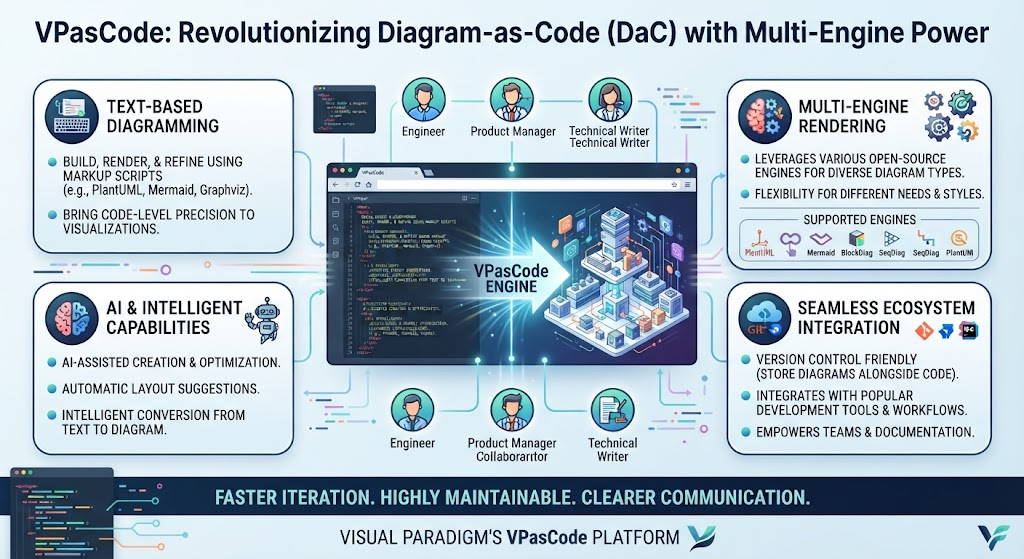
Suggested Article Title: "From Text to Vision: How VPasCode Transforms Diagram-as-Code Workflows for Modern Engineering Teams" Introduction: The Documentation Gap in Modern Software Development In today's fast-paced engineering environments, software architecture evolves at the same velocity as source code. Yet, a persistent challenge remains: keeping architectural documentation synchronized with implementation. Traditional visual modeling tools, while powerful, often create friction—they live outside the codebase, require manual updates, and struggle to integrate with version control and CI/CD pipelines. Enter VPasCode, Visual Paradigm's unified Diagram-as-Code (DaC) platform. By shifting diagram creation into the text editor—where developers already spend their…continue reading →