Breaking Down Silos: A Comprehensive Guide to the Visual Paradigm Unified Platform

Introduction In modern enterprise environments, product managers, architects, and business analysts often find themselves juggling multiple tools. You might design a complex ArchiMate model on your desktop, manage user stories in a cloud-based agile tool, and draft documentation in a separate wiki. This fragmentation creates friction, version control nightmares, and significant context-switching costs. The Visual Paradigm Unified Platform emerges as the solution to this disjointed workflow. It is not just another tool; it is a central workspace and coordination layer designed to connect fragmented tools, files, and workflows into a cohesive ecosystem. Acting as the…continue reading →

Visual Paradigm Unified Platform: Comprehensive Guide

Visual Paradigm Unified Platform: Comprehensive Guide

The Visual Paradigm Unified Platform is the central workspace for the Visual Paradigm ecosystem. It connects Visual Paradigm Desktop, VP Online, cloud-based design and planning applications, shared project artifacts, documentation tools, and AI-assisted utilities through one interface. Its primary role is not to replace Visual Paradigm Desktop or VP Online. Instead, it acts as an integration and orchestration layer: a common home where users can discover tools, create artifacts, organize projects, access desktop models, and move from analysis to design, implementation, documentation, and collaboration. 1. What problem does it solve? Visual Paradigm has historically consisted of…continue reading →
The Complete UML Reference: Structural and Behavioral Diagrams Explained with PlantUML and Visual Paradigm AI

The Complete UML Reference: Structural and Behavioral Diagrams Explained with PlantUML and Visual Paradigm AI

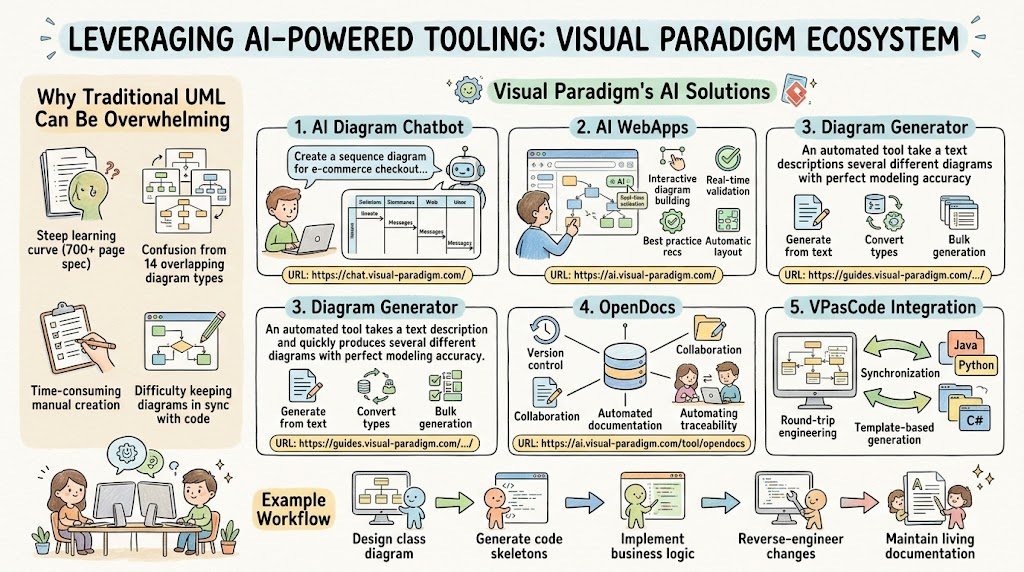
Introduction The Unified Modeling Language (UML) stands as the de facto industry standard for visualizing, specifying, constructing, and documenting software-intensive systems. Managed by the Object Management Group (OMG), UML provides a rich set of graphic notation techniques that enable developers, architects, and stakeholders to communicate complex system designs effectively. With UML 2.2 introducing 14 distinct diagram types and specifications spanning over 700 pages, many practitioners find UML overwhelming and complex. However, as Grady Booch—one of UML's primary creators—wisely noted: "For 80% of all software, only 20% of UML is needed." This comprehensive guide demystifies all 14…continue reading →

Introducing Visual Paradigm 18.1: A New Era of Unified Ecosystems and AI-Driven Innovation

Introduction: Beyond the Hype As a professional who has spent years navigating complex system architectures, product roadmaps, and enterprise modeling, I’ve tested my fair share of diagramming and development tools. When Visual Paradigm announced the release of Version 18.1, the claims of a "unified ecosystem" and "production-ready AI tools" immediately caught my attention. I decided to take the latest milestone release for a spin to see if it truly lives up to the hype. What I found was not just a cosmetic face-lift, but a massive evolution that successfully bridges the gap between desktop…continue reading →