




Transforming Enterprise Architecture: A Case Study on AI-Enhanced TOGAF ADM Implementation with Visual Paradigm
Introduction
In today’s rapidly evolving digital landscape, organizations face unprecedented pressure to align their technology investments with strategic business objectives. Enterprise Architecture (EA) has emerged as a critical discipline for bridging this gap, yet many organizations struggle with the complexity, documentation overhead, and collaborative challenges inherent in traditional EA frameworks.
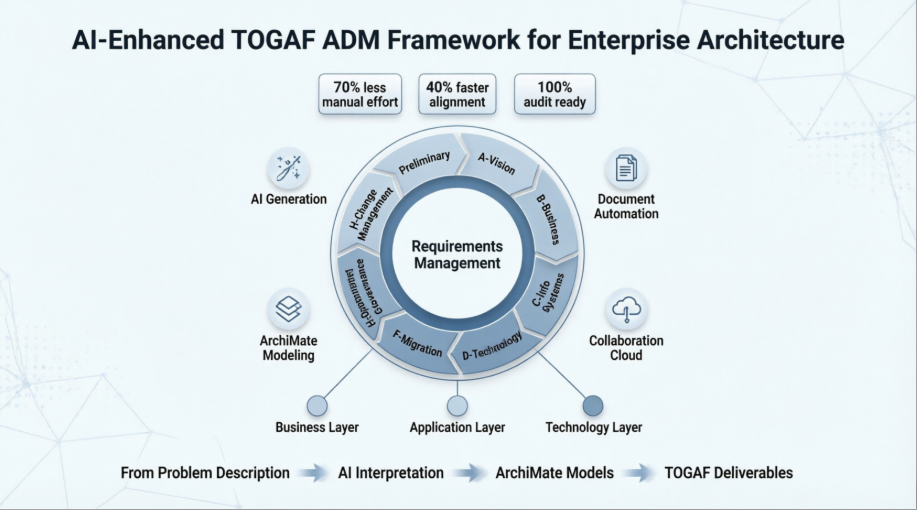
This case study explores how a global financial services organization successfully implemented The Open Group Architecture Framework (TOGAF®) Architecture Development Method (ADM) by leveraging AI-powered tooling through Visual Paradigm. By combining TOGAF’s proven methodology with intelligent automation, the organization achieved significant improvements in architecture delivery speed, stakeholder alignment, and strategic decision-making—demonstrating a replicable pathway for enterprises seeking to modernize their architecture practice.
Why TOGAF?
The IT architecture needs to closely reflect the business goals of the organization. Indeed, specific techniques (business scenarios) should be used to ensure that the business goals are properly understood by the IT architect, and reflected in the IT architecture developed using TOGAF.
Here are the reasons that we should adopt TOGAF ADM for architecture development:
-
A comprehensive general method
-
Complementary to, not competing with, other frameworks
-
Widely adopted in the market
-
Tailorable to meet an organization and industry needs
-
Available under a free perpetual license
-
Vendor, tool and technology neutral open standard
-
Avoids re-inventing the wheel
-
Business IT alignment
-
Based in best practices
-
Possible to participate in the evolution of the framework
What is TOGAF Architecture Development Method (ADM)?
The Architecture Development Method (ADM) is applied to develop an enterprise architecture which will meet the business and information technology needs of an organization. The TOGAF ADM is the result of continuous contributions from a large number of architecture practitioners for serving the following purposes:
-
It describes a method for developing and managing the lifecycle of an enterprise architecture, and forms the core of TOGAF.
-
It may be tailored to the organization’s needs and is then employed to manage the execution of architecture planning activities.
TOGAF and ArchiMate
ArchiMate is a modeling standard introduced by the Open Group. It provides a rich set of modeling notations and concepts that supports modeling Enterprise Architectures consistently within and across domains.
Since both TOGAF and ArchiMate are standards maintained by the Open Group and they both are used in enterprise architecture development, many people are confused between them, asking questions like “what’s the difference between TOGAF and ArchiMate?”, “TOGAF vs ArchiMate?”, etc. The TOGAF framework and the ArchiMate modeling language are both maintained by The Open Group. The TOGAF 9.1 and ArchiMate 2.1 or above work well together and are compatible and complementary for EA development. While TOGAF ADM is an EA framework that can be used to develop and implement enterprise systems, processes, and structures, ArchiMate can be served as a visual modeling language that can be used to create EA descriptions.
It is important to reiterate that the ArchiMate standard is a modeling language and not a framework. The ArchiMate language is widely used for developing visual EA models, usually in conjunction with the TOGAF ADM. Moreover, the TOGAF and ArchiMate standards can put together to provide a set of viewpoints that can be applied for modeling the different architectures.
The ArchiMate language consists of the ArchiMate core language, which includes the Business, Application, and Technology Layers, along with elements to model the strategy and motivation underlying an architecture, as well as its implementation and migration.
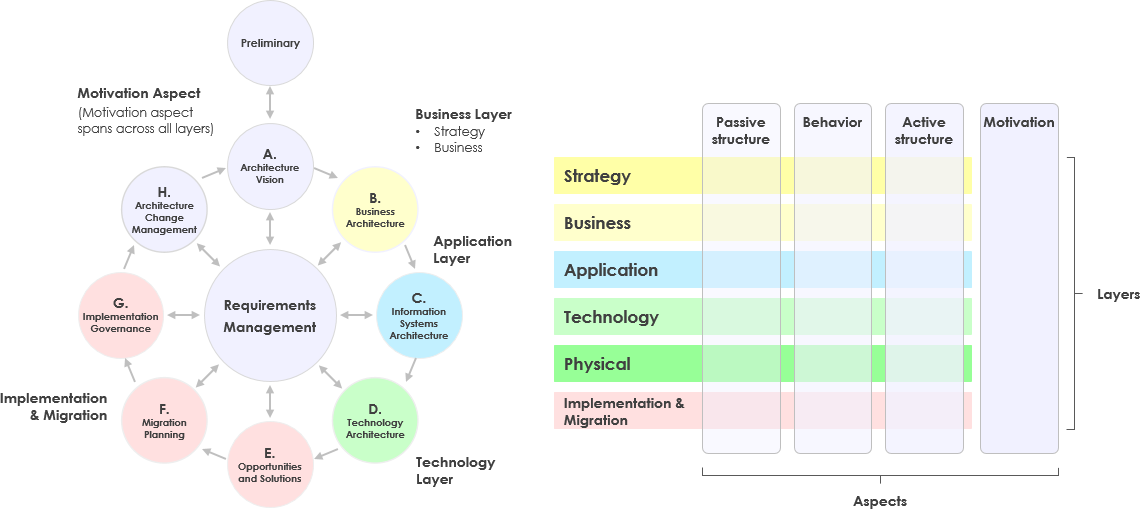
The figure below shows a simplified mapping of how the ArchiMate language can be used in relation to the phases of the TOGAF Architecture Development Method (ADM).
ArchiMate Core
The code ArchiMate layers enables modeling of the architecture domains defined by TOGAF.
The Business, Application, and Technology Layers support the description of the Business, Information Systems, and Technology Architecture domains defined by the TOGAF framework, as well as their interrelationships.
Strategy and Motivation Extension
The strategy & motivation extension enables the modeling of stakeholders, drivers for change, business goals, principles and requirements.
The strategy and motivation elements in the ArchiMate language can be used to support the Requirements Management, Preliminary, and Architecture Vision phases of the TOGAF ADM, which establish the high level business goals, architecture principles, and initial business requirements. They are also relevant to the Architecture Change Management phase of the TOGAF ADM, since the phase deals with changing requirements.
Implementation and Migration Extension
The implementation and migration extension enables the modeling of project portfolio management, gap analysis and transition and migration planning.
The implementation and migration elements of the ArchiMate language support the implementation and migration of architectures through the Opportunities and Solutions, Migration Planning, and Implementation Governance phases of the TOGAF ADM.
TOGAF ADM Lifecycle – Iteration
The ADM supports the concept of iteration at three levels:
Cycling around the ADM: The ADM is presented in a circular manner indicating that the completion of one phase of architecture work directly feeds into subsequent phases of architecture work.
Iterating between phases: TOGAF describes the concept of iterating across phases (e.g., returning to Business Architecture on completion of Technology Architecture).
Cycling around a single phase: TOGAF supports repeated execution of the activities within a single ADM phase as a technique for elaborating architectural content.
TOGAF ADM
During application of the ADM process, a number of outputs are produced based on some inputs and steps according to the phase objective provided by the ADM.
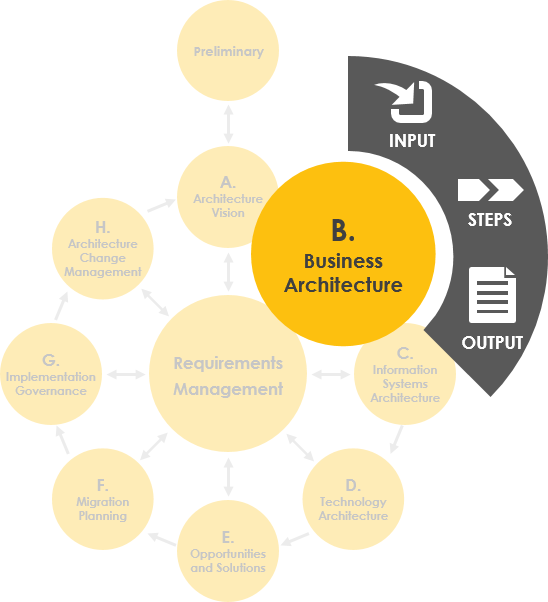
For example:
-
process flows
-
architectural requirements
-
project plans
-
project compliance assessments
-
etc.
In order to collate and present these major work products in a consistent and structured manner, TOGAF defines a structural model, in which to place them.
ADM Input and Output
TOGAF provides a number of input and output deliverables from each phases:
-
These are suggestions and need not be followed exactly
-
Each deliverable produced should be versioned to indicate when a change has occurred
-
The version numbering shown is also a suggestion and need not be followed
Deliverables
A work product that is contractually specified and in turn formally reviewed, agreed, and signed off by the stakeholders. It will typically be archived at completion of a project, or transitioned into an Architecture Repository as a reference model
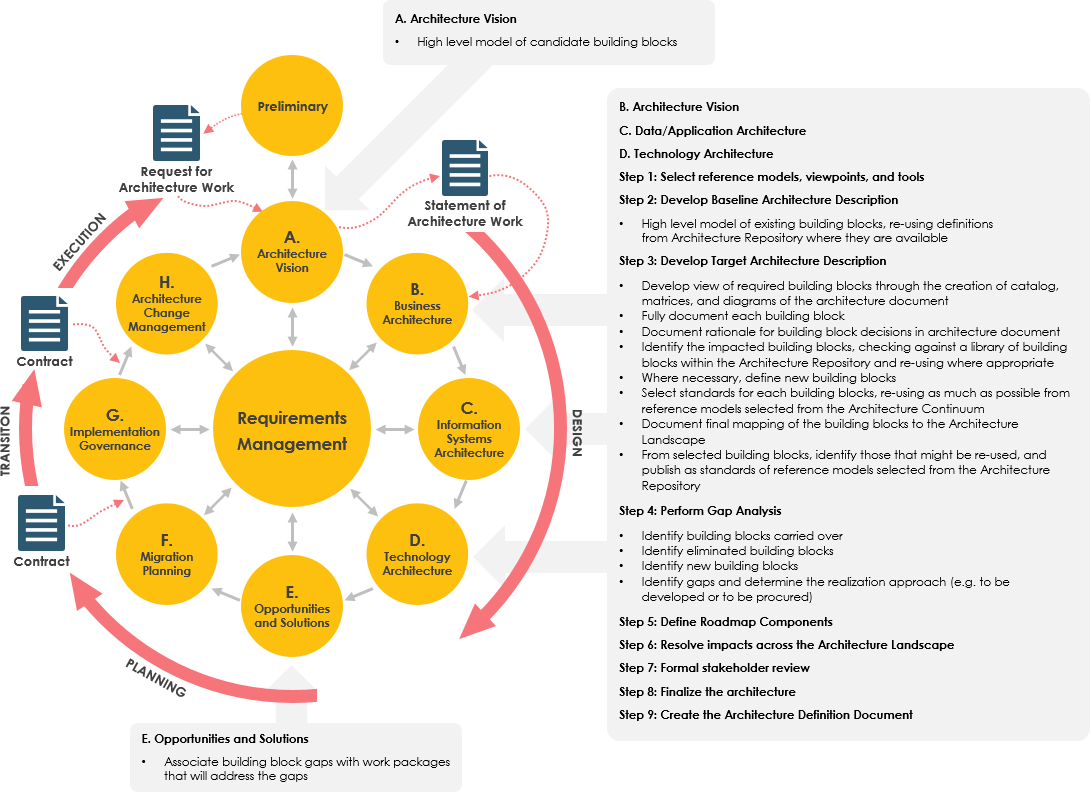
ADM Preliminary Phase
The preparation and initiation activities required to create an Architecture Capability including customization of TOGAF and definition of Architecture
Output Deliverables:
-
Tailored architecture framework
ADM Phase A: Architecture Vision
The initial phase of an architecture development cycle. It includes information about defining the scope of the architecture development initiative, identifying the stakeholders, creating the Architecture Vision, and obtaining approval to proceed with the architecture development
Output Deliverables:
-
Architecture roadmap
-
Tailored architecture framework
ADM Phase B: Business Architecture
Business Architecture: the development of a Business Architecture to support the agreed Architecture Vision
Output Deliverables:
-
Architecture roadmap
ADM Phase C: Information Systems Architecture
Information Systems Architectures: the development of Information Systems Architectures to support the agreed Architecture Vision
-
Architecture roadmap
ADM Phase D: Technology Architecture
Technology Architecture: the development of the Technology Architecture to support the agreed Architecture Vision
Output Deliverables:
-
Architecture roadmap
ADM Phase E: Opportunities & Solutions
Opportunities & Solutions conducts initial implementation planning and the identification of delivery vehicles for the architecture defined in the previous phases
Output Deliverables:
-
Architecture roadmap
-
Implementation and migration plan
ADM Phase F: Migration Planning
Migration Planning addresses how to move from the Baseline to the Target Architectures by finalizing a detailed Implementation and Migration Plan
-
Architecture building blocks
-
Architecture roadmap
-
Change request Implementation and migration plan
-
Implementations governance plan
ADM Phase G: Implementation Governance
Implementation Governance provides an architectural oversight of the implementation
Output Deliverables:
-
Change request
-
Compliance assessment
-
Solution building blocks
ADM Phase H: Architecture Change Management
Architecture Change Management establishes procedures for managing change to the new architecture Requirements Management examines the process of managing architecture requirements throughout the ADM
Summary
The ADM is a comprehensive general method
-
It recommends a sequence for various phases and steps involved in developing an architecture
-
It is an iterative method
-
It draws on the other parts of TOGAF for assets and processes
-
It can be used with other deliverables from other frameworks
Here is the overview of the TOGAF ADM for each of the development phase as shown in the following Figure:
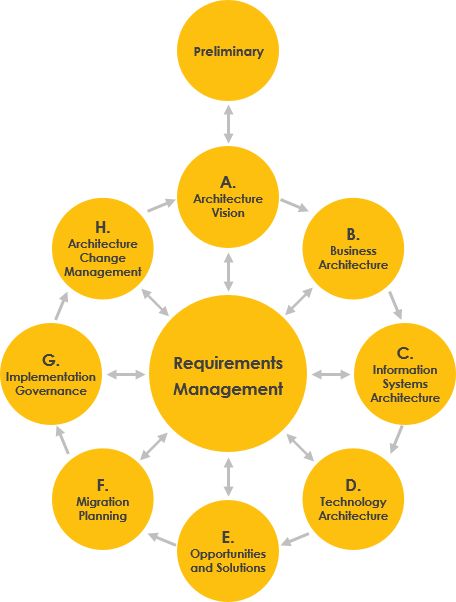
| TOGAF ADM Phase | Phase Objective |
|---|---|
| Preliminary | Prepares the organization for a successful architecture project |
| A. Architecture Vision | Sets the scope, constraints and expectations for the project. Validate the business context and create the Statement of Architecture Work |
| B. Business Architecture | Develop Business Architecture. Develop baseline as-is and target to-be and analyze the gaps. |
| C. Information Systems Architectures | Develop Information Systems Architectures. Develop baseline as-is and target to-be and analyze the gaps. |
| D. Technology Architecture | Develop Technology Architecture. Develop baseline as-is and target to-be and analyze the gaps. |
| E. Opportunities and Solutions | Identify major implementation projects |
| F. Migration Planning | Analyze the costs, benefits and risks. Produce an implementation roadmap. |
| G. Implementation Governance | Ensure that the implementation projects conforms to the architecture |
| H. Architecture Change Management | Ensure that the architecture responds to the needs of the enterprise as changes arise |
| Requirements Management | Every stage of the project should be based on and validate business requirements. |
AI-Powered TOGAF ADM Guide-Through
Master Enterprise Architecture with our intelligent ADM navigator. From Preliminary Phase to Migration Planning, let AI transform your problem descriptions into professional ArchiMate® models and artifacts.
AI TOGAF Generation
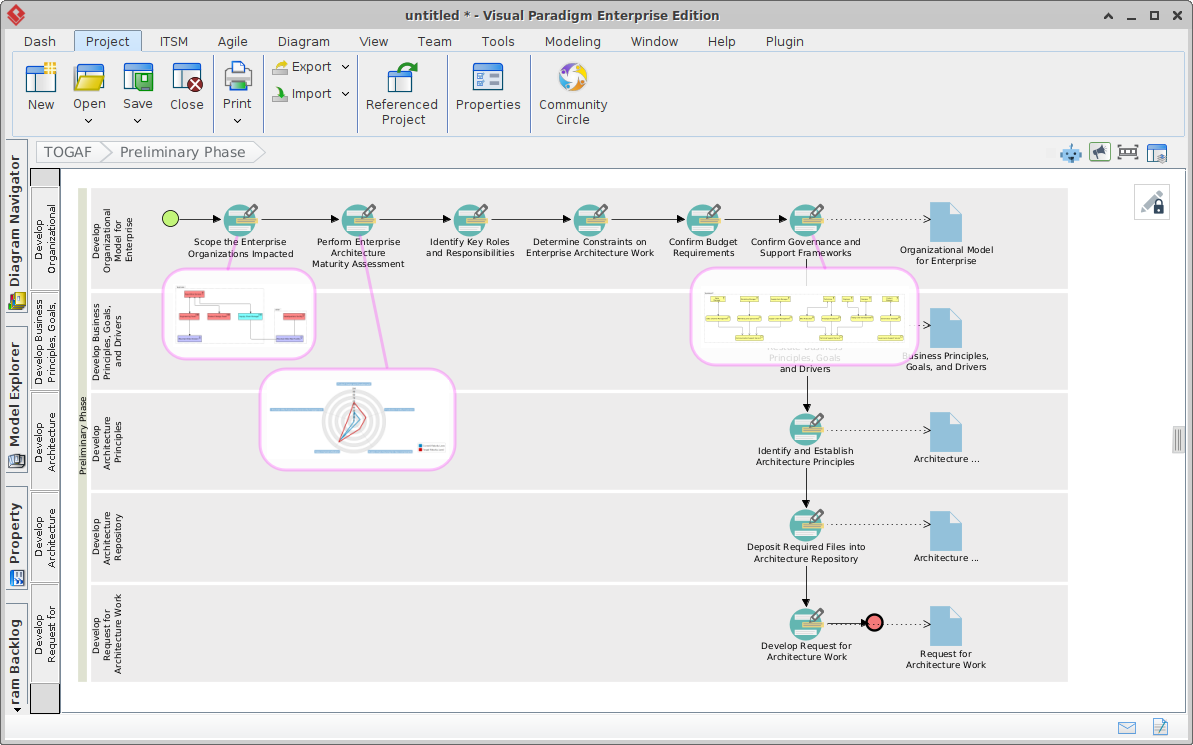
Master the TOGAF ADM with an AI-driven navigator that provides step-by-step guidance and automated artifact creation across every phase.
AI-Powered EA Stakeholder & Impact Visualization
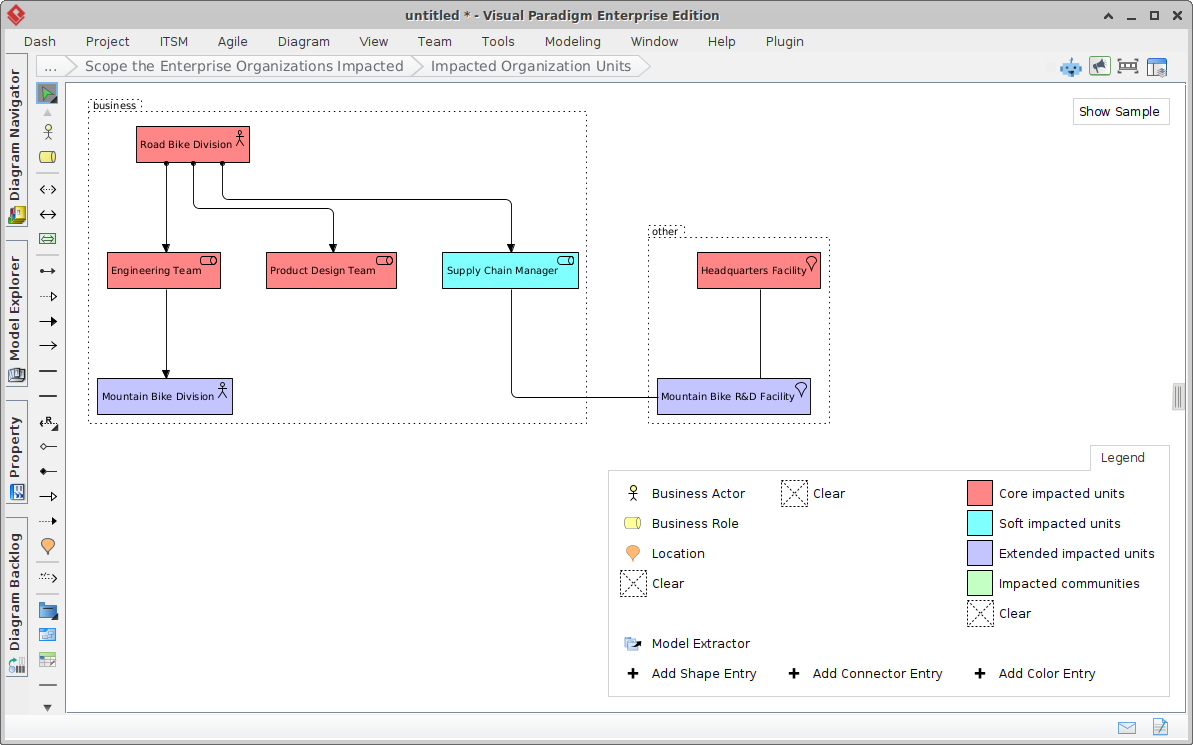
An ArchiMate diagram generated by Visual Paradigm’s AI TOGAF tool, visualizing the organizational units impacted by the architecture work.
AI-Driven Organization Impact Analysis
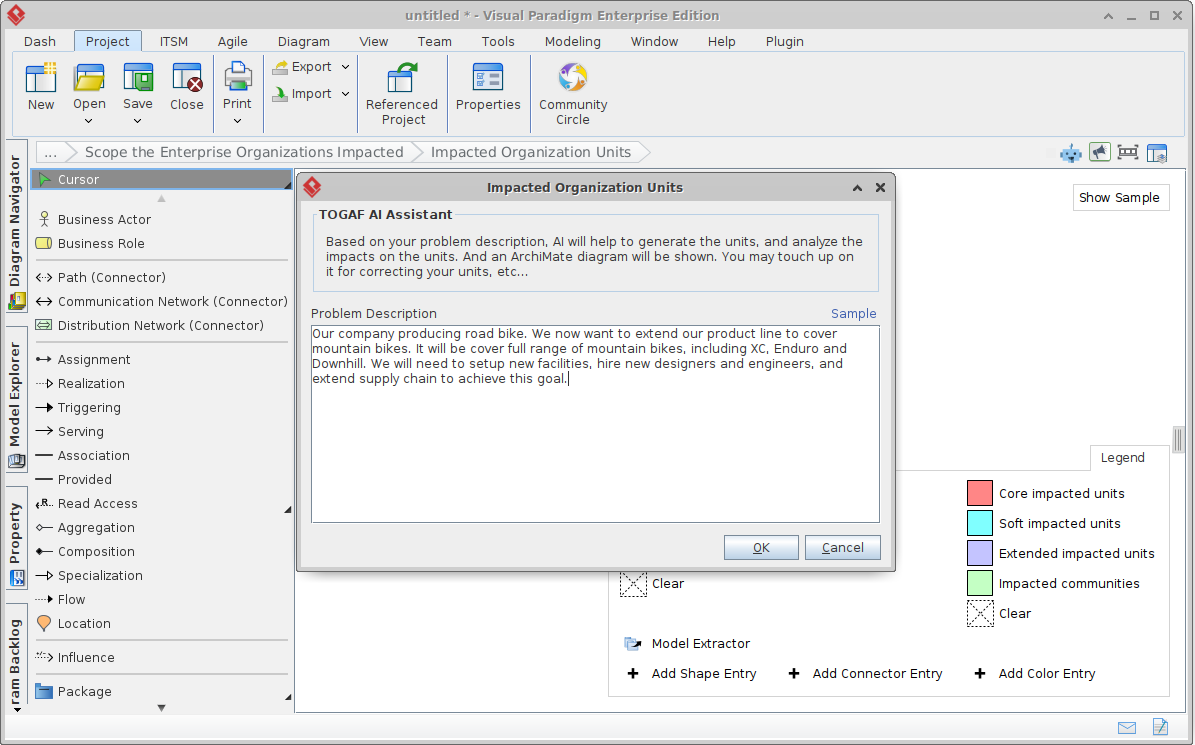
Transform a simple problem description into a detailed map of impacted organizational units and ArchiMate® models instantly.
Accelerate Your ADM Cycle
Reduce manual diagramming effort by up to 70%. Let AI handle the heavy lifting of TOGAF artifact creation.
The TOGAF Guide-Through with AI Support provides a structured walkthrough of the Architecture Development Method. As you navigate through work items and steps, our AI assistant actively builds the forms, diagrams, and charts required for compliance.
Intelligent Synthesis
AI-Powered Artifact Generation
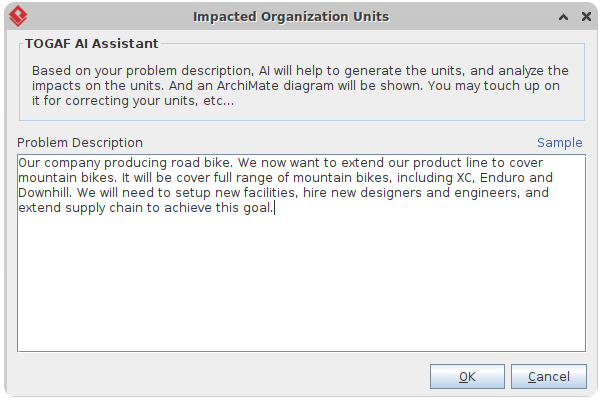
Stop manually drawing complex models. Our generative AI engine interprets your Problem Description to build high-fidelity TOGAF artifacts instantly.
-
Natural Language Interpretation: Simply describe your organization’s challenges, and the AI identifies impacted units, business capabilities, and technology gaps.
-
Automated Diagram Synthesis: The engine doesn’t just draw shapes; it models logic. It generates ArchiMate relationships, scores maturity factors, and builds WBS hierarchies automatically.
Architecture Vision
Accelerate Your Strategic Vision
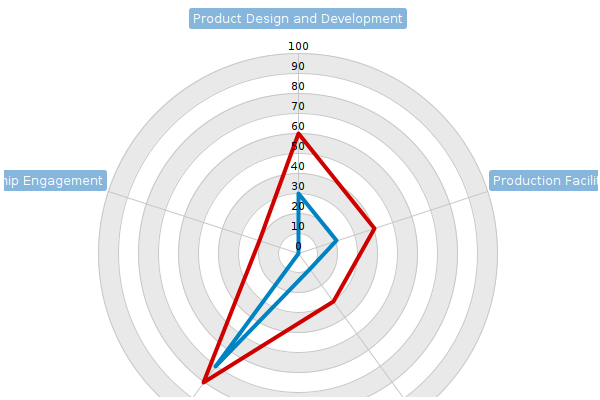
Quickly define your vision with AI-created solution concept diagrams and business/IT capability assessment radar charts. The AI TOGAF software even reviews and updates maturity assessments automatically.
-
Automated Assessments: AI scores business and IT capabilities based on your description, instantly rendering professional Radar Charts.
-
Intelligent Reviews: Let AI analyze existing Maturity Assessments and suggest updates based on new architecture objectives.
ADM Phase Highlights
Explore how AI enhances every phase of the TOGAF cycle.
Maturity Assessment
AI analyzes factors and scores Architecture Maturity, presenting results in a professional radar chart for the Preliminary Phase.
Solution Concepts
Rapidly develop high-level architecture objectives in Phase A with AI-generated ArchiMate solution concept diagrams.
Transition Planning
Model Transition Architectures and Architecture States in Phases E & F with automated timeline progression logic.
Common Questions
Learn more about the AI integration in TOGAF Guide-Through.
How does the AI understand my specific business context?
The AI uses the problem description you provide at the start of each work item. It maps your unique constraints and requirements to TOGAF standards and ArchiMate patterns.
Can I modify the AI-generated ArchiMate diagrams?
Yes. The AI provides a starting baseline. You can fully “touch up” and correct any generated units or relationships using the integrated ArchiMate editor to ensure 100% accuracy.
Which phases of the ADM are supported by AI?
Our AI support covers the entire lifecycle: Preliminary Phase (Scoping/Maturity), Phase A (Objectives/Capabilities), Phases B-D (Domain Architectures & Gaps), and Phases E-F (Migration & WBS).
Visual Paradigm provides an enterprise-grade, certified TOGAF ADM (Architecture Development Method) lifecycle management tool built directly into its enterprise architecture suite. Rather than forcing architects to manage separate text documents, spreadsheets, and drawings, Visual Paradigm integrates the entire TOGAF 9.x / 10 framework into a unified, step-by-step visual workflow engine.
1. The Interactive TOGAF ADM Guide-Through Process
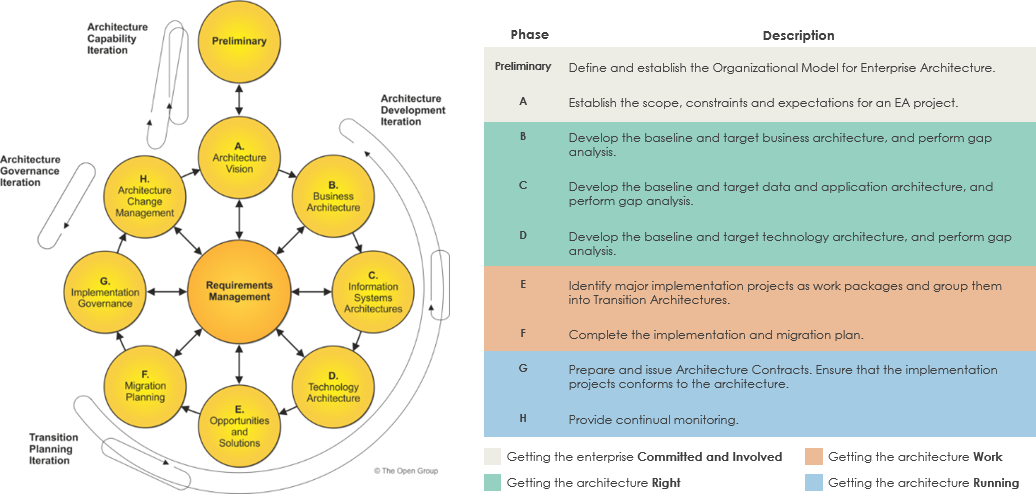
The core of Visual Paradigm’s TOGAF support is its interactive ADM wheel interface. It acts as a structural wizard that walks enterprise architecture teams through every phase of the development method:
-
Step-by-Step Task Checklist: Clicking on any phase of the ADM wheel expands a detailed, sequential checklist of activities required by the TOGAF standard.
-
Pre-Mapped Diagrams: Each task automatically provides the exact modeling canvas required for that step (e.g., ArchiMate, BPMN, UML, or Organization Charts), ensuring architects don’t have to guess which diagram to use.
-
Form-Based Data Entry: For steps requiring qualitative analysis (like risk assessments or principle definitions), the tool provides out-of-the-box form templates to cleanly collect structured text data.
2. Deep Integration with ArchiMate 3.1
While Visual Paradigm supports standard UML and BPMN, its TOGAF ADM framework relies heavily on native ArchiMate compliance, the Open Group’s dedicated enterprise architecture modeling language.
-
Cross-Layer Alignment: It seamlessly maps elements across the core ArchiMate layers: Business (processes/roles), Application (software components/services), and Technology (hardware/networks).
-
Strategy and Motivation Elements: Built-in support for capturing high-level drivers, goals, outcomes, principles, and requirements, ensuring physical systems map directly back to business strategy.
-
Implementation and Migration Layers: Provides explicit ArchiMate shapes to visualize work packages, plateaus, and deliverables directly inside Phases E and F (Opportunities, Solutions, and Migration Planning).
3. Key Features for Enterprise Architects
Gap Analysis Matrix (Phases B, C, and D)
Visual Paradigm features an automated Gap Analysis Matrix tool. Architects place “As-Is” (Baseline) architecture elements on one axis and “To-Be” (Target) elements on the other. The software tracks which systems are being Eliminated, New, Enhanced, or Unchanged, completely eliminating manual cross-referencing.
Architecture Repository & Building Blocks
Every element drawn or documented in any phase of the ADM is stored as a reusable enterprise asset in the central repository. Architects can define Architecture Building Blocks (ABBs) in early phases and instantiate them as Solution Building Blocks (SBBs) during implementation planning.
Capability-Based Planning & Heatmapping
Visualize organizational capabilities using nested matrix charts. Architects can apply color-coded Heatmapping to instantly highlight strategic gaps, high-risk systems, or underfunded business capabilities.
4. Automated Document Generation (Deliverables tool)
One of the most tedious aspects of a TOGAF audit is writing formal documentation. Visual Paradigm solves this with an automated Just-in-Time (JIT) Document Generation pipeline.
-
Auto-Compiling Deliverables: As you complete the forms and diagrams inside the ADM workflow, the tool automatically injects that data into officially formatted TOGAF templates.
-
Standard Out-of-the-Box Layouts: Instantly generates complex structural documents, including the Architecture Principles, Statement of Architecture Work, Architecture Definition Document (ADD), and the Requirements Impact Assessment.
-
Custom Layout Reporting: If the standard TOGAF templates do not fit your company’s guidelines, you can use a drag-and-drop report developer to design custom enterprise blueprints.
5. Multi-User Collaboration & Governance
Enterprise architecture requires cross-department alignment. Visual Paradigm handles this through its secure cloud repository (VP Server / Teamwork Server).
-
Element-Level Version Control: Multiple architects can work on the same TOGAF project simultaneously. The system manages conflicts down to individual model elements, not just flat files.
-
Architecture Governance Workflows: Set up formal approval gates between ADM phases. For example, Phase A cannot be marked complete until the steering committee digitally reviews and signs off on the auto-generated Statement of Architecture Work.
Are you looking to use Visual Paradigm to map out a brand-new cloud migration strategy, or are you documenting an existing legacy enterprise architecture? Let me know your project scope, and I can guide you on how to initialize your first TOGAF ADM workspace!
Case Study Application: Global Financial Services Cloud Migration
Background
A multinational financial services organization with operations across 15 countries faced increasing pressure to modernize its legacy IT infrastructure. The organization’s architecture team was tasked with developing a comprehensive cloud migration strategy that would improve scalability, reduce operational costs by 30%, and enhance regulatory compliance capabilities—all while maintaining business continuity.
Challenge
The architecture team recognized that traditional documentation-heavy approaches to TOGAF ADM implementation were creating bottlenecks:
-
Manual diagram creation consumed 60% of architects’ time
-
Stakeholder alignment meetings frequently stalled due to inconsistent artifact formats
-
Version control issues led to rework and delayed decision-making
-
Regulatory audit preparation required extensive manual compilation of deliverables
Solution Implementation
The organization adopted Visual Paradigm’s AI-powered TOGAF ADM Guide-Through to transform their architecture practice:
Phase 1: Preliminary & Architecture Vision (Weeks 1-3)
-
Used AI-driven problem description input to automatically generate initial ArchiMate models of impacted business units
-
Leveraged automated maturity assessment radar charts to baseline current architecture capabilities
-
Generated the Statement of Architecture Work using JIT document templates, reducing preparation time by 75%
Phases B-D: Domain Architecture Development (Weeks 4-10)
-
Applied the automated Gap Analysis Matrix to compare legacy on-premise systems with target cloud architectures across Business, Application, and Technology layers
-
Utilized cross-layer ArchiMate alignment to ensure business capabilities mapped directly to technology enablers
-
Stored all Architecture Building Blocks in the central repository for reuse across migration workstreams
Phases E-F: Migration Planning (Weeks 11-14)
-
Modeled transition architectures and migration plateaus using ArchiMate Implementation and Migration extensions
-
Generated work breakdown structures and implementation roadmaps through AI-assisted planning
-
Applied capability heatmapping to prioritize high-impact migration initiatives
Phases G-H: Governance & Change Management (Ongoing)
-
Established digital approval workflows for architecture compliance reviews
-
Enabled element-level version control to support parallel workstreams across geographic regions
-
Automated generation of compliance assessments for regulatory audit submissions
Results
-
70% reduction in manual diagramming and documentation effort
-
40% faster stakeholder alignment cycles due to consistent, AI-generated visual artifacts
-
100% audit readiness with auto-compiled deliverables meeting TOGAF and regulatory standards
-
Improved decision quality through real-time capability assessments and gap visualization
-
Enhanced collaboration with multi-user workflows supporting 25+ architects across three time zones
Key Success Factors
-
Starting with a clear problem description to leverage AI interpretation capabilities
-
Customizing TOGAF templates to align with organizational governance requirements
-
Investing in team training on ArchiMate modeling conventions alongside tool adoption
-
Establishing governance workflows early to ensure artifact quality and compliance
Conclusion
The convergence of proven enterprise architecture methodology and intelligent automation represents a transformative opportunity for organizations navigating complex digital transformation initiatives. This case study demonstrates that TOGAF ADM, when enhanced with AI-powered tooling like Visual Paradigm’s Guide-Through, can overcome traditional implementation challenges while delivering measurable business value. By automating repetitive modeling tasks, ensuring artifact consistency, and enabling real-time collaboration, organizations can shift their architecture teams from documentation producers to strategic advisors. The integration of ArchiMate modeling with TOGAF’s structured lifecycle further strengthens the connection between business strategy and technology execution. As enterprise architecture continues to evolve, the combination of open standards, intelligent automation, and collaborative platforms will be essential for organizations seeking to build agile, resilient, and future-ready architectures. The pathway demonstrated here—starting with clear problem framing, leveraging AI for artifact generation, and maintaining governance through integrated workflows—provides a replicable model for any organization committed to elevating its enterprise architecture practice.
References
- Essential TOGAF ADM Knowledge: Comprehensive guide covering core TOGAF Architecture Development Method concepts and implementation best practices.
- Elevate Your Enterprise Architecture Game with Visual Paradigm: Strategic insights on leveraging Visual Paradigm tools to enhance EA practice maturity and delivery outcomes.
- What’s New in the TOGAF Standard 10th Edition: Overview of updates and enhancements introduced in the latest TOGAF standard release.
- Comprehensive Guide to Adopting Visual Paradigm for Enterprise Architecture Modeling: Practical guidance for implementing Visual Paradigm as an EA modeling platform.
- 10 Tips for Effective Business Process Capturing with Visual Paradigm: Actionable techniques for modeling business processes using Visual Paradigm’s BPMN and ArchiMate capabilities.
- Best TOGAF Software: Comparative analysis of software tools supporting TOGAF ADM implementation and enterprise architecture delivery.
- Using the ArchiMate Language to Model TOGAF Architectures: Official Open Group guidance on integrating ArchiMate modeling with TOGAF framework phases.
- Technology View in Visual Paradigm User Guide: Detailed documentation on modeling technology architecture components within Visual Paradigm.
- What Is a Gap Analysis: Your Guide to AI-Powered Strategic Planning: Methodology for conducting architecture gap analysis using AI-assisted tools and techniques.
- TOGAF 8 Documentation Review: Architecture Vision: Historical reference material on TOGAF Phase A deliverables and objectives.
- Deliverable vs Artifact vs Building Block in TOGAF ADM: Clarification of key TOGAF terminology and work product classifications.
- Construction Computing: Enterprise Architecture in Practice: Industry case study demonstrating EA application in the construction sector.
- Getting Started with Visual Paradigm: Onboarding guide for new users of the Visual Paradigm platform.
- VP UML Knowledge Base: Collection of resources covering UML modeling techniques within Visual Paradigm.
- Mastering Enterprise Architecture with ArchiMate and TOGAF: The Visual Paradigm Advantage: Advanced strategies for combining ArchiMate and TOGAF using Visual Paradigm tooling.
- TOGAF ADM Tools: Product overview of Visual Paradigm’s dedicated TOGAF Architecture Development Method support features.
- Just-in-Time TOGAF Templates: Description of automated document generation capabilities for TOGAF deliverables.
This post is also available in Deutsche, Español, فارسی, Français, English, Bahasa Indonesia, 日本語, Polski, Portuguese, Ру́сский, Việt Nam, 简体中文 and 繁體中文.
