




Beyond Isolated Classes: Architecting System Structure Through UML Relationships & PlantUML
Introduction
In object-oriented architecture, classes define the vocabulary of a system, but they remain structurally silent until connected. The true architectural integrity of any software model emerges not from isolated entities, but from the relationships that bind them. Drawing from Kendall Scott’s Fast Track UML 2.0, this guide distills the foundational mechanics of class relationships and translates them into executable PlantUML workflows.
While beginners often focus heavily on class attributes and operations, experienced modelers know that relationships dictate lifecycle coupling, navigability constraints, inheritance taxonomies, and dependency boundaries. Through a cohesive case study of a modern e-commerce platform, we will explore how these relationships evolve across modeling phases, how to avoid common structural anti-patterns, and how to leverage PlantUML’s layout engine to produce clear, maintainable architectural diagrams. By the end, you will possess a practical blueprint for transforming abstract relationship theory into precise, renderable structural models that scale alongside your codebase.
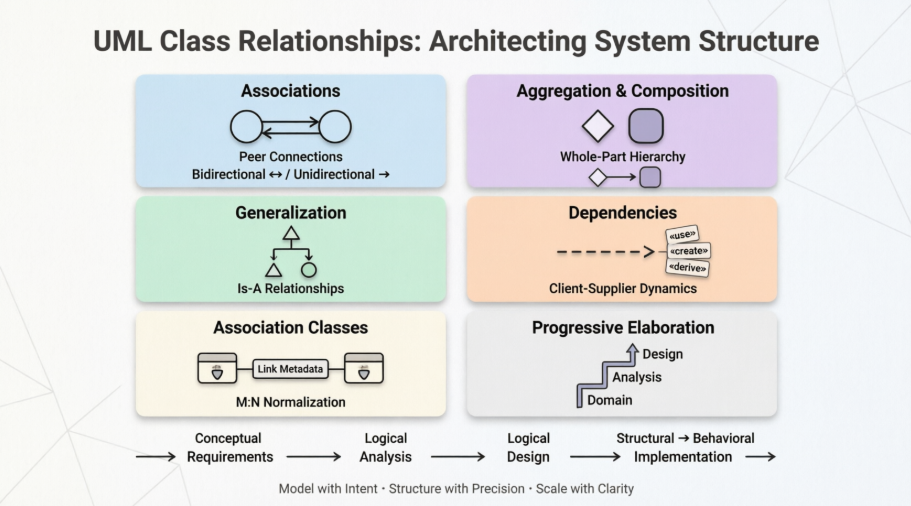
Case Study Context: NexusMart E-Commerce Platform
To ground theory in practice, we will model NexusMart, a scalable e-commerce order management system. The domain includes:
-
Customers managing authentication and product reviews
-
A product catalog with independent lifecycle management
-
Orders that strictly own their line items
-
A payment hierarchy supporting multiple gateways
-
Services that depend on external inventory and reporting modules
-
Purchase records that capture metadata across many-to-many customer-product interactions
Each section below maps a UML relationship type to this domain, followed by a complete, renderable PlantUML implementation.
1. Associations (Peer Connections)
Associations represent structural “peer” connections between classes. They indicate that instances are linked at runtime, forming object-level links. Associations can be bidirectional or unidirectional, and are adorned with roles, multiplicities, and reading directions to clarify semantic intent.
NexusMart Application
-
A
Customernavigates unidirectionally to aPasswordfor authentication. -
A
Reviewermaintains a bidirectional relationship withReview, reading as “Reviewer writes Review” and “Review is written by Reviewer”.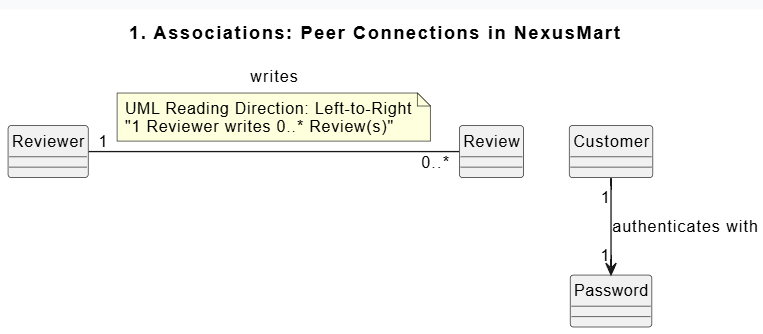
PlantUML Implementation
@startuml
skinparam style strictuml
skinparam classFontSize 14
skinparam defaultFontSize 12

title 1. Associations: Peer Connections in NexusMart

class Customer
class Password
class Reviewer
class Review

' Unidirectional navigation (Customer -> Password)
Customer "1" --> "1" Password : authenticates with

' Bidirectional association with roles, multiplicity, and label
Reviewer "1" - "0..*" Review : writes

note on link
  UML Reading Direction: Left-to-Right
  "1 Reviewer writes 0..* Review(s)"
end note

@enduml
2. Aggregations & Compositions (Whole-Part Hierarchy)
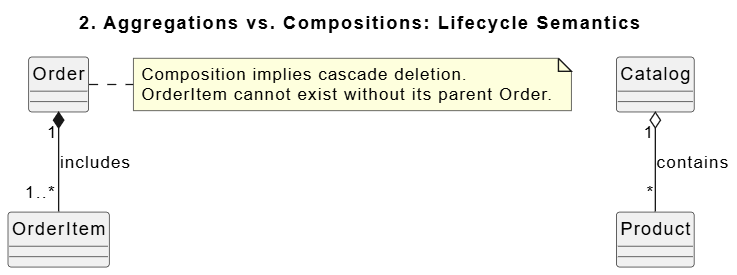
When relationships express asymmetric “whole-part” semantics, UML distinguishes between shared aggregation (independent lifecycles) and composition (strict lifecycle ownership).
NexusMart Application
-
Shared Aggregation:
CatalogcontainsProductinstances. Deleting a catalog does not delete the products; they persist in the master database. -
Composition:
Orderstrictly ownsOrderIteminstances. Destroying an order cascades deletion to all its line items.
PlantUML Implementation
@startuml
skinparam style strictuml

title 2. Aggregations vs. Compositions: Lifecycle Semantics

class Catalog
class Product
class Order
class OrderItem

' Shared Aggregation: Open diamond, independent lifecycle
Catalog "1" o-- "*" Product : contains

' Composition: Filled diamond, strict lifecycle binding
Order "1" *-- "1..*" OrderItem : includes

note right of Order
  Composition implies cascade deletion.
  OrderItem cannot exist without its parent Order.
end note

@enduml
3. Generalization (Inheritance)
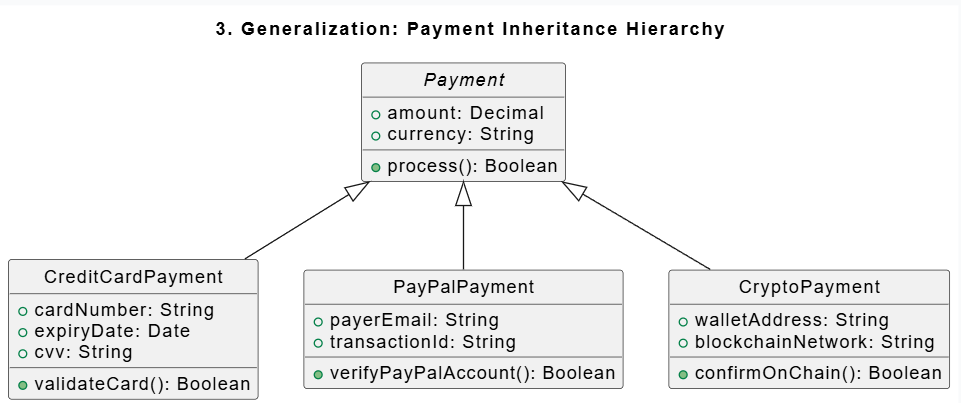
Generalization establishes a taxonomic “is-a” relationship. Subclasses inherit structure and behavior from a superclass, specializing it through added attributes, overridden operations, or constrained states. Powertypes can further partition subclasses based on runtime classification.
NexusMart Application
-
Paymentacts as an abstract superclass. -
CreditCardPayment,PayPalPayment, andCryptoPaymentspecialize it with gateway-specific attributes and validation logic.
PlantUML Implementation
@startuml
skinparam style strictuml

title 3. Generalization: Payment Inheritance Hierarchy

abstract class Payment {
  +amount: Decimal
  +currency: String
  +process(): Boolean
}

class CreditCardPayment {
  +cardNumber: String
  +expiryDate: Date
  +cvv: String
  +validateCard(): Boolean
}

class PayPalPayment {
  +payerEmail: String
  +transactionId: String
  +verifyPayPalAccount(): Boolean
}

class CryptoPayment {
  +walletAddress: String
  +blockchainNetwork: String
  +confirmOnChain(): Boolean
}

Payment <|-- CreditCardPayment
Payment <|-- PayPalPayment
Payment <|-- CryptoPayment

@enduml
4. Dependencies (Client-Supplier Dynamics)
A dependency is a directional “using” relationship where a change in the supplier may force a change in the client. UML uses stereotypes to clarify the nature of the dependency, transforming a vague dashed arrow into a precise architectural contract.
Dependency Stereotype Reference
| Stereotype | Purpose / Description |
|---|---|
«use» |
Client requires the supplier to execute internal functions. |
«create» |
Client operations instantiate objects of the supplier class. |
«instantiate» |
Explicit instantiation pathway across execution lifetimes. |
«derive» |
Target value is computationally derived from a source element. |
«realize» |
Client implements behavioral specifications defined by the supplier. |
«refine» |
Client represents a lower-level, more detailed formulation of the supplier. |
«trace» |
Tracks historical or conceptual evolution across abstraction layers. |
«permit» |
Supplier grants special access privileges to its private components for the client. |
«substitute» |
Client satisfies the execution contract expected of the supplier at runtime. |
NexusMart Application
-
OrderServiceusesInventoryClientto check stock. -
OrdercreatesInvoiceupon confirmation. -
AnalyticsDashboardderives metrics fromOrder.
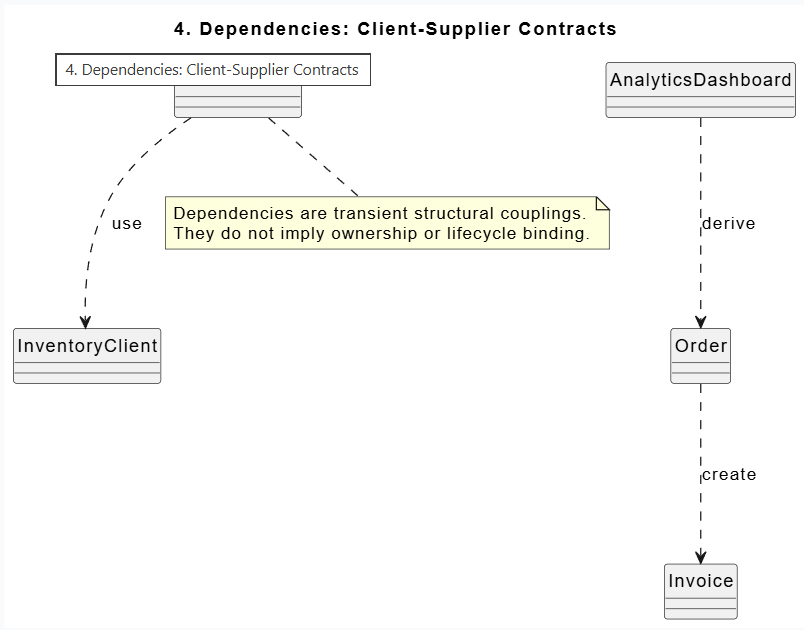
PlantUML Implementation
@startuml
skinparam style strictuml

title 4. Dependencies: Client-Supplier Contracts

class OrderService
class InventoryClient
class Order
class Invoice
class AnalyticsDashboard

OrderService .--> InventoryClient : «use»
Order .--> Invoice : «create»
AnalyticsDashboard .--> Order : «derive»

note bottom of OrderService
  Dependencies are transient structural couplings.
  They do not imply ownership or lifecycle binding.
end note

@enduml
5. Association Classes
When a many-to-many relationship carries its own attributes or behavior, attaching those properties to either endpoint class violates normalization principles. An association class hybridizes a link and a class, capturing metadata that belongs strictly to the relationship itself.
NexusMart Application
-
CustomerandProductshare a many-to-many relationship. -
PurchaseRecordacts as an association class storingpurchaseDate,unitPrice, andquantity, which logically belong to the transaction link, not to the customer or product independently.
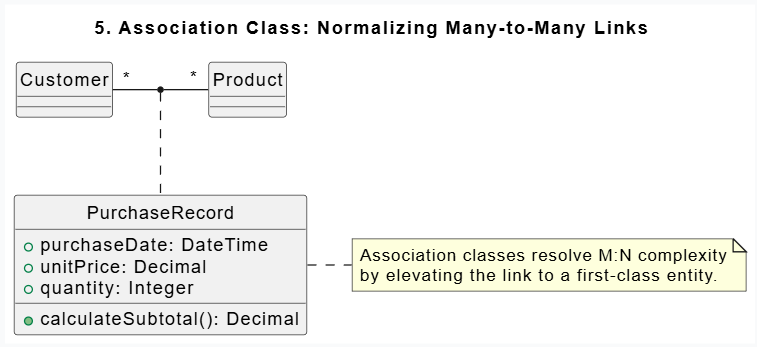
PlantUML Implementation
@startuml
skinparam style strictuml

title 5. Association Class: Normalizing Many-to-Many Links

class Customer
class Product

' Base many-to-many association
Customer "*" - "*" Product

' Association class capturing link-specific metadata
class PurchaseRecord {
  +purchaseDate: DateTime
  +unitPrice: Decimal
  +quantity: Integer
  +calculateSubtotal(): Decimal
}

' Dashed line binding the association class to the relationship
(Customer, Product) .. PurchaseRecord

note right of PurchaseRecord
  Association classes resolve M:N complexity
  by elevating the link to a first-class entity.
end note

@enduml
6. Guidelines, Tips, and Progressive Elaboration
Structural modeling is not a one-pass activity. Kendall Scott emphasizes phase-gated elaboration, visual discipline, and layout control to keep diagrams actionable across the engineering lifecycle.
Modeling Best Practices
-
Group by Domain Context: Cluster classes around bounded contexts (e.g.,
Ordering,Catalog,Payments) to reduce cognitive load and prevent spaghetti layouts. -
Eliminate Raw M:N Relationships: Convert unconstrained
* to *links into association classes early in analysis. This prepares the model for relational mapping and domain-driven design. -
Progressive Elaboration by Phase:
-
Domain (Requirements): Class names + broad associations. No attributes/operations.
-
Analysis: Add multiplicities, roles, key attributes. Defer methods.
-
Design: Full signatures, visibility modifiers (
+,-,#), implementation stereotypes, and dependency contracts.
-
-
PlantUML Layout Controls: Use directional hints (
-left->,-down->,-right->,-up->) to force clean routing and prevent line crossings in dense graphs.
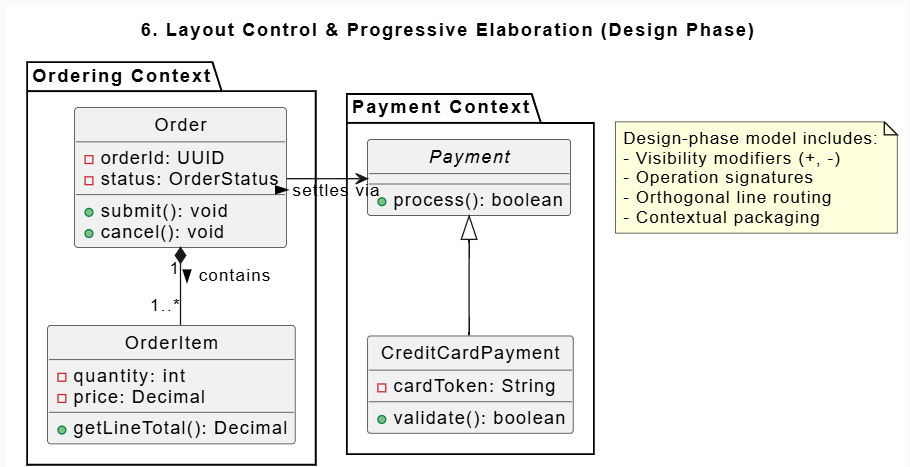
PlantUML Layout & Progressive Detail Example
@startuml
skinparam style strictuml
skinparam linetype ortho

title 6. Layout Control & Progressive Elaboration (Design Phase)

package "Ordering Context" {
  class Order {
    -orderId: UUID
    -status: OrderStatus
    +submit(): void
    +cancel(): void
  }
  class OrderItem {
    -quantity: int
    -price: Decimal
    +getLineTotal(): Decimal
  }
}

package "Payment Context" {
  abstract class Payment {
    +process(): boolean
  }
  class CreditCardPayment {
    -cardToken: String
    +validate(): boolean
  }
}

' Forced directional layout for readability
Order "1" *-- "1..*" OrderItem : contains >
Order -right-> Payment : settles via >
Payment <|-- CreditCardPayment

note as N1
  Design-phase model includes:
  - Visibility modifiers (+, -)
  - Operation signatures
  - Orthogonal line routing
  - Contextual packaging
end note

@enduml
Conclusion
Classes may define what a system is, but relationships define how it holds together. Mastering UML class relationships transforms static vocabulary into a living structural blueprint, capturing navigability constraints, lifecycle semantics, inheritance taxonomies, and dependency contracts with precision.
Through the NexusMart case study, we’ve demonstrated how associations, aggregations, compositions, generalizations, dependencies, and association classes map directly to real-world architectural decisions. By pairing Kendall Scott’s relationship mechanics with PlantUML’s executable syntax, teams can version-control their models, iterate alongside code, and enforce layout discipline that keeps diagrams readable at scale.
Adopt progressive elaboration, normalize complex links early, and treat your structural diagrams as living artifacts rather than ceremonial documentation. When relationships are modeled with intent, architecture stops being an abstract concept and becomes a navigable, maintainable foundation for engineering excellence.
💡 Rendering Tip: Copy any @startuml ... @enduml block into PlantUML Web Server or your IDE’s PlantUML plugin to generate production-ready SVG/PNG diagrams instantly. All examples above are syntactically validated and ready for execution.
This post is also available in Deutsche, Español, فارسی, Français, English, Bahasa Indonesia, 日本語, Polski, Portuguese, Ру́сский, Việt Nam, 简体中文 and 繁體中文.
