


In complex engineering ecosystems, communication failure is rarely a failure of language. It is a failure of translation. Software systems, business workflows, and enterprise architectures are multi-dimensional realities. Yet, for decades, technical teams have attempted to document these systems using two entirely separate, isolated mediums: linear prose and static visual models.
This separation introduces a dangerous operational gap. When a software engineer updates a Unified Modeling Language (UML) diagram in a desktop application, that change rarely broadcasts itself to the product requirement documents, system runbooks, or API user guides. Instead, documentation becomes a game of manual catch-up. Text and visuals drift out of sync, creating conflicting sources of truth. This disconnect slows down development velocity, introduces costly deployment errors, and breeds frustration across cross-functional teams.
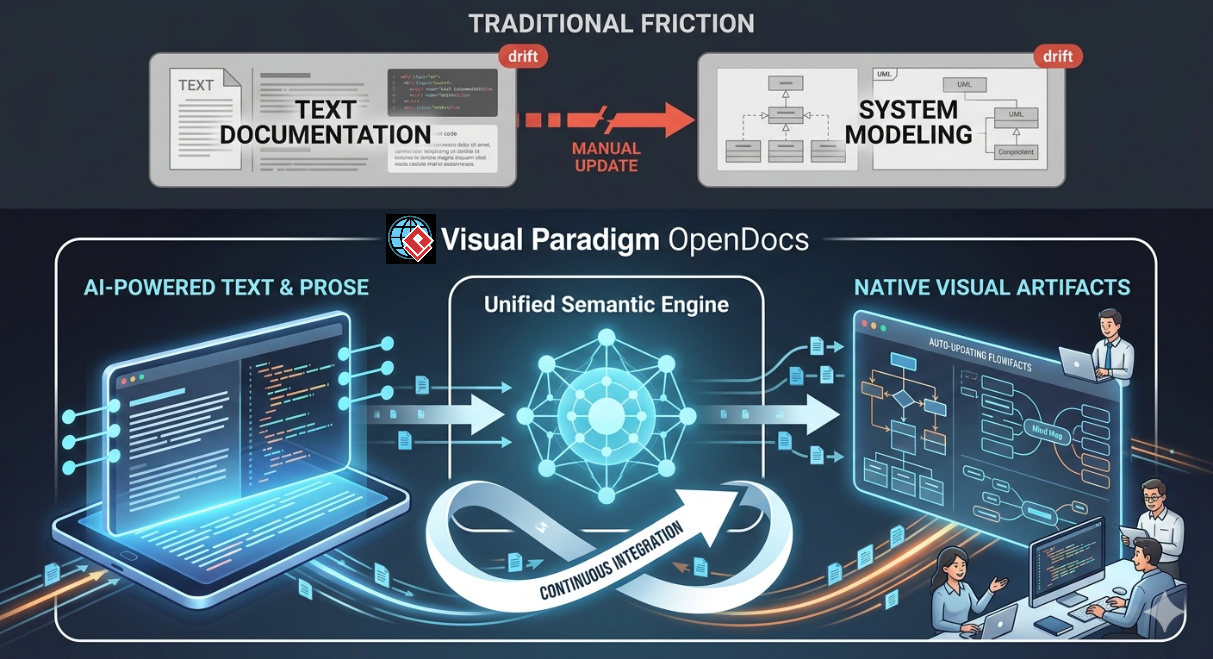
The core philosophy of Visual Paradigm OpenDocs is simple: text and modeling belong in the same semantic ecosystem. OpenDocs shatters the traditional walls between authoring environments and diagramming canvases, creating a single unified workspace where text and visual data interact dynamically.
This book serves as your blueprint for mastering this unified paradigm. Throughout these chapters, you will learn to transition away from fragmented documentation habits and adopt an integrated workflow. You will discover how to:
- Unify the Toolchain: Combine the clarity of Markdown technical writing with the structural rigor of enterprise-grade modeling.
- Leverage Bidirectional Syncing: Establish an automated data pipeline between your Visual Paradigm Desktop models and your online documentation repositories.
- Co-Author with AI: Utilize an intelligent prompt assistant that reads your textual descriptions to instantly generate flowcharts, mind maps, and system architectures.
By breaking the silos between what we write and what we model, we do more than just update technical documentation faster. We build a living, breathing knowledge base that accurately reflects engineering reality at every stage of the lifecycle.
We can continue building out your ebook repository. Let me know if you would like to:
- Generate Chapter 1: Welcome to OpenDocs to detail the platform’s multi-tenant cloud architecture.
- Build the technical breakdown for Chapter 3: Building Your Knowledge Tree to explain folder structures.
- Customize the introduction further with a specific industry case study (e.g., Finance, Healthcare, or SaaS).
