


Documentation is a cross-functional responsibility, yet different roles approach it with distinct priorities, tools, and pain points. This book is specifically designed to bridge those gaps. It provides actionable workflows for the three core pillars of any product team: the creators of the technology, the strategic owners of the product, and the specialized communicators who translate complex logic for the world.
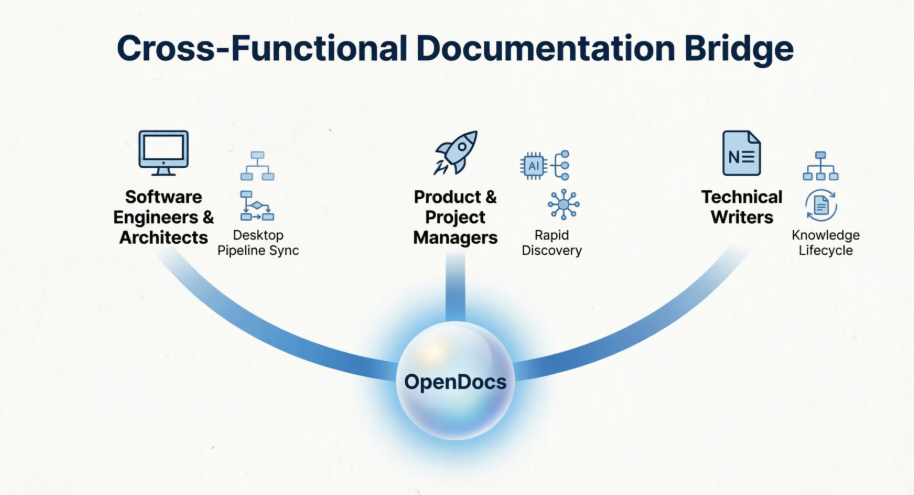
💻 Software Engineers & Architects
For developers, documentation is often a distraction from writing code. Traditional tools require leaving the integrated development environment (IDE) or modeling canvas to manually update text files, leading to stale documentation and fragmented context.
- The Focus: Maintaining a single source of architectural truth with minimal manual overhead.
- Key Takeaways: Learn to use the Desktop-to-OpenDocs Pipeline to push UML, C4, and sequence diagrams straight from your engineering workspace into live documentation.
- The Benefit: Eliminate documentation drift. Your architectural models stay synced with your technical specifications automatically.
🚀 Product & Project Managers
Product managers own the “why” and the “what” of a system. They need to turn high-level business requirements into clear, functional specifications without getting bogged down in low-level markdown syntax or complex engineering configurations.
- The Focus: Accelerating product discovery, mapping requirements clearly, and aligning stakeholders.
- Key Takeaways: Master the AI Prompt Assistant (
/commands) to rapidly draft requirements, brainstorm mind maps, and turn unstructured notes into clean, structured user journeys. - The Benefit: Faster delivery cycles. Translate business rules into initial visual workflows instantly to get immediate sign-off from both engineers and business stakeholders.
📝 Technical Writers & Content Strategists
Technical writers are the custodians of organizational knowledge. They struggle with fragmented asset management, chasing engineers for updated diagrams, and copy-pasting visual assets across different content management systems.
- The Focus: Structuring intuitive information architecture, maintaining content quality, and governing the document lifecycle.
- Key Takeaways: Master the Knowledge Tree hierarchical organization, leverage enterprise revision controls, and embed live, auto-updating workspace artifacts seamlessly.
- The Benefit: Absolute content control. Stop manual asset management and focus on authoring precise, high-impact content inside a modern, unified environment.
|
SOFTWARE ENGINEERS
“How the system works” |
PRODUCT MANAGERS
“What we need to build” |
TECHNICAL WRITERS
“How we clarify and scale knowledge” |
|---|---|---|
|
• UML & Architecture
• Desktop Pipeline Sync • Code-Level Clarity |
• User Journeys
• AI Prompt Tools • Rapid Discovery |
• Information Tree
• Lifecycle & Auditing • Single Source Truth |
We have completed the foundational front matter! Let me know how you would like to proceed with the ebook repository:
- Generate Chapter 1: Welcome to OpenDocs to dive into the cloud workspace architecture and tenant security.
- Generate Chapter 4: Advanced Document Editing to explore deep Markdown integration and code formatting.
- Provide an integrated code snippet example or diagram recipe to include in the next section.
