




Modeling Dynamic Behavior: A Comprehensive Case Study in UML 2.0 State Machines
Introduction
Modern software systems are rarely static. Objects, components, and services continuously evolve, reacting to user inputs, network messages, hardware signals, and internal timers. While structural modeling excels at defining what a system is made of, it falls short of capturing how those components behave over time. This is where behavioral modeling becomes indispensable.
State Machine Diagrams provide a rigorous, standardized approach to mapping the dynamic lifecycle of an object. By explicitly defining conditions, events, and the rules that govern state changes, engineers can eliminate ambiguity, prevent runtime anomalies, and create highly maintainable architectures. This case study explores the core mechanics of UML 2.0 state machines, demonstrates their practical application through real-world modeling scenarios, and outlines proven engineering practices for designing predictable, scalable behavioral models.
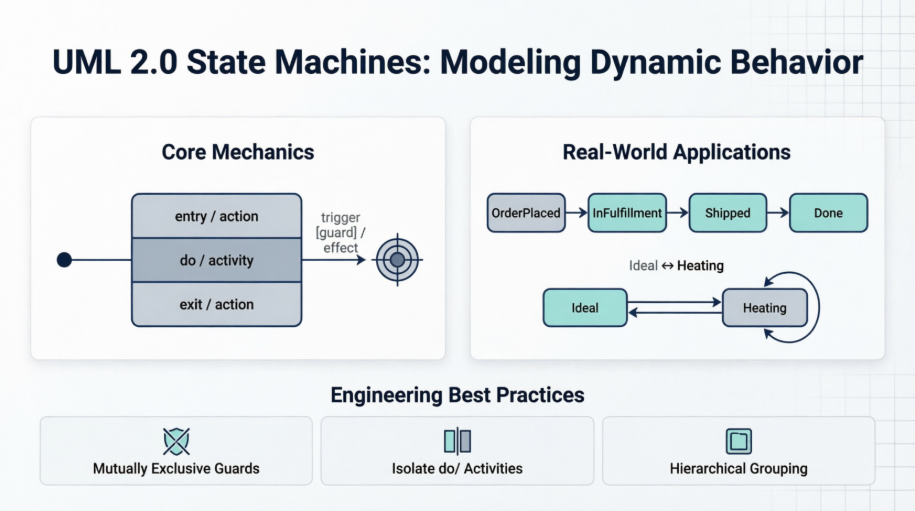
1. Foundational Mechanics of State Machines
1.1 States and Lifecycle Boundaries
A state represents a distinct condition in an object’s lifecycle where it satisfies specific invariants, performs ongoing work, or waits for stimuli. State transitions are triggered by discrete events, causing the object to cross boundaries from one configuration to another.
Every valid state machine is anchored by two critical boundary nodes:
-
Initial Pseudostate: Denoted by a solid black circle. It serves as the singular entry point, defining where execution begins.
-
Final State: Represented as a bullseye (solid circle within a ring). It marks the terminal point of the lifecycle, indicating that the object has completed its purpose and will no longer process events.
1.2 Internal Behavior Compartments
States are not merely passive containers; they can host internal behaviors that execute at precise moments in the lifecycle:
-
entry /: Fires instantly upon crossing into the state. Used for initialization, flag updates, or resource allocation. -
exit /: Executes immediately before leaving the state. Typically handles cleanup, logging, or resource release. -
do /: Represents a continuous, interruptible activity that runs for the entire duration the object resides in the state. Unlikeentry/exit,doactivities can be paused or preempted by incoming events.
1.3 Transition Anatomy & Topology
Transitions are directed relationships governed by a strict syntax:
trigger [guard] / effect
| Component | Purpose |
|---|---|
| Trigger | The event that activates the transition (e.g., method call, signal, time expiration). |
| Guard | A boolean expression in [brackets]. The transition only proceeds if the expression evaluates to true. |
| Effect | An atomic action following the / that executes during the transition path, after exiting the source but before entering the target. |
Transition Topologies:
-
External: Crosses state boundaries. Fires both
exitandentrybehaviors. -
Internal: Handles an event while remaining within the same state. Preserves the active
doactivity and skipsexit/entryexecutions.
2. Applied Case Study: Modeling Dynamic Systems
To demonstrate how these mechanics translate into production-ready models, we examine two interconnected subsystems within a modern distributed architecture: an e-commerce order processor and an IoT environmental controller.
2.1 Scenario A: E-Commerce Order Fulfillment Lifecycle
The Order entity must navigate a strict progression from creation to fulfillment, with conditional branching for cancellations and strict logging at each phase. Internal entry/exit actions ensure audit trails and warehouse notifications are decoupled from the core state transitions.
@startuml

title Online Order Lifecycle (States & Transitions)

' 1. State Machine Entry
[*] --> OrderPlaced : checkoutCompleted

' 2. State Box Declarations with Internal Behaviors
state OrderPlaced {
entry : logOrderCreation()
exit : notifyWarehouse()
}

state InFulfillment {
entry : assignPicker()
do : assemblePackageContents()
}

state Shipped {
entry : generateTrackingNumber()
}

state Cancelled {
entry : initiateRefund()
}

' 3. Transition Routing Matrix with Guards and Effects
OrderPlaced --> InFulfillment : paymentVerified / authorizeLogistics()

InFulfillment --> Shipped : packageScanned [StockConfirmed] / emailCustomer()

' Alternative Error Route using a Guard and clear downward routing layout
OrderPlaced -down-> Cancelled : cancelRequested [Within24Hours]

Shipped --> [*] : deliveryConfirmed

@endumlCase Study Analysis:
-
Lifecycle Boundaries: The diagram begins at
[*]and terminates at[*]only afterdeliveryConfirmed, enforcing a clear success path. -
Internal Behaviors:
logOrderCreation()andnotifyWarehouse()are isolated toentry/exit, ensuring they fire deterministically regardless of which transition activates the state. -
Guarded Routing: The transition from
InFulfillmenttoShippedrequires[StockConfirmed], preventing premature shipping when inventory checks fail. The[Within24Hours]guard on the cancellation path ensures refunds are only triggered within a strict policy window.
2.2 Scenario B: IoT Environmental Controller
Hardware controllers require continuous background operations (do activities) but must also handle high-frequency sensor updates without disrupting critical thermal management routines. Internal transitions provide the necessary efficiency.
@startuml
skinparam style strictuml

title Smart Thermostat - Environmental Controller

[*] --> Idle

state Idle {
entry / displayCurrentTemp()
}

state Heating {
entry / openGasValve()
' Continuous processing activity
do / runFurnaceFans()
exit / closeGasValve()

' Internal Transition: Handles an event without firing entry/exit logic
Heating : tempCalibrated / recalculateBurnRate()
}

' External Transitions causing state entry/exit disruptions
Idle --> Heating : tempDropped [TargetTemp > CurrentTemp]

Heating --> Idle : tempReached [CurrentTemp >= TargetTemp] / triggerAlertBeep()

@endumlCase Study Analysis:
-
Continuous Operations:
do / runFurnaceFans()runs indefinitely while inHeating, modeling a physical process that persists until interrupted. -
Internal Transition Efficiency: The
tempCalibrated / recalculateBurnRate()event is handled internally. The thermostat recalculates its burn rate without closing the gas valve (exit) or reopening it (entry), preventing dangerous hardware thrashing. -
Guarded State Switching: The
[TargetTemp > CurrentTemp]and[CurrentTemp >= TargetTemp]guards ensure the system only toggles betweenIdleandHeatingwhen thermodynamic thresholds are legitimately crossed.
3. Engineering Best Practices
Designing robust state machines requires discipline. The following guidelines prevent common modeling pitfalls and improve system predictability:
1. Enforce Mutually Exclusive Guards
When multiple transitions share the same trigger from a single state, their guard conditions must be strictly non-overlapping. Overlapping guards introduce non-determinism, leaving the execution engine to arbitrarily choose a path. Example: [inventory > 0] vs. [inventory == 0] guarantees a single valid route.
2. Isolate do Activities from Instantaneous Actions
entry and exit behaviors must execute atomically and without interruption. Reserve them for state initialization, flag updates, or synchronous cleanup. Long-running processes, event listeners, or polling loops belong exclusively in do / compartments, where they can be safely interrupted or preempted by higher-priority triggers.
3. Avoid Transition “Spaghetti” Through Hierarchical Grouping
A dense web of cross-cutting transitions indicates an improperly scoped boundary. If multiple states share identical error or cancellation paths, encapsulate them within a Composite State. This reduces visual clutter, enforces modular design, and makes the primary execution path immediately recognizable.
4. Optimize Diagram Layout & Syntax Clarity
-
Strict Syntax Adherence: Always format transitions as
trigger [guard] / effect. Omit unused components cleanly rather than leaving dangling slashes or empty brackets. -
Directional Flow Control: Use layout directives (e.g.,
-right->,-down->) to guide the primary “happy path” vertically or horizontally, routing exceptions and error states to the periphery. -
Concise Guard Expressions: Keep boolean conditions short and domain-specific. Replace verbose natural language with precise identifiers (e.g.,
[HasValidToken]instead of[If the authentication service confirms the session is active and authorized]).
Conclusion
State Machine Diagrams are not merely documentation artifacts; they are executable blueprints for dynamic system behavior. By rigorously defining states, internal behaviors, and transition rules, engineers can eliminate runtime ambiguity, enforce business constraints at the modeling layer, and create systems that respond predictably under complex event streams.
The case studies presented demonstrate how UML 2.0 state machines scale from high-level business workflows to low-level hardware control loops. When paired with disciplined guard design, proper behavioral compartmentalization, and clean visual architecture, state modeling becomes a powerful tool for bridging the gap between abstract requirements and deterministic implementation. Mastering these mechanics ensures that every object in your system knows exactly what it is doing, why it is doing it, and precisely where it should go next.
This post is also available in Deutsche, Español, فارسی, Français, English, Bahasa Indonesia, 日本語, Polski, Portuguese, Ру́сский, Việt Nam, 简体中文 and 繁體中文.
Related posts:
 Beyond Imports: A Practical Case Study on UML 2.0 Package Merge for Layered & Extensible Architectures
 Beyond Pretty Pictures: A Modern Guide to Analysis and Design with AI, Diagram-as-Code, and Visual Paradigm
 A Comprehensive Guide to the Object Constraint Language (OCL)
A Comprehensive Guide to Using OCL in UML with PlantUML Examples
A Comprehensive Guide to the Object Constraint Language (OCL)
A Comprehensive Guide to Using OCL in UML with PlantUML Examples
