




Orchestrating Complexity: Sequential vs. Concurrent Substates in State Machine Modeling Introduction
Introduction
As modern software systems grow in scale and functionality, flat state diagrams quickly become unwieldy. Real-world applications rarely operate in a simple linear fashion; instead, they manage interdependent workflows, background processes, and user-driven interactions that demand precise orchestration. To tackle this complexity, state machine modeling introduces composite states, which encapsulate internal behaviors within a single parent state. The architectural decision of how to structure these internal behaviors hinges on two fundamental paradigms: Sequential (Or) Substates and Concurrent (And) Substates.
Choosing between these paradigms is not merely a diagramming preference; it directly influences system architecture, concurrency handling, error recovery, and maintainability. This case study explores the practical application of both approaches within a modern e-commerce order lifecycle, demonstrating how sequential and concurrent substates can be leveraged to build resilient, scalable, and logically sound state machines.
Foundational Concepts
Before diving into the case study, it is essential to establish the theoretical distinction between the two substate architectures.
Sequential Substates (Or-States)
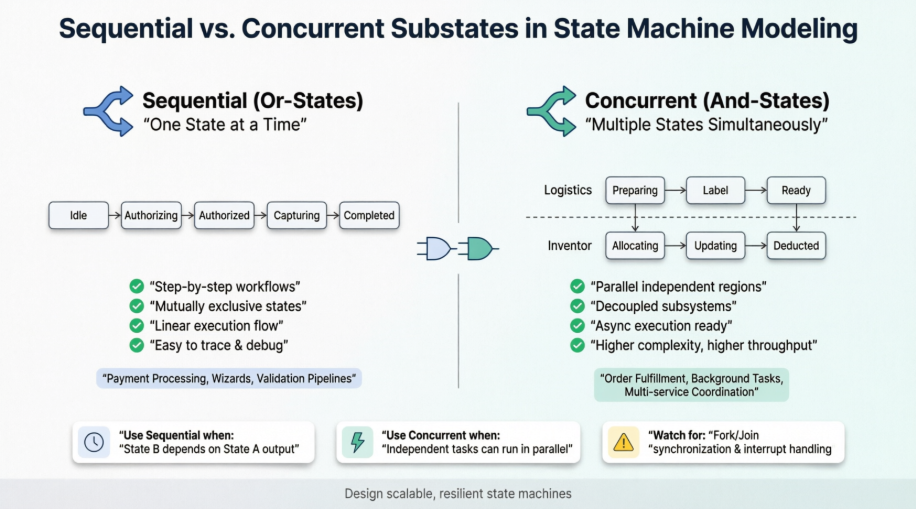
In a sequential configuration, a composite state can only occupy one substate at a time. Transitions follow a predetermined, linear path where each state must complete before the next begins.
-
Logical Condition: State A OR State B.
-
Best Used For: Step-by-step workflows, wizards, validation pipelines, and mutually exclusive operational modes.
Concurrent Substates (And-States)
In a concurrent configuration, a composite state is divided into multiple independent regions. When the parent state becomes active, all regions are activated simultaneously, each maintaining its own independent lifecycle and state transitions.
-
Logical Condition: Region 1 (State A) AND Region 2 (State X).
-
Best Used For: Parallel process execution, background monitoring alongside UI interaction, and decoupled subsystem coordination.
Structural Comparison
| Feature | Sequential Substates | Concurrent Substates |
|---|---|---|
| Active States | Exactly one substate is active at any given moment. | One substate in every parallel region is active simultaneously. |
| Internal Variables | Shared context, modified sequentially. | Often independent; modifications must be thread-safe or event-driven. |
| Complexity | Low to medium; easy to trace linearly. | Higher; requires tracking synchronization and potential race conditions. |
| Exit Condition | Reaching a final state inside, or an explicit outer transition. | Usually requires all regions to reach their final states (join), or an outer interrupt. |
Case Study: E-Commerce Order Lifecycle
To illustrate these concepts in practice, we will model two critical phases of an e-commerce platform’s order processing pipeline: Payment Processing and Order Fulfillment. Each phase demonstrates why a specific substate architecture is the optimal choice.
Phase 1: Sequential Substates in Payment Processing
Payment processing is inherently linear and state-dependent. Authorization must precede fraud validation, which must precede fund capture. Skipping steps or executing them in parallel would violate financial compliance and risk transaction integrity. Therefore, a sequential (Or) configuration is mandatory.
@startuml
skinparam architecture {
    BackgroundColor White
    ArrowColor #222222
    BorderColor #222222
}

title Sequential Substates - Payment Processing

state PaymentProcessing {
    [*] --> Idle
    Idle --> Authorizing : User submits payment
    Authorizing --> Authorized : Card validation success
    Authorized --> Capturing : Trigger settlement
    Capturing --> Completed : Funds secured

    state Authorizing : entry/ Check fraud metrics
    state Capturing : entry/ Transfer funds from escrow
}

Completed --> [*]
@endum
Architectural Takeaway: The sequential model enforces strict ordering. Entry/exit actions (e.g., fraud checks, escrow transfers) are triggered predictably, making debugging, audit logging, and rollback strategies straightforward.
Phase 2: Concurrent Substates in Order Fulfillment
Once payment is secured, the system must prepare the order for shipment. However, logistics preparation and inventory management operate on different data stores, involve different teams/services, and do not depend on each other’s completion to proceed. Modeling them sequentially would create artificial bottlenecks. A concurrent (And) configuration allows both workflows to execute in parallel, dramatically reducing overall order processing time.
@startuml
title Concurrent Substates - Order Fulfillment

state OrderFulfillment {

    ' Logistics Region
    [*] --> PreparingPackage
    note on link: **Logistics Region**
    PreparingPackage --> GeneratingShippingLabel : Items boxed
    GeneratingShippingLabel --> PackageReady : Label printed

    --

    ' Inventory Region
    [*] --> AllocatingStock
    note on link: **Inventory Region**
    AllocatingStock --> UpdatingERP : Stock verified
    UpdatingERP --> InventoryDeducted : ERP sync complete
}

OrderFulfillment --> Shipping : Both regions complete (Join)
@endum
Architectural Takeaway: The concurrent model reflects real-world parallelism. Each region operates independently, allowing the logistics service to print labels while the inventory service synchronizes with the ERP. The parent state only transitions to Shipping once both regions naturally complete, acting as an implicit synchronization barrier.
Architectural Considerations & Best Practices
Selecting between sequential and concurrent substates extends beyond diagramming; it dictates runtime behavior and infrastructure requirements.
When to Prioritize Sequential Design
-
State-Dependent Rules: If Substate B relies on data, tokens, or side effects produced exclusively by Substate A, sequential modeling guarantees deterministic execution.
-
Regulated Workflows: Compliance-driven processes (e.g., KYC verification, payment gateways, multi-factor authentication) require auditable, step-by-step progression.
-
User-Guided Interfaces: Multi-step wizards or configuration flows where users cannot bypass validation checkpoints.
When to Prioritize Concurrent Design
-
Decoupled Subsystems: Ideal for architectures where independent services handle distinct domains (e.g., hardware sensor polling running parallel to UI rendering).
-
Performance Optimization: Concurrent substates explicitly identify opportunities for asynchronous execution, worker queues, or microservice parallelization.
-
Continuous Monitoring: Background processes that run indefinitely (e.g., health checks, logging, telemetry) alongside primary business logic.
Navigating Synchronization Pitfalls (Forks & Joins)
Concurrent substates introduce specific lifecycle challenges that architects must anticipate:
-
Implicit Fork on Entry: Entering the parent state automatically splits execution flow across all regions. Initialization logic must be carefully scoped to avoid conflicting state setups.
-
Join on Exit: Graceful exit typically requires all regions to reach a final state. If regions complete at different times, the system must track completion status without blocking indefinitely.
-
Interrupt Handling: Outer transitions that force an exit from a concurrent state will abruptly terminate all parallel regions, regardless of their progress. Architects must implement compensating transactions, cleanup hooks, or idempotent operations to prevent data corruption when premature exits occur.
Conclusion
State machine modeling provides a powerful abstraction for managing system complexity, but its effectiveness hinges on correctly structuring composite states. Sequential substates excel at enforcing deterministic, stepwise progression, making them indispensable for compliance-heavy, state-dependent workflows. Concurrent substates, by contrast, unlock true parallelism, enabling independent subsystems to operate simultaneously without artificial bottlenecks.
The e-commerce case study demonstrates that neither approach is universally superior; rather, they are complementary tools in an architect’s toolkit. By carefully mapping business requirements to the appropriate substate architecture, teams can build systems that are not only functionally correct but also performant, maintainable, and resilient to failure. As modern applications continue to embrace asynchronous, event-driven, and distributed architectures, mastering the distinction between Or-states and And-states will remain a foundational skill for designing robust, scalable software systems.
This post is also available in Deutsche, Español, فارسی, Français, English, Bahasa Indonesia, 日本語, Polski, Portuguese, Ру́сский, Việt Nam, 简体中文 and 繁體中文.
Related posts:
 Orchestrating Complex Control Flow: A Comprehensive Case Study on UML 2.0 Interaction Fragments
 Modeling Dynamic Behavior: A Comprehensive Case Study in UML 2.0 State Machines
 Structuring System Behavior: A Practical Guide to UML Use Case Relationships
 From Stories to Systems: Mastering Use-Case 2.0 for Agile and AI-Driven Development
