




Architecting with Clarity: A Comprehensive Case Study on UML Building Blocks
Introduction
Modern software systems are inherently complex, composed of hundreds of interacting components, concurrent processes, and intricate data flows. Bridging the gap between abstract business requirements and concrete technical implementation requires a standardized, unambiguous medium of communication. The Unified Modeling Language (UML) serves as that universal blueprint, providing a visual vocabulary that developers, architects, and stakeholders can share across disciplines.
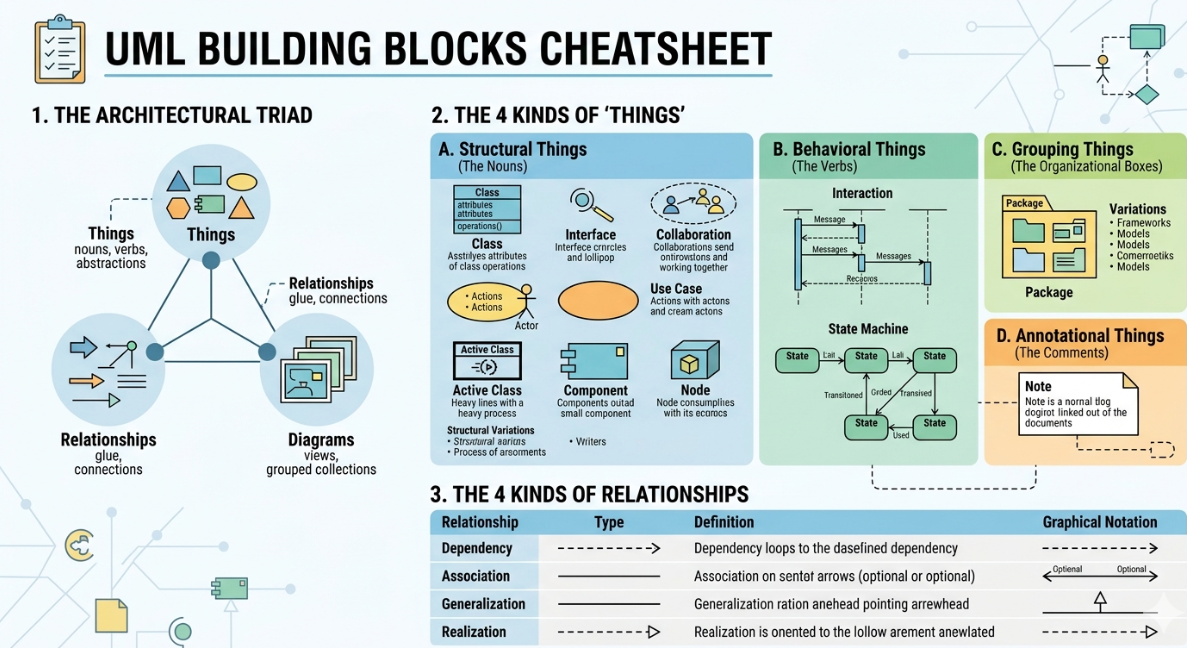
While theoretical knowledge of UML syntax is valuable, true mastery emerges when these concepts are applied to a cohesive, real-world scenario. This case study demonstrates how the three foundational building blocks of UML—Things, Relationships, and Diagrams—interlock to model a complete software architecture. By applying each UML element to the design of a modern e-commerce platform, we will translate abstract modeling principles into actionable, production-ready visual artifacts.
Case Study Context: The “ShopSphere” E-Commerce Platform
ShopSphere is a scalable, cloud-native online marketplace that connects buyers, third-party sellers, and administrative staff. The system must handle user authentication, product catalog management, shopping cart operations, secure payment processing, order fulfillment, and real-time inventory tracking. To ensure maintainability and clear team communication, the architecture team has adopted UML as their primary modeling standard.
Part 1: Modeling with UML “Things”
Things are the first-class citizens of any UML model. They represent the static nouns, dynamic verbs, organizational containers, and explanatory comments that form the foundation of the ShopSphere architecture.
1. Structural Things (The Static Nouns)
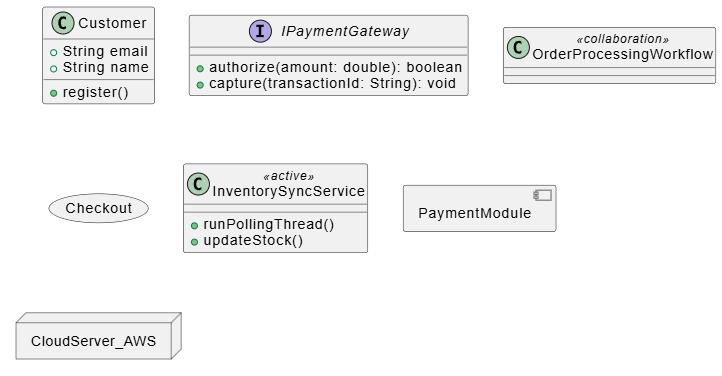
Structural things define the physical and conceptual elements that persist within the system.
@startuml
' Enables mixing of classes, use cases, and components
allowmixing
' Structural Things Example
class Customer {
  +String email
  +String name
  +register()
}
interface IPaymentGateway {
  +authorize(amount: double): boolean
  +capture(transactionId: String): void
}
class OrderProcessingWorkflow <collaboration>
usecase "Checkout" as UC_Checkout
class InventorySyncService <active> {
  +runPollingThread()
  +updateStock()
}
component PaymentModule
node CloudServer_AWS
@enduml-
Classes (
Customer): Define object blueprints with attributes and operations. -
Interfaces (
IPaymentGateway): Specify contracts without implementation details. -
Collaborations (
[OrderProcessingWorkflow]): Model cooperative roles working toward a shared goal. -
Use Cases (
Checkout): Capture externally visible system behaviors. -
Active Classes (
[InventorySyncService]): Represent concurrent processes or threads. -
Components (
[PaymentModule]): Deployable, replaceable physical modules. -
Nodes (
[CloudServer_AWS]): Runtime computational resources.
2. Behavioral Things (The Dynamic Verbs)
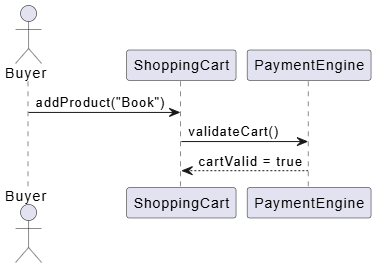
Behavioral things capture how the system evolves over time and responds to stimuli.
@startuml
' Interaction (Message Exchange)
actor Buyer
participant ShoppingCart
participant PaymentEngine
Buyer -> ShoppingCart : addProduct("Book")
ShoppingCart -> PaymentEngine : validateCart()
PaymentEngine --> ShoppingCart : cartValid = true
@enduml-
Interactions: Sequences of messages (
validateCart(),cartValid = true) exchanged between objects. -
State Machines: Lifecycle transitions (
Pending→Processing→Shipped/Cancelled) triggered by events.
3. Grouping Things (The Organizational Containers)
Grouping things decompose complex models into manageable namespaces.

@startuml
' Allows mixing classes and components on the same canvas
allowmixing
package "CoreCommerce" {
  class Order
  class Invoice
}
package "UserManagement" {
  class Customer
  class AdminUser
}
package "ExternalIntegrations" {
  component [StripeConnector]
  component [FedExAPI]
}
@enduml-
Packages: Purely conceptual containers that organize related elements during development.
4. Annotational Things (The Explanatory Comments)
Annotational things provide clarity, constraints, and developer guidance.

@startuml
class Order {
  +Double totalAmount
  +String status
}
note right of Order
  Business Rule: totalAmount must include
  tax and shipping before status transitions
  to 'Processing'.
end note
@enduml-
Notes: Dog-eared text blocks attached to elements for constraints, remarks, or documentation.
Part 2: Connecting Elements with UML Relationships
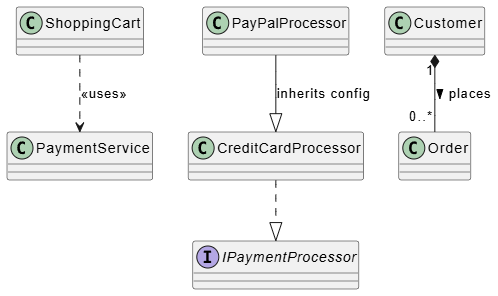
Relationships define the semantic and structural dependencies that bind things together. ShopSphere’s architecture relies on four primary relational building blocks:
@startuml
' Relationship Types in ShopSphere
class ShoppingCart
class PaymentService
interface IPaymentProcessor
class CreditCardProcessor
class PayPalProcessor

' 1. Dependency (Dashed line)
ShoppingCart ..> PaymentService : <<uses>>

' 2. Association & Aggregation (Solid line with diamond)
Customer "1" *-- "0..*" Order : places >

' 3. Realization (Dashed + hollow arrow)
CreditCardProcessor ..|> IPaymentProcessor

' 4. Generalization (Solid + hollow arrow)
PayPalProcessor --|> CreditCardProcessor : inherits config
@enduml
-
Dependency: A change in
PaymentServicemay impactShoppingCart. -
Association/Aggregation:
Customermaintains a structural “whole/part” link withOrder. -
Realization:
CreditCardProcessorguarantees the contract specified byIPaymentProcessor. -
Generalization:
PayPalProcessorspecializesCreditCardProcessor, inheriting its structure and behavior.
Part 3: Visualizing Architecture with UML Diagrams
Diagrams are graphical projections that group things and relationships into stakeholder-specific views. Below are the complete diagram implementations for ShopSphere, categorized by structural and behavioral perspectives.
Structural Diagrams
Capture the static architecture and physical deployment.
Class Diagram
Shows system classes, interfaces, and their static relationships.
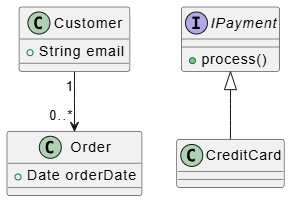
@startuml
class Customer {
  +String email
}

class Order {
  +Date orderDate
}

interface IPayment {
  +process()
}

class CreditCard
CreditCard ..|> IPayment

Customer "1" --> "0..*" Order
@enduml
Object Diagram
Represents a snapshot of instantiated objects at runtime.
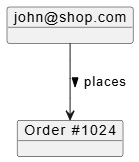
@startuml
object "[email protected]" as c1
object "Order #1024" as o1
c1 --> o1 : places >
@enduml
Component Diagram
Illustrates modular dependencies and interfaces.
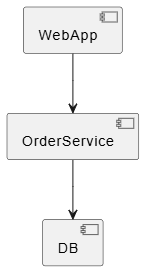
@startuml
component [WebApp]
component [OrderService]
component [DB]
[WebApp] --> [OrderService]
[OrderService] --> [DB]
@enduml
Deployment Diagram
Maps software components to physical runtime nodes.
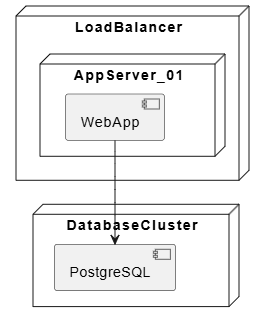
@startuml
node "LoadBalancer" {
  node "AppServer_01" {
    component [WebApp]
  }
}
node "DatabaseCluster" {
  component [PostgreSQL]
}
[WebApp] --> [PostgreSQL]
@enduml
Behavioral Diagrams
Capture dynamic workflows, interactions, and control flow.
Use Case Diagram
Maps actors to system functionalities.
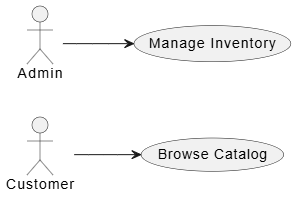
@startuml
left to right direction
actor Customer
actor Admin
usecase "Browse Catalog" as UC1
usecase "Manage Inventory" as UC2
Customer --> UC1
Admin --> UC2
@enduml
Sequence Diagram
Emphasizes time-ordered message exchanges.
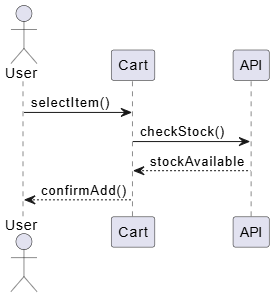
@startuml
actor User
participant Cart
participant API
User -> Cart : selectItem()
Cart -> API : checkStock()
API --> Cart : stockAvailable
Cart --> User : confirmAdd()
@enduml
Communication Diagram
Focuses on structural organization of message-passing objects.

@startuml
object User
object Cart
object API
User -> Cart : 1: selectItem()
Cart -> API : 2: checkStock()
API --> Cart : 3: returnResult()
@enduml
Statechart Diagram
Displays reactive state transitions.
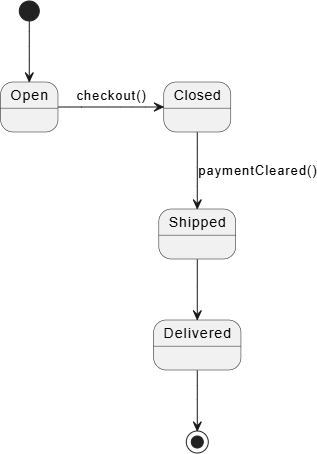
@startuml
[*] --> Open
Open -> Closed : checkout()
Closed --> Shipped : paymentCleared()
Shipped --> Delivered
Delivered --> [*]
@enduml
Activity Diagram
Highlights sequential and concurrent control flows.
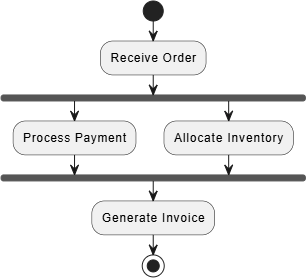
@startuml
start
:Receive Order;
fork
  :Process Payment;
fork again
  :Allocate Inventory;
end fork
:Generate Invoice;
stop
@enduml
Conclusion
The Unified Modeling Language is far more than a collection of diagrams and syntax rules; it is a disciplined framework for thinking about system complexity. By decomposing ShopSphere into Things, we established a precise vocabulary for static structures, dynamic behaviors, organizational boundaries, and documentation. Through Relationships, we mapped the semantic dependencies that dictate how these elements interact, inherit, and realize contracts. Finally, by projecting these elements into targeted Diagrams, we created tailored visualizations that serve distinct stakeholder needs—from high-level use cases for product managers to detailed deployment maps for DevOps engineers.
Mastering UML is an iterative process. As systems evolve, models must remain living artifacts that guide development, facilitate onboarding, and prevent architectural drift. By grounding abstract UML concepts in concrete case studies and leveraging modern modeling tools like PlantUML, development teams can transform ambiguity into clarity, ensuring that software architectures are as robust, scalable, and well-documented as the code that brings them to life.
This post is also available in Deutsche, Español, فارسی, Français, English, Bahasa Indonesia, 日本語, Polski, Portuguese, Ру́сский, Việt Nam, 简体中文 and 繁體中文.
