




Structuring Complexity: A Real-World Implementation of UML Package Architecture
Introduction
As software systems scale in scope and team size, architectural models inevitably grow unwieldy. Diagrams become cluttered, naming collisions multiply, and cross-module dependencies spiral into unmanageable tangles. Without a disciplined grouping mechanism, even the most experienced engineering teams struggle to maintain clear boundaries, enforce encapsulation, or onboard new contributors efficiently.
UML 2.0 packages provide the foundational remedy to this challenge. Far more than simple visual folders, packages serve as logical containers that govern namespace management, visibility rules, and structural hierarchy. This case study examines how a mid-to-large-scale enterprise platform leveraged UML 2.0 package mechanics to transform a fragmented, tightly coupled model into a cohesive, maintainable architectural blueprint. By applying core package concepts, relationship mappings, and automated diagramming practices, the team established a scalable design framework that aligned perfectly with modern modular development workflows.
Case Study Context: The Challenge of Unbounded Complexity
Organization: OmniRetail Systems
Project: Next-Generation Supply Chain & Catalog Platform
Initial State:
The platform’s architectural model had evolved organically over three years. It contained over 400 classes, dozens of use cases, and multiple interlinked diagrams scattered across different repositories. Key pain points included:
-
Uncontrolled visibility across subsystems, leading to accidental API exposure
-
Frequent naming collisions when integrating third-party registries with internal ledgers
-
Bidirectional dependencies that created architectural coupling and hindered independent deployment
-
Inconsistent diagram notation that made cross-team reviews error-prone and time-consuming
Objective:
Restructure the system model using UML 2.0 package principles to enforce clear boundaries, manage visibility explicitly, resolve namespace conflicts, and establish a repeatable, diagram-as-code workflow for architectural documentation.
Phase 1: Establishing Structural Boundaries
The architecture team began by applying the Exclusive Ownership Rule: every model element was assigned to exactly one package. This eliminated ambiguous references and clarified accountability. They recognized that a model itself is simply a top-level package, acting as the root container for all subordinate sub-packages.
Crucially, the team treated packages as conceptual boundaries rather than physical deployment units. While packages influenced module boundaries and build configurations, they did not enforce strict one-to-one mappings with compiled artifacts. This flexibility allowed logical groupings to evolve independently of runtime infrastructure.
To manage diagram complexity, the team standardized on three UML 2.0 visual notations:
-
Members Hidden: Used for high-level architecture reviews. The package name appeared centered in the folder body, suppressing internal details to reduce cognitive load.
-
Members Shown Internally: Deployed during subsystem design sessions. The package name sat in the upper tab, with contained elements listed inside the folder.
-
Members Shown Externally: Reserved for dependency analysis. Elements were drawn outside the folder, connected via solid lines within a bounding box to highlight cross-package interactions.
Phase 2: Controlling Visibility & Managing Dependencies
With structural containers in place, the team enforced strict access controls using UML visibility markers:
-
Public (
+): Applied to elements intentionally exposed for cross-package interaction. -
Private (
-): Restricted to internal package use, shielding implementation details from external consumers.
To manage cross-package communication, the team replaced ad-hoc references with explicit, stereotyped dependencies:
Element Import vs. Element Access
When the Web Application Engine required catalog data, the team used a «import» (Public Import) relationship. This pulled public elements like +Book and +Author into the web layer, automatically exposing them to downstream consumers. Conversely, security utilities were integrated via «access» (Private Access), allowing the web engine to use vault validation routines without re-exporting them to the public interface.
Package Import
Rather than importing individual elements one by one, the team utilized Package Import at the subsystem level. A single «import» dependency line between two package folders enabled the importing package to treat all public contents of the target package as locally declared, dramatically reducing diagram clutter.
Phase 3: Resolving Namespace Collisions & Extending Frameworks
During integration, the team encountered a classic namespace collision: both the Inventory Ledger and Publisher Registry contained a class named Book.
To maintain model integrity, they initially applied Aliasing, mapping the external Registry::Book to a local pseudonym (RegistryBook) within the ledger package. While functionally sound, the team recognized that excessive aliasing degrades diagram readability. Following architectural guidelines, they ultimately renamed the conflicting class outright, preserving long-term clarity over temporary convenience.
For framework extension, the team leveraged Package Merge («merge»). This allowed a base infrastructure package to absorb and extend a target package’s contents across multiple architectural layers. Instead of duplicating structural features, the merge directive streamlined inheritance-like behavior at the package level, reducing maintenance overhead and ensuring consistent baseline definitions.
Phase 4: Automating Documentation with PlantUML
To enforce consistency and enable version-controlled architectural diagrams, the team adopted PlantUML as their diagram-as-code standard. The following implementations were integrated directly into their CI/CD pipeline for automated model validation:
Scenario A: Structural Framework (Package Import, Access, and Visibility)
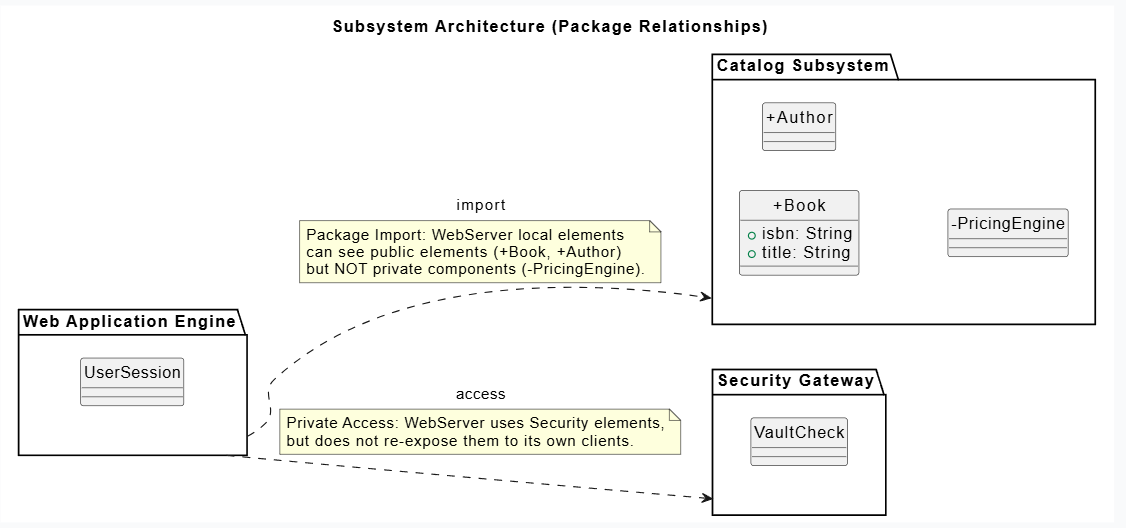
@startuml
skinparam style strictuml
left to right direction

title Subsystem Architecture (Package Relationships)

' 1. Package with internal members listed
package "Catalog Subsystem" as Catalog <<Folder>> {
  class "+Book" as Book {
    +isbn: String
    +title: String
  }
  class "+Author" as Author
  class "-PricingEngine" as PricingEngine
}

' 2. Package showcasing external contents using standard syntax
package "Web Application Engine" as WebServer <<Folder>> {
  class "UserSession" as UserSession
}

package "Security Gateway" as Security <<Folder>> {
  class "VaultCheck" as VaultCheck
}

' Relationship Mappings
WebServer ..> Catalog : «import»
note on link
  Package Import: WebServer local elements
  can see public elements (+Book, +Author)
  but NOT private components (-PricingEngine).
end note

WebServer ..> Security : «access»
note on link
  Private Access: WebServer uses Security elements,
  but does not re-expose them to its own clients.
end note

@enduml
Scenario B: Resolving Namespace Collisions (Element Import with Aliasing)
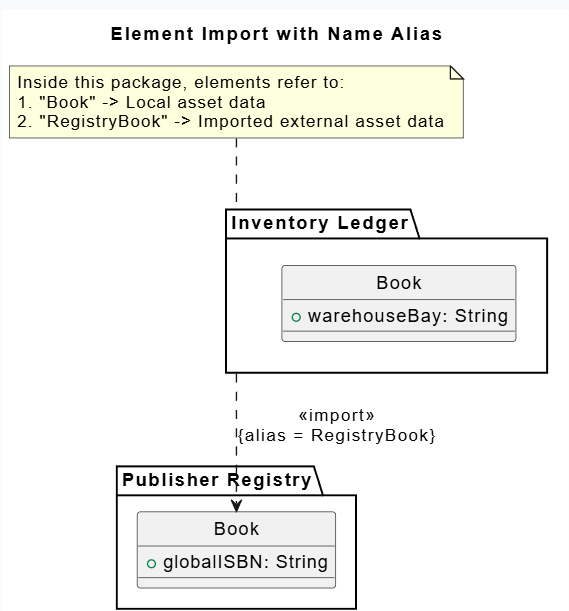
@startuml
skinparam style strictuml

title Element Import with Name Alias

package "Inventory Ledger" as Ledger <<Folder>> {
  class "Book" as LocalBook {
    +warehouseBay: String
  }
}

package "Publisher Registry" as Registry <<Folder>> {
  class "Book" as ExternalBook {
    +globalISBN: String
  }
}

' Individual Element Import using an Alias configuration
Ledger ..> ExternalBook : «import»\n{alias = RegistryBook}

note top of Ledger
  Inside this package, elements refer to:
  1. "Book" -> Local asset data
  2. "RegistryBook" -> Imported external asset data
end note

@enduml
Architectural Guidelines & Lessons Learned
Throughout the restructuring, four core principles emerged as critical to sustaining package architecture health:
-
Maintain Cohesive Groupings: Package names were kept short and semantically precise. Each package bundled elements sharing a tight conceptual domain (e.g., a specific use case bundle, a localized functional subsystem, or a bounded context).
-
Rename Over Aliasing: While
{alias = ...}resolves immediate collisions, it introduces cognitive overhead. The team established a policy: rename conflicting elements at the design phase rather than relying on aliases in production diagrams. -
Enforce Unidirectional Hierarchies: Cyclic dependencies (
Package A → Package B → Package A) were systematically eliminated. All«import»and«access»relationships flowed in a single architectural direction, preserving layer integrity and enabling independent deployment. -
Optimize PlantUML Layouts for Readability:
-
skinparam style strictumlensured strict UML compliance. -
Nested inline packages explicitly visualized containment boundaries.
-
Directional arrows (
-up->,-right->) enforced a clean top-to-bottom flow, positioning utility packages beneath high-level clients.
-
Conclusion
The implementation of UML 2.0 package mechanics transformed OmniRetail’s architectural model from a fragmented, tightly coupled monolith into a structured, maintainable blueprint. By treating packages as conceptual containers, enforcing strict visibility rules, and leveraging explicit relationship stereotypes, the team achieved clear namespace isolation, reduced accidental coupling, and streamlined cross-team collaboration.
More importantly, the shift to diagram-as-code with PlantUML institutionalized architectural governance, ensuring that package boundaries remain visible, versioned, and continuously validated. As systems continue to grow in complexity, disciplined package architecture will remain indispensable. It is not merely a diagramming convention; it is a foundational strategy for scaling design clarity, enabling modular development, and future-proofing enterprise software ecosystems.
This post is also available in Deutsche, Español, فارسی, Français, English, Bahasa Indonesia, 日本語, Polski, Portuguese, Ру́сский, Việt Nam, 简体中文 and 繁體中文.
Related posts:
 Architecting Clarity: A Practical Case Study in UML 2.0 Package Design
 Beyond Pretty Pictures: A Modern Guide to Analysis and Design with AI, Diagram-as-Code, and Visual Paradigm
 A Comprehensive Guide to the Object Constraint Language (OCL)
A Comprehensive Guide to Using OCL in UML with PlantUML Examples
A Comprehensive Guide to the Object Constraint Language (OCL)
A Comprehensive Guide to Using OCL in UML with PlantUML Examples
