




Beyond Imports: A Practical Case Study on UML 2.0 Package Merge for Layered & Extensible Architectures
📖Introduction
In modern software architecture, the tension between core stability and contextual flexibility is constant. Organizations routinely struggle with how to extend foundational domain models for specific technological, regulatory, or client-specific requirements without violating separation of concerns, introducing duplication, or fracturing the Open/Closed Principle. Traditional UML mechanisms like «import» or «access» solve namespace visibility but fall short when structural fusion is required. They leave developers manually composing fragmented models, duplicating attributes, or tightly coupling infrastructure to business logic.
Enter the UML 2.0 Package Merge («merge»). Often misunderstood or underutilized, this specification-grade relationship provides a deterministic, model-driven mechanism to incrementally extend, specialize, and layer package contents without mutating the source definitions. This case study explores how a mid-scale enterprise architecture team leveraged Package Merge to design a highly modular, product-line-ready payment processing platform. By dissecting their implementation, we will see how Package Merge transforms abstract UML theory into a practical blueprint for enterprise-grade model management, framework extensibility, and clean architectural boundaries.
🏢 Case Study: AuroraPay’s Multi-Channel Payment Platform
1. Background & Architectural Challenge
AuroraPay, a fintech solutions provider, was tasked with building a next-generation payment processing platform. The system needed to support:
-
A pure, technology-agnostic business domain (
User,Transaction,Ledger) -
Three distinct deployment contexts: Cloud SaaS, On-Premise Banking Integration, and Mobile SDK
-
Strict regulatory compliance (PCI-DSS, GDPR) requiring contextual data masking, audit trails, and region-specific persistence strategies
The Problem:
Initially, the architecture team used «import» to pull the core domain into each context package. This led to:
-
Structural fragmentation: Each context package had to redeclare domain classes just to add persistence IDs, encryption flags, or audit timestamps.
-
Synchronization debt: When the domain model evolved, context packages required manual, error-prone updates.
-
Violation of clean architecture: Infrastructure concerns bled into domain definitions, making unit testing and regulatory audits cumbersome.
2. The Package Merge Solution
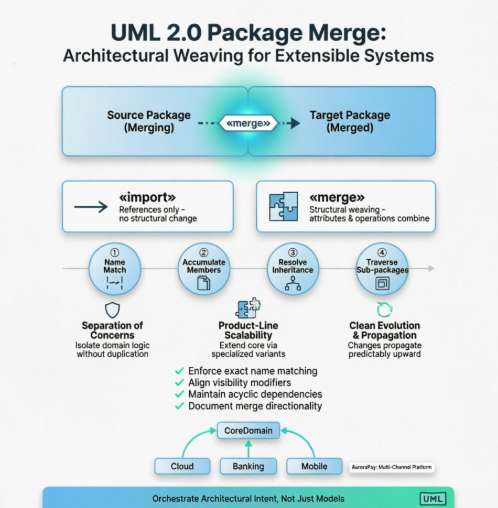
The architecture team pivoted to UML 2.0 Package Merge. They restructured the model into a directional, layered topology:
-
Target Package (
CoreDomain): Remained pristine. Defined only business concepts, validations, and domain behavior. -
Source Packages (
CloudPersistence,BankingCompliance,MobileSDK): Each initiated a«merge»relationship withCoreDomain. They declared matching class names and injected context-specific attributes, operations, and sub-packages.
This approach turned Package Merge into an architectural weaving mechanism, allowing each layer to absorb and specialize the baseline model implicitly.
3. Modeling the Architecture (PlantUML Representation)
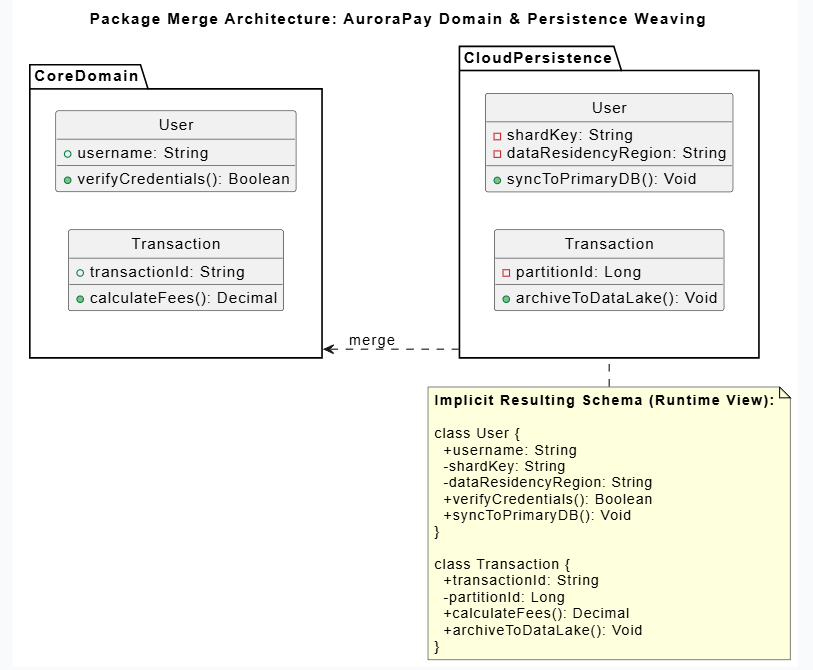
The team documented the foundational merge relationship as follows:
@startuml
skinparam style strictuml
left to right direction

title Package Merge Architecture: AuroraPay Domain & Persistence Weaving

' 1. Foundational Target Package (Infrastructure-agnostic)
package "CoreDomain" as Core <<Folder>> {
  class "User" as CoreUser {
    +username: String
    +verifyCredentials(): Boolean
  }

  class "Transaction" as CoreTxn {
    +transactionId: String
    +calculateFees(): Decimal
  }
}

' 2. Specialized Source Package (Initiates merge & injects context)
package "CloudPersistence" as Cloud <<Folder>> {
  class "User" as CloudUser {
    -shardKey: String
    -dataResidencyRegion: String
    +syncToPrimaryDB(): Void
  }

  class "Transaction" as CloudTxn {
    -partitionId: Long
    +archiveToDataLake(): Void
  }
}

' Directional Merge Dependency
Cloud .up.> Core : «merge»

note top of Cloud
  **Implicit Resulting Schema (Runtime View):**

  class User {
    +username: String
    -shardKey: String
    -dataResidencyRegion: String
    +verifyCredentials(): Boolean
    +syncToPrimaryDB(): Void
  }

  class Transaction {
    +transactionId: String
    -partitionId: Long
    +calculateFees(): Decimal
    +archiveToDataLake(): Void
  }
end note

@enduml
4. How the Mechanics Played Out in Practice
During model validation and code-generation phases, the UML execution engine applied the deterministic resolution rules:
-
Name & Metaclass Matching:
UserinCloudPersistenceperfectly matchedUserinCoreDomain(bothClassstereotypes). Any typo likeUsersorUserEntitywould have triggered a namespace collision instead of a merge. -
Attribute & Operation Accumulation: The merged
Userclass seamlessly combinedusername+verifyCredentials()(from Core) withshardKey+syncToPrimaryDB()(from Cloud). No manual composition was required. -
Generalization Stabilization: Both packages defined
PremiumUsergeneralizingUser. The merge engine collapsed duplicate inheritance arrows into a single, unambiguous hierarchy during model compilation. -
Recursive Sub-package Traversal:
CoreDomaincontained aComplianceRulessub-package.CloudPersistencedeclared a matchingComplianceRulessub-package, which automatically merged cloud-specific audit policies without additional mapping.
5. Realized Benefits
| Architectural Goal | Outcome Achieved via «merge» |
|---|---|
| Separation of Concerns | Domain engineers maintained CoreDomain independently. Infrastructure teams worked in isolated source packages. |
| Product Line Scalability | Created BankingCompliance and MobileSDK packages by simply merging CoreDomain and injecting client-specific fields. Zero duplication. |
| Clean Evolution | Adding twoFactorEnabled to CoreDomain.User automatically propagated to all merged contexts during the next build. |
| Regulatory Clarity | Compliance auditors reviewed CoreDomain for business logic and CloudPersistence for data residency rules. Boundaries remained explicit. |
6. Navigating Limitations & Applied Best Practices
The team encountered real-world friction and implemented mitigations aligned with UML 2.0 guidelines:
-
🔧 Tool Support Variance: Their primary CASE tool flattened merged packages during code generation. Mitigation: They scripted a pre-build validation step that generated a merged documentation view using the
noteconvention, ensuring developers could inspect the implicit combined schema. -
🧠 Cognitive Overhead: Junior developers struggled to trace where specific attributes originated. Mitigation: Adopted strict naming conventions (
core_,cloud_,bank_prefixes in comments) and enforced architecture decision records (ADRs) documenting merge directionality. -
⚠️ Visibility Conflicts: A protected operation in
CoreDomainclashed with a public override attempt in a source package. Mitigation: Established a modeling policy: target packages expose domain contracts aspublicorprotected, while source packages only addprivatepersistence fields orpublicinfrastructure methods. -
🔄 Cyclic Dependency Risks: Early drafts accidentally created bidirectional merges between
CloudPersistenceandMobileSDK. Mitigation: Integrated a dependency graph linter in CI/CD that flagged any non-DAG (Directed Acyclic Graph) package relationships before model compilation.
📝Conclusion
The AuroraPay case study demonstrates that UML 2.0 Package Merge is far more than a theoretical modeling construct—it is a pragmatic architectural pattern for systems that demand incremental extensibility, strict layering, and product-line variability. By treating the merge as a directional, implicit weaving operation rather than a static import, teams can preserve the integrity of foundational domain models while safely injecting context-specific concerns.
However, its power demands discipline. Success hinges on strict naming conventions, acyclic dependency management, visibility alignment, and toolchain awareness. When applied judiciously, Package Merge bridges the gap between conceptual design and implementation reality, enabling architecture teams to scale frameworks without fracturing codebases. As model-driven engineering and multi-tenant platform architectures continue to dominate enterprise development, mastering Package Merge will remain a critical competency for architects seeking to design systems that are both resilient to change and elegant in structure.
In essence, Package Merge doesn’t just combine models; it orchestrates architectural intent.
This post is also available in Deutsche, Español, فارسی, Français, English, Bahasa Indonesia, 日本語, Polski, Portuguese, Ру́сский, Việt Nam, 简体中文 and 繁體中文.
