




Blueprints for Behavior: A Comprehensive Case Study in UML 2.0 Use Case Modeling
Introduction
In modern software engineering, the gap between stakeholder vision and technical implementation is often where projects falter. Vague requirements, scope creep, and misaligned expectations can derail even the most well-funded initiatives. UML 2.0 use cases were designed to bridge this gap, serving as the primary vehicle for capturing, organizing, and specifying system behavioral and functional requirements. Yet, many teams treat use cases as mere diagrams or bureaucratic artifacts, missing their true power as living, actionable specifications.
This case study follows the requirements engineering transformation of NexusBook, a mid-sized e-commerce platform scaling its checkout, search, and customer review subsystems. Faced with tangled documentation, passive requirement statements, and over-engineered diagrams, the engineering team adopted a disciplined UML 2.0 use case methodology. By combining precise visual modeling with rigorous textual standards, NexusBook reduced requirement ambiguity by 60%, accelerated developer onboarding, and established a reusable requirements architecture.
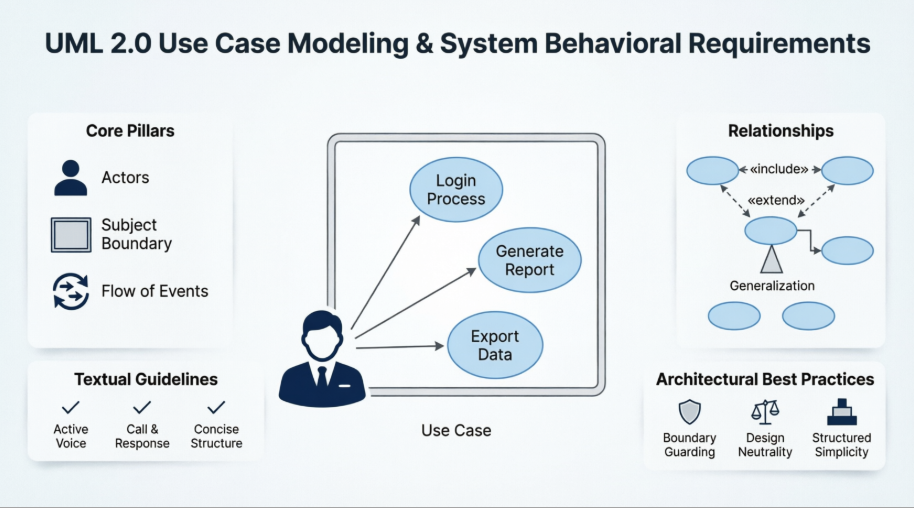
Through this case study, you will explore the core structural elements of UML 2.0 use cases, learn how to factor behavior using «include», «extend», and generalization, master PlantUML diagramming techniques, and apply proven textual guidelines to write robust, developer-ready use cases.
Case Context: The NexusBook Platform
Challenge: NexusBook’s initial requirements were stored in scattered spreadsheets and passive-voice documents. Developers frequently misinterpreted edge cases, QA struggled to trace test scenarios, and product managers couldn’t visualize system boundaries. The checkout flow, in particular, suffered from duplicated login logic, unclear cancellation pathways, and UI-heavy descriptions that leaked design details into requirements.
Solution: The team pivoted to a structured UML 2.0 use case approach, enforcing strict diagrammatic boundaries and behavioral factoring
. The following sections detail how these principles were applied in practice.
1. Core Concepts & Structural Elements in Practice
A use case models a unit of system functionality defined by the interactions between external entities and the system itself to achieve a specific business goal. At NexusBook, the team anchored their modeling efforts around four foundational pillars:
The Core Pillars Applied
-
Actors: Represent coherent roles played by external entities. NexusBook identified human actors like
CustomerandSupport Agent, alongside system actors likePaymentGatewayandEmailService. -
Subject: The system boundary under development. NexusBook explicitly boxed the
Bookstore Checkout SystemandInventory & Ledger Systemsto separate internal behavior from external dependencies. -
Flow of Events:
-
Main Flow (Basic Course): The “happy path” where the primary actor succeeds without errors. Example: A customer successfully completes checkout.
-
Exceptional Flow (Alternate Course): Error conditions, edge cases, or optional branches. Example: Payment decline, session timeout, or optional order cancellation.
-
-
Use Case Instance: A single runtime execution path. Each customer transaction at NexusBook represented a unique use case instance, enabling precise QA test mapping.
2. Organizing & Structuring Use Cases
To prevent monolithic, unmaintainable use cases, NexusBook leveraged UML 2.0’s three relationship mechanisms to factor out common behaviors and handle variant pathways.
I. Include («include»)
-
Concept: A base use case explicitly pulls in the behavior of an inclusion use case at a defined point. The included use case cannot stand alone.
-
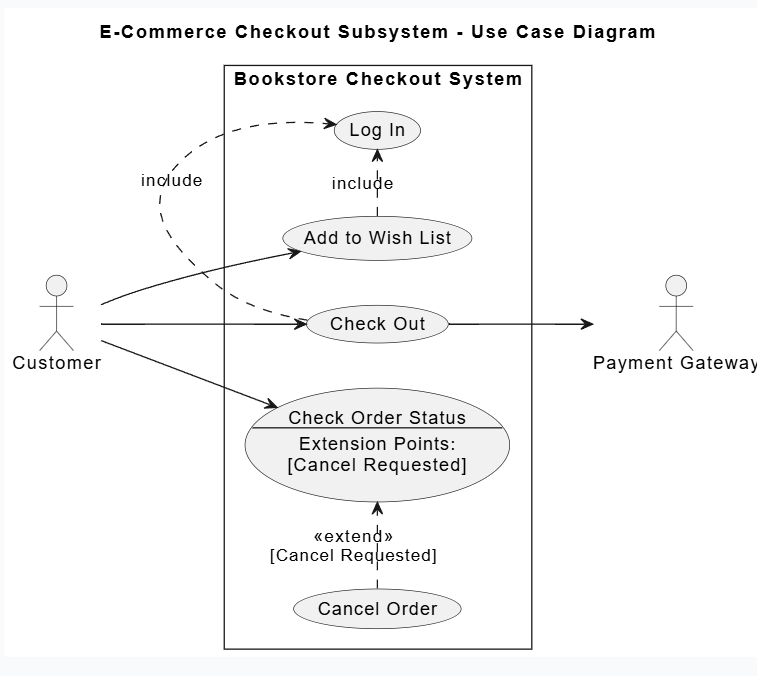
NexusBook Application: Both
Add to Wish ListandCheck Outrequired authentication. Instead of duplicating steps, the team created a standaloneLog Inuse case and included it wherever mandatory. -
Purpose: Eliminates redundancy and centralizes shared behavior.
II. Extend («extend»)
-
Concept: A variant use case implicitly inserts its behavior into a base use case only at explicitly named Extension Points.
-
NexusBook Application: During
Check Order Status, customers could optionally triggerCancel Order. This was modeled as an extension tied to the[Cancel Requested]extension point. -
Purpose: Handles optional, conditional, or infrequent behavior without cluttering the main flow.
III. Generalization
-
Concept: Functions like class inheritance. A parent use case defines a behavioral template that children specialize or override. Actors can also inherit privileges.
-
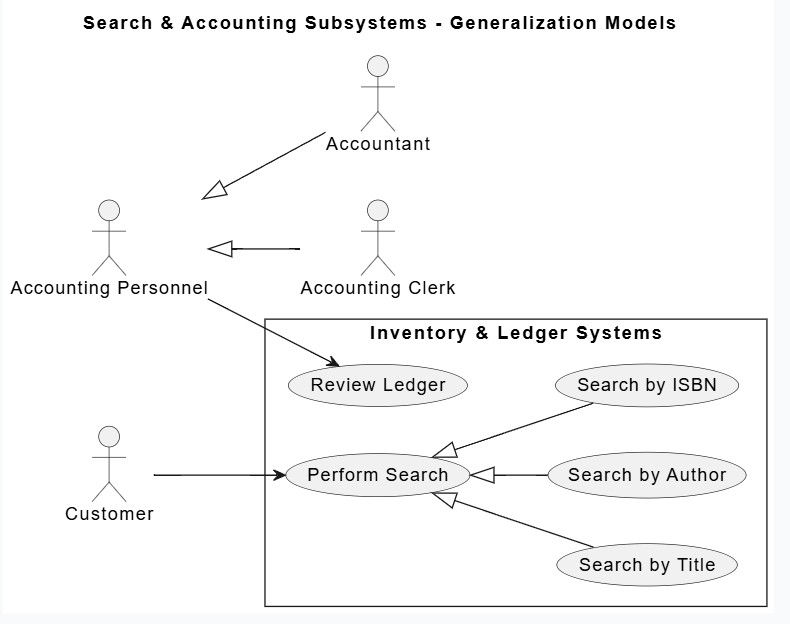
NexusBook Application:
Perform Searchserved as a parent toSearch by Title,Search by Author, andSearch by ISBN. Similarly,Accounting Personnelpassed base permissions toAccountantandAccounting Clerk. -
Purpose: Enables taxonomic classification and role-based access modeling.
3. PlantUML Visual Modeling & Layout Strategies
Diagrams provide the architectural skeleton of use case modeling. Below are the exact PlantUML specifications NexusBook used, complete with layout controls to prevent tangled graphs.
Scenario A: Structural Relationships («include» & «extend»)
Maps system boundaries, actors, and behavioral factoring for the checkout subsystem.
@startuml
skinparam style strictuml
left to right direction

title E-Commerce Checkout Subsystem - Use Case Diagram

actor "Customer" as cust
actor "Payment Gateway" as gateway

rectangle "Bookstore Checkout System" {
  usecase "Log In" as login

  ' Base use cases featuring inclusions
  usecase "Add to Wish List" as wishlist
  usecase "Check Out" as checkout

  ' Base use case containing an explicit extension point
  usecase "Check Order Status\n--\nExtension Points:\n[Cancel Requested]" as status
  usecase "Cancel Order" as cancel

  ' Relationship Mappings
  wishlist .> login : «include»
  checkout .> login : «include»

  cancel .> status : «extend»\n[Cancel Requested]
}

' Actor Interactions
cust --> wishlist
cust --> checkout
cust --> status
checkout --> gateway

@enduml
Scenario B: Generalization Hierarchy (Actors & Use Cases)
Illustrates taxonomic classification for search mechanisms and internal corporate actors.
@startuml
skinparam style strictuml
left to right direction

title Search & Accounting Subsystems - Generalization Models

' Actor Generalization Hierarchy
actor "Accounting Personnel" as staff
actor "Accountant" as accountant
actor "Accounting Clerk" as clerk

staff <|-- accountant
staff <|-- clerk

rectangle "Inventory & Ledger Systems" {
  ' Use Case Generalization Hierarchy
  usecase "Perform Search" as base_search
  usecase "Search by Title" as title_search
  usecase "Search by Author" as author_search
  usecase "Search by ISBN" as isbn_search

  base_search <|-- title_search
  base_search <|-- author_search
  base_search <|-- isbn_search

  usecase "Review Ledger" as ledger
}

' Interactions
actor "Customer" as buyer
buyer --> base_search
staff --> ledger

@enduml
🛠️ PlantUML Layout Tips & Tricks
Dense use case diagrams easily tangle automated layout engines. NexusBook applied these controls to maintain readability:
-
Force Horizontal Flow:
left to right directionaligns actors on the flanks and positions subsystems horizontally. -
Shorten Dependency Lines: Use
.>instead of..>to pin included/extended use cases closer to their base. -
Directional Overrides: Use
-up->,-down->,-left->, or-right->to manually route crossing lines. -
Explicit Extension Point Labels: Embed extension points directly in the base use case label for immediate visual traceability.
4. The Textual Core: Writing Robust Use Cases
Diagrams alone are insufficient. The core “meat” of a use case lies in its text. NexusBook adopted strict grammatical and structural standards to ensure clarity, testability, and developer readiness.
✍️ Textual Guidelines Enforced
-
Enforce Active Voice: Always write from the actor’s perspective.
✅ “The Customer selects the item.”
❌ “The item is selected by the customer.” -
Write in Present Tense: Avoid future-tense engineering phrasing like “The system shall…”. Use “The system displays…” for cleaner path tracing.
-
Apply “Call and Response” Sequencing: Format as a direct exchange.
Step 1: Actor does X.→Step 2: System responds with Y. -
Adhere to the Three-Paragraph Limit: A robust use case addresses one focused requirement in 2–3 paragraphs. Longer? Factor it out. Shorter? It lacks substance.
-
Explicitly Name Your Classes: Embed concrete business objects: Domain Model Classes (
Account,Review) and Boundary Classes (Book Page,Login Window). -
Establish Initial Context: Define step-zero clearly via an opening sentence or formal Precondition.
📄 Use Case Text Template (NexusBook Implementation)
Use Case: Add Customer Review
Precondition: The Customer has navigated to the designatedBook Page.Basic Course (Main Flow):
The Customer clicks the Write a Review button on theBook Page. The system responds by displaying theReview Form Page. The Customer inputs their rating, fills out the review title, and drafts the body text. When finished, the Customer clicks the Preview My Review button. The system displays aLook Over Your Review Pagereflecting the exact values provided. The Customer clicks the Save button. The system stores the data associated with the newReviewentity and returns the Customer back to theBook Page.Alternate Course (Exceptional Flow):
If the Customer clicks the Review Guidelines button on the initial page, the system displays theCustomer Review Guidelines Page. When the Customer clicks the OK button on that page, the system returns them directly back to the activeBook Page.
5. Architectural Guidelines & Engineering Lessons
Through iterative refinement, NexusBook distilled four architectural guidelines that prevented common use case anti-patterns:
1. Guard System Boundaries Rigorously
Always group use cases inside a subject box (rectangle in PlantUML) and keep actors strictly outside. This forces clear visibility into what lies within your system’s scope versus what constitutes an external interface dependency. NexusBook used this to isolate third-party payment integrations from internal checkout logic.
2. Avoid Design & Implementation Details
When describing interactions with boundary items (HTML pages, modals, windows), never detail visual styles, button colors, or internal technical logic (e.g., database persistence, API retries). Focus exclusively on behavioral obligations required for downstream engineers to implement the feature.
3. Prevent Structural Over-Engineering
Do not over-analyze «include» vs «extend» during early discovery phases. NexusBook learned to prioritize clean, well-formed text using active voice and call-and-response dynamics first. Diagrams were applied later to identify structural patterns and deduplicate functionality.
4. Treat Use Cases as Living Artifacts
Use cases are not sign-and-forget documents. They must evolve alongside the domain model, UI prototypes, and test suites. NexusBook integrated use case reviews into sprint planning, ensuring that every behavioral change was reflected in both diagram and text before development began.
Conclusion
UML 2.0 use cases are far more than static diagrams or bureaucratic checkboxes; they are the behavioral blueprints that align product vision, engineering execution, and quality assurance. As demonstrated in the NexusBook case study, success hinges on two synergistic disciplines: precise visual modeling that respects system boundaries and behavioral factoring, and rigorous textual specification that enforces active voice, present tense, and call-and-response sequencing.
By adopting «include» for mandatory shared behavior, «extend» for conditional pathways, and generalization for taxonomic clarity, teams can transform sprawling requirements into modular, reusable specifications. Coupled with PlantUML’s layout controls, use cases become living artifacts that accelerate development, reduce ambiguity, and provide traceable foundations for testing.
In an era of agile delivery and continuous iteration, disciplined use case modeling remains one of the most reliable mechanisms for capturing what a system must do, why it matters, and how it behaves under real-world conditions. Master the structure, respect the boundaries, and let the text drive the diagram. The result is not just better documentation, but better software.
This post is also available in Deutsche, Español, فارسی, Français, English, Bahasa Indonesia, 日本語, Polski, Portuguese, Ру́сский, Việt Nam, 简体中文 and 繁體中文.
