



ArchiMate 4 Meets TOGAF 10: A Comprehensive Review
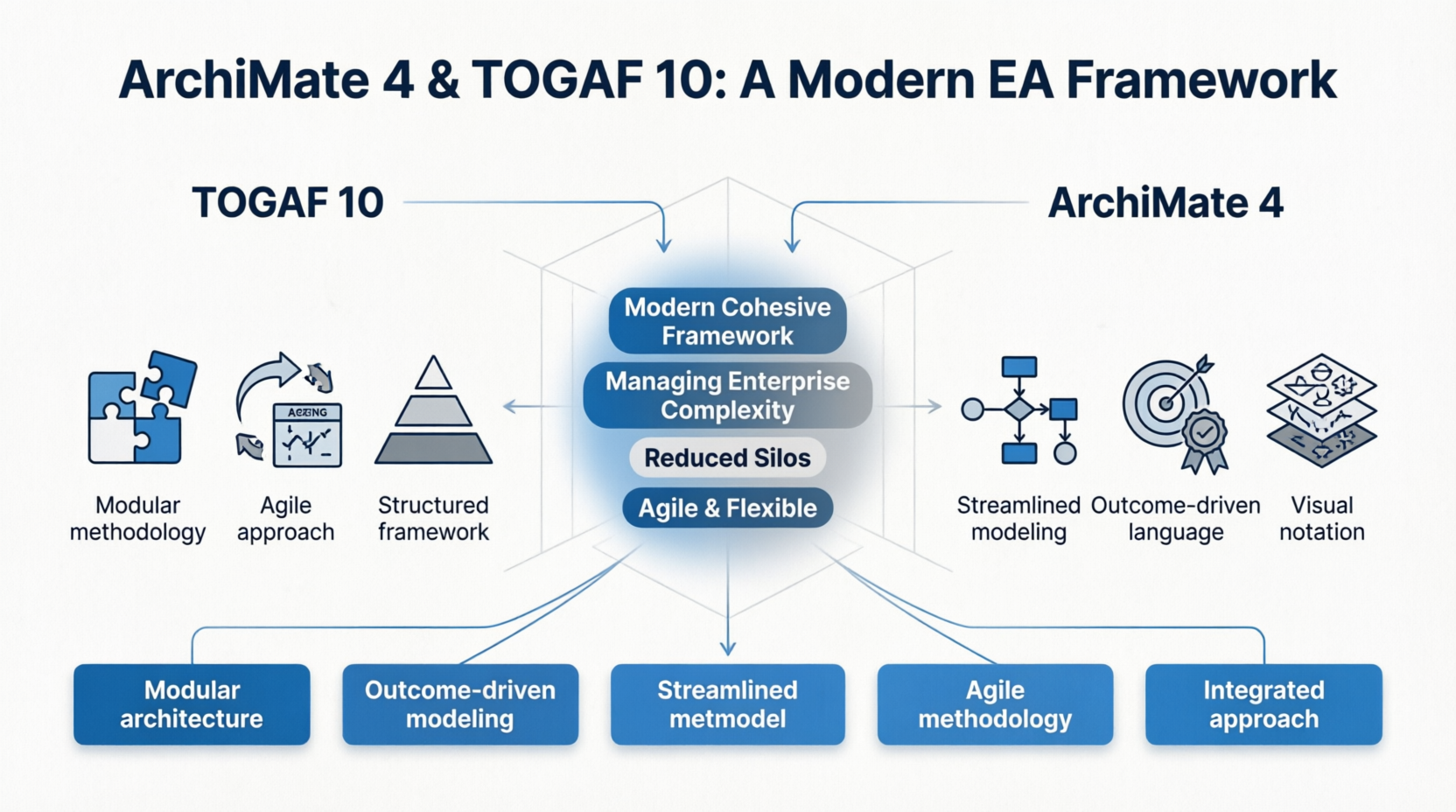
The convergence of ArchiMate 4 (released by The Open Group) and the TOGAF Standard, 10th Edition marks a pivotal evolution in Enterprise Architecture (EA). For years, organizations grappled with rigid hierarchies, siloed layers, and bloated metamodels. Together, TOGAF 10’s modular, agile methodology and ArchiMate 4’s streamlined, outcome-driven modeling language deliver a modern, cohesive framework for managing enterprise complexity.
1. The Core Philosophy: Method Meets Notation
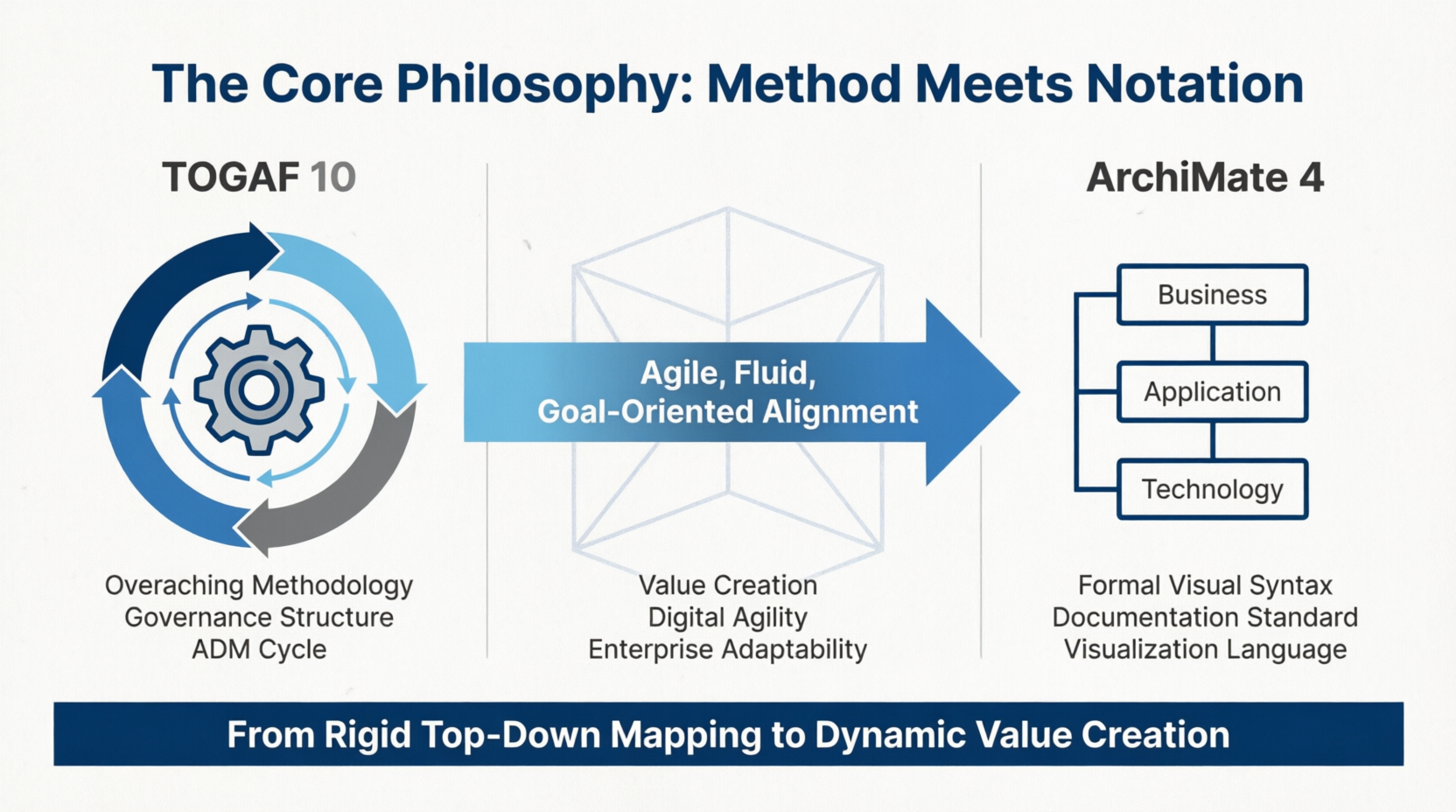
While TOGAF 10 provides the overarching methodology, governance structure, and the Architecture Development Method (ADM) cycle (the “what to do and how to govern it”), ArchiMate 4 offers the formal visual syntax (the “how to document and visualize it”).
With the arrival of ArchiMate 4, this partnership has shifted from a rigid top-down mapping to an agile, fluid, and goal-oriented alignment. Rather than forcing artifacts into strict technical silos, the integration focuses on value creation, digital agility, and enterprise adaptability.
2. Key Architectural Shifts in ArchiMate 4
ArchiMate 4 introduces transformative structural updates that directly enhance its compatibility with TOGAF 10’s modular philosophy:
-
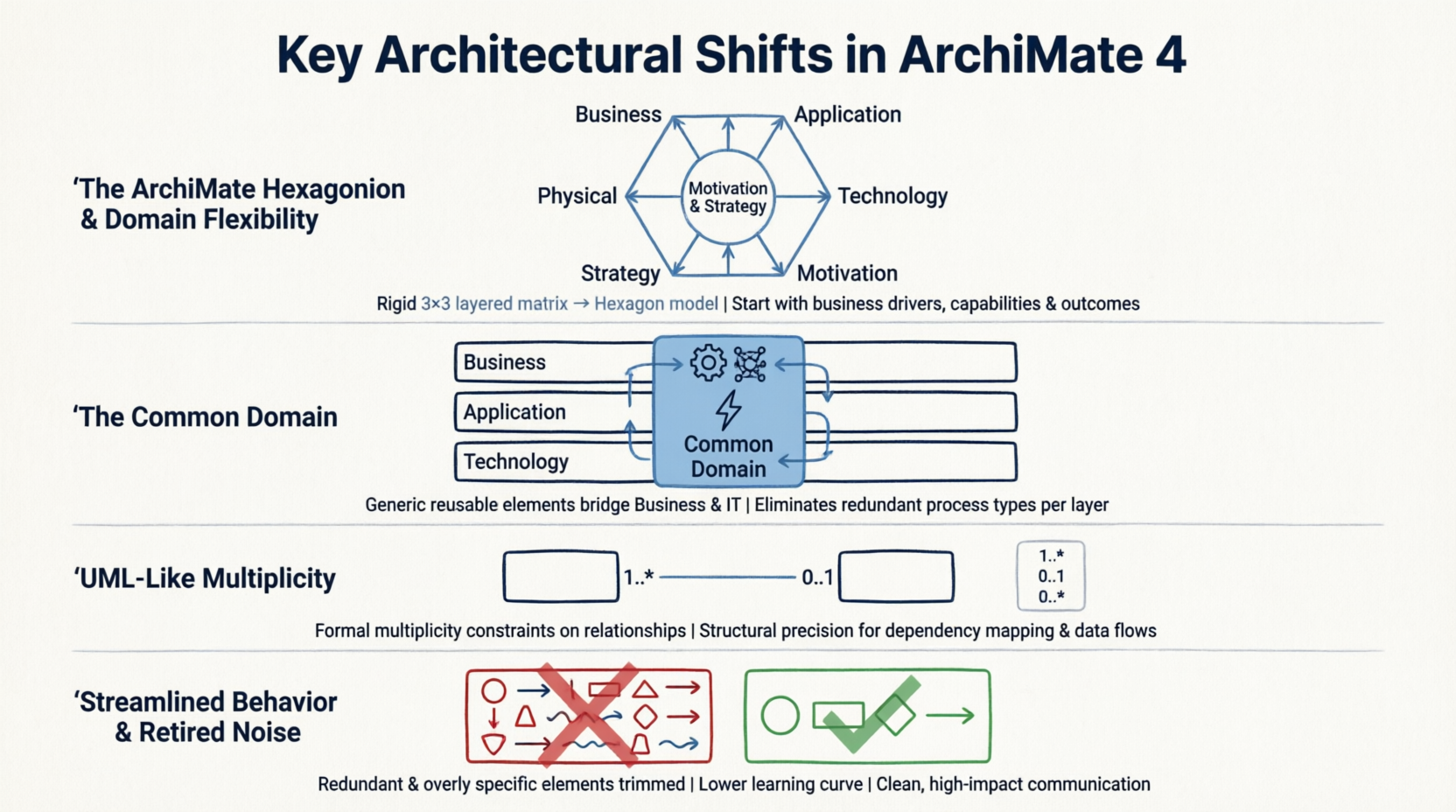
The ArchiMate Hexagonion & Domain Flexibility: The rigid 3×3 layered matrix (Business, Application, Technology) has evolved into the Hexagonion model. Motivation and strategy sit centrally, radiating outward. This matches TOGAF 10’s emphasis on starting architecture work with business drivers, capabilities, and outcomes rather than plunging straight into technical layers.
-
The Common Domain: A newly introduced space housing generic, reusable elements (such as universal processes, events, and services) that bridge across business and IT. This eliminates the redundancy of maintaining separate process types for each layer.
-
UML-Like Multiplicity: ArchiMate 4 introduces formal multiplicity constraints (e.g.,
1..*,0..1) on relationships, bringing structural precision to dependency mapping, data flows, and interface contracts without overcomplicating diagrams. -
Streamlined Behavior & Retired Noise: Redundant or overly specific elements have been trimmed, cutting down the learning curve and focusing modelers on clean, high-impact communication.
3. ADM Phase-by-Phase Synergy
When applied within a TOGAF 10 framework, ArchiMate 4 maps seamlessly across the ADM lifecycle:
| TOGAF 10 ADM Phase | ArchiMate 4 Integration & Value |
|---|---|
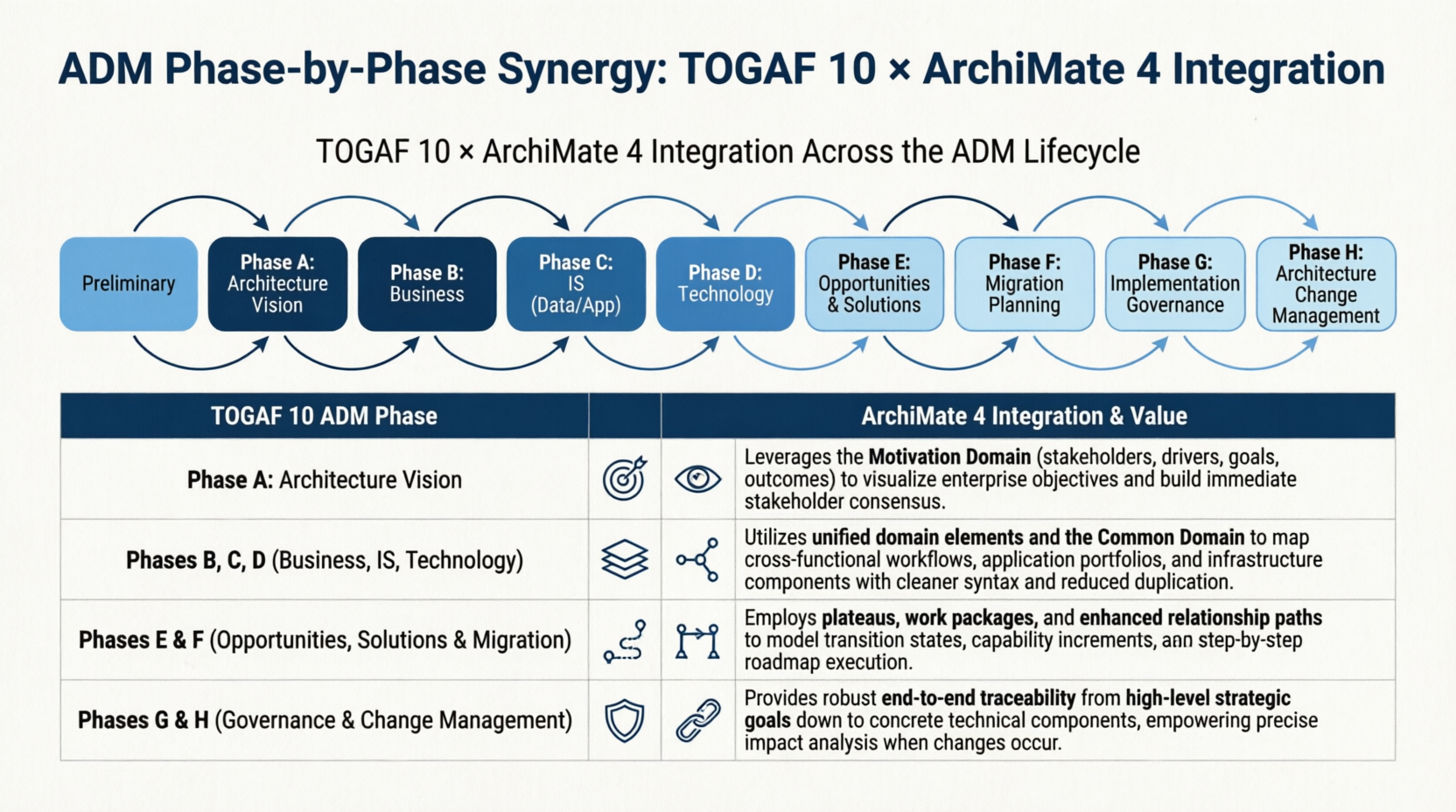
| Phase A: Architecture Vision | Leverages the Motivation Domain (stakeholders, drivers, goals, and outcomes) to visualize enterprise objectives and build immediate stakeholder consensus. |
| Phases B, C, D (Business, IS, Technology) | Utilizes unified domain elements and the Common Domain to map cross-functional workflows, application portfolios, and infrastructure components with cleaner syntax and reduced duplication. |
| Phases E & F (Opportunities, Solutions & Migration) | Employs plateaus, work packages, and enhanced relationship paths to model transition states, capability increments, and step-by-step roadmap execution. |
| Phases G & H (Governance & Change Management) | Provides robust end-to-end traceability from high-level strategic goals down to concrete technical components, empowering precise impact analysis when changes occur. |
4. Strategic Benefits for Enterprise Architecture Practices
-
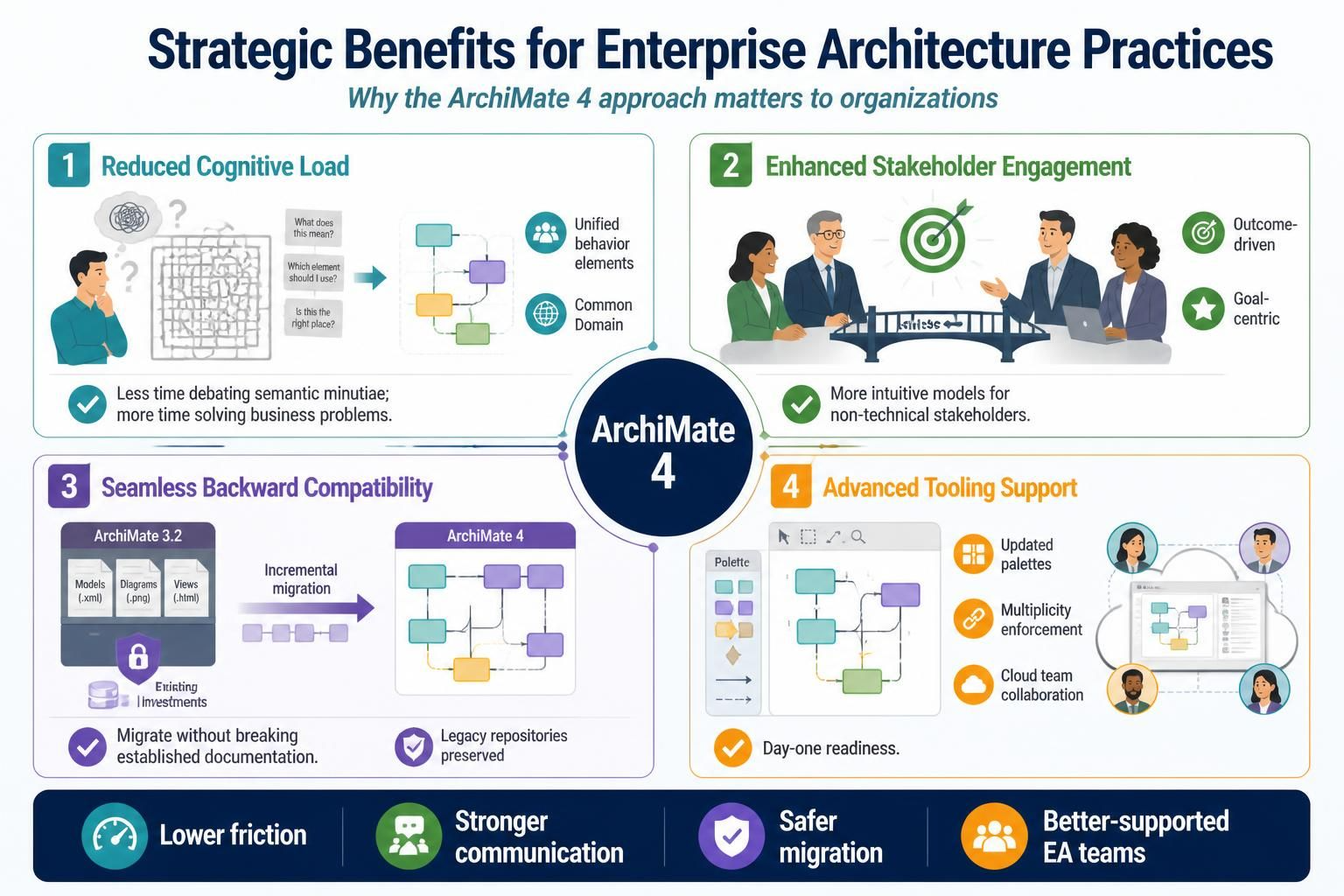
Reduced Cognitive Load: By unifying behavior elements and introducing the Common Domain, architects spend less time debating semantic minutiae and more time solving business problems.
-
Enhanced Stakeholder Engagement: The shift toward outcome-driven and goal-centric architecture makes models intuitive for non-technical executive stakeholders, bridging the classic business-IT communication gap.
-
Seamless Backward Compatibility: ArchiMate 4 respects existing investments by offering complete backward compatibility with ArchiMate 3.2 models, allowing organizations to migrate incrementally without breaking legacy documentation repositories.
-
Advanced Tooling Support: Leading platforms (such as Visual Paradigm) provide day-one readiness for ArchiMate 4, featuring updated palettes, multiplicity enforcement on connectors, and cloud-based team collaboration workspaces.
Conclusion
ArchiMate 4 and TOGAF 10 together form a mature, future-proof ecosystem for modern enterprise architecture. By shedding legacy clutter in favor of agility, goal alignment, and structural precision, this combination equips organizations to navigate complex digital transformations, hybrid architectures, and AI-driven business models with confidence.
Reference
-
Mastering TOGAF 10: A Modular Guide to Enterprise Architecture with Visual Paradigm: Comprehensive guide to TOGAF 10’s modular structure and how Visual Paradigm supports ADM phases, techniques, and artifact management.
-
Architecting Agility: Mastering TOGAF 10 with Visual Paradigm’s AI-Powered Toolkit: Explores TOGAF 10’s key concepts—modularity, business outcomes, Agile integration—and demonstrates Visual Paradigm’s BPMN and AI-assisted features.
-
Native AI ArchiMate 4 Generation & Viewpoints | Visual Paradigm Desktop: Announces AI-powered native ArchiMate 4 diagram generation with viewpoint support directly in Visual Paradigm Desktop.
-
AI ArchiMate 4 Generator: New Chatbot Import Support | Visual Paradigm: Details the AI Chatbot enhancement for generating ArchiMate 4 diagrams via natural language and seamless import into Visual Paradigm Desktop.
-
Transforming Enterprise Architecture: A Case Study on Adopting TOGAF 10 with Visual Paradigm: Real-world case study of NexGen Financial Services implementing TOGAF 10 with Visual Paradigm, including measurable outcomes and lessons learned.
-
Comprehensive Guide for Using TOGAF ADM with Visual Paradigm: Practical guidance on applying TOGAF ADM across architecture styles, iteration strategies, partitioning, and using Visual Paradigm’s ADM tools.
-
ArchiMate 4 Specification Official Release | The Open Group: Official announcement of ArchiMate 4 Specification, detailing key changes from version 3.2 including element merges, domain terminology, and relationship multiplicities.
-
The Open Group Announces ArchiMate 4 Specification: Press release emphasizing ArchiMate 4’s continuity, user-level compatibility, and alignment with the TOGAF Standard.
-
The Open Group Announces Launch of the TOGAF Standard, 10th Edition: Official launch announcement highlighting TOGAF 10’s refreshed modular structure, Agile guidance, and expanded “how-to” material.
-
TOGAF Standard Overview | The Open Group: Authoritative overview of the TOGAF Standard, including its Fundamental Content, Series Guides, certification portfolio, and applicability across organization sizes and sectors.
