




From User Stories to Use Cases: Bridging Agile Requirements with Visual Modeling
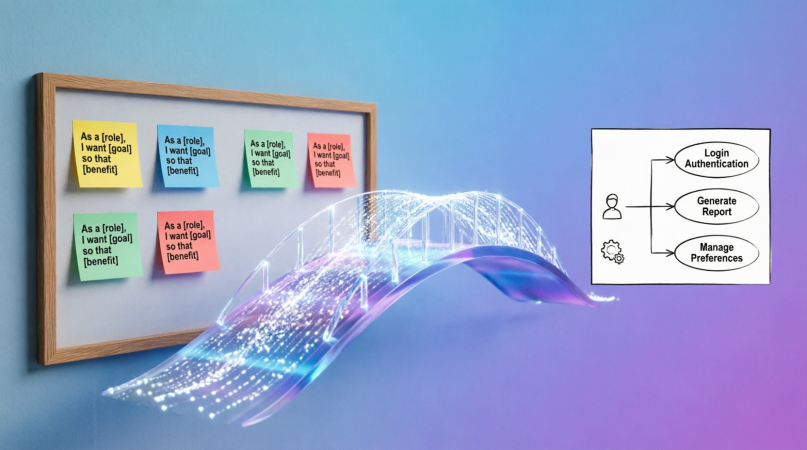
Agile development methodologies have revolutionized how software teams approach requirements, championing user stories as the primary tool for capturing functionality from a user’s perspective. While user stories are effective for their simplicity and focus on value, they can sometimes lack the broader context needed for complex systems. This is where use case modeling steps in—not as a replacement for user stories, but as a powerful complement that bridges the gap between high-level Agile requirements and detailed system understanding.
Use case modeling helps capture, document, and communicate software requirements from a user’s perspective. In Agile environments, where user stories define the core functionality, use cases play a complementary role by providing a more comprehensive view of system interactions.
Why Use Cases Complement User Stories
Use case modeling helps capture, document, and communicate software requirements from a user’s perspective. In Agile environments, where user stories define the core functionality, use cases play a complementary role by providing a more comprehensive view of system interactions.
Why Use Cases Complement User Stories
User stories typically follow the format: “As a [role], I want [goal] so that [benefit].” They are excellent for prioritizing features and maintaining a focused backlog. However, they often represent isolated pieces of functionality without illustrating how different actors and system components interact.
Use cases, on the other hand, expand on these stories by:
-
Illustrating how different actors interact with the system
-
Revealing additional requirements and dependencies
-
Showing the full flow of events, including alternative paths and exceptions
-
Providing a visual representation of system boundaries and actor relationships
“Use cases are like the universal language of software development. They enable end-users to understand and validate requirements, ensuring that what gets built aligns perfectly with what is needed.”
Key Benefits in Agile Contexts
User-Centric Focus
Requirements start with the user’s perspective (similar to user stories), but use cases expand this into complete scenarios, including alternatives and exceptions.
Improved Communication
Non-technical stakeholders easily understand use case diagrams and narratives without requiring deep UML knowledge. Use cases act as a common language between product owners, developers, and testers, reducing misunderstandings.
Scope Management
Agile projects often involve evolving requirements. Use cases help teams manage scope by providing a structured way to evaluate and prioritize features and changes.
Testable and Traceable
Flows of events become the basis for acceptance tests, ensuring “done” means “works as the user expects.” Use cases provide a foundation for test planning, aligning with the Agile principle of delivering potentially shippable product increments.
Big-Picture Visibility
Use case diagrams show the full set of functionality at a glance, helping teams avoid missing critical goals. This aligns with Use-Case 2.0 Principle 2: “Understand the big picture”.
The Use-Case 2.0 Approach
Modern use-case thinking has evolved. Use-Case 2.0—a new generation of use-case-driven development—has been inspired by user stories and Agile methodologies like Scrum and Kanban. It introduces an important concept: the use-case slice.
“A slice being a carefully selected part of a use case… the key use-case slices assist systematically in finding the application architecture. They drive the identification of components or other software elements in software design. They are the elements that have to go through testing—and truly support test-driven design.”
Six Core Principles of Use-Case 2.0:
-
Keep it simple by telling stories – Storytelling is the simplest way to communicate what a system should do.
-
Understand the big picture – Without understanding the system as a whole, decisions about scope, cost, and value become impossible.
-
Focus on value – Focus on how the system will be used to achieve goals, not on lists of features.
-
Build the system in slices – Identify the most useful thing, slice it into manageable pieces, and build incrementally.
-
Deliver the system in increments – Each increment should provide a demonstrable or usable version.
-
Adapt to meet the team’s needs – Different teams and situations require different styles and levels of detail.
Practical Example: Bridging User Stories and Use Cases
Let’s consider an E-commerce Platform example:
User Stories might include:
-
“As a customer, I want to browse products so that I can find items to purchase”
-
“As a customer, I want to add items to my cart so that I can prepare for checkout”
Use Case Modeling expands this:
Actors: Customer, Guest, Admin, Payment Gateway
Key Use Cases:
-
Browse Products
-
Search Products
-
Add to Cart
-
Proceed to Checkout
-
Make Payment (with
«include»relationship from Checkout) -
Apply Coupon (with
«extend»relationship to Checkout) -
Track Order
Benefit: The early use case diagram reveals missing flows—such as “Guest Checkout”—that can be added before sprint commitments, preventing potential issues in production.
Visual Paradigm’s AI-Powered Approach
Visual Paradigm enhances the bridge between user stories and use cases through AI-powered capabilities:
-
Narrative to Diagram Transformation: Convert plain-text user stories into Activity Diagrams automatically, complete with actions, decisions, forks/joins, and swimlanes.
-
Use Case Refinement Tools: AI analyzes use cases and intelligently proposes
«include»relationships for reusable sub-goals and«extend»relationships for optional behavior. -
Seamless Agile Integration: Use cases can be refined into user tasks, epics, and user stories for organized project structure using story maps; send use cases directly to the Agile product backlog for efficient planning.
When to Use What
-
User Stories excel at: Backlog management, sprint planning, and capturing value-focused requirements in simple terms.
-
Use Cases excel at: Providing broader context, revealing dependencies, modeling complex interactions, supporting comprehensive testing, and visualizing the full system landscape.
In Agile development, effective requirements management is crucial. Use case modeling serves as a valuable bridge between customer needs and software implementation. By integrating use cases alongside user stories, Agile teams can efficiently deliver software that aligns with user needs and business objectives while maintaining flexibility and responsiveness.
This article is part of a series exploring the integration of use case modeling and Agile development practices.
This post is also available in Deutsche, Español, فارسی, Français, English, Bahasa Indonesia, 日本語, Polski, Portuguese, Ру́сский, Việt Nam, 简体中文 and 繁體中文.
