




From Concept to Code: A Comprehensive UML Class Diagram Guide & Case Study
Introduction
Unified Modeling Language (UML) Class Diagrams serve as the blueprint for software architecture, bridging the gap between abstract requirements and concrete code implementation. By visualizing the structure of a system—its classes, attributes, operations, and the relationships among them—developers can ensure robust design before writing a single line of code.
This guide dissects the essential syntax of UML Class Diagrams using a comprehensive cheatsheet and applies these concepts to a real-world scenario: The Unified Food Delivery Platform. By the end of this article, you will understand how to model complex systems involving inheritance, interfaces, composition, and aggregation.
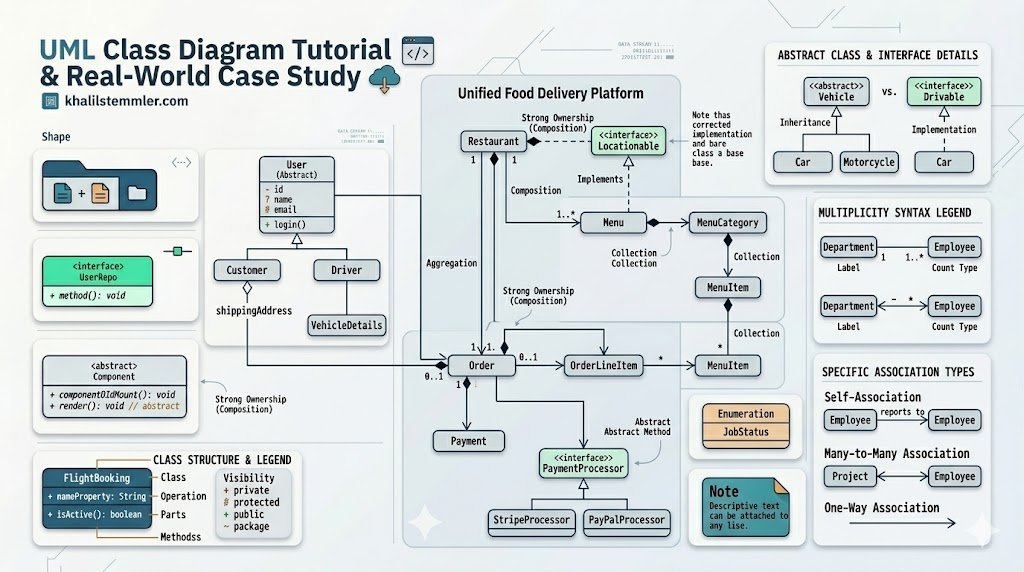
Part 1: The Building Blocks (Syntax & Legend)
Before diving into the case study, we must establish the vocabulary used in UML diagrams.
1. Class Structure & Visibility
A class is represented by a rectangle divided into three compartments:
-
Top: Class Name (e.g.,
FlightBooking). -
Middle: Properties/Attributes (e.g.,
+ nameProperty: String). -
Bottom: Methods/Operations (e.g.,
+ isActive(): boolean).
Visibility Modifiers:
-
+Public: Accessible by any other class. -
-Private: Accessible only within the class. -
#Protected: Accessible within the class and its subclasses. -
~Package: Accessible only within the same package.
2. Special Class Types
-
Interfaces (
<<interface>>): Contracts defining methods without implementation. Represented by a green box (in this cheatsheet) or standard notation.-
Example:
UserRepowith+ method(): void.
-
-
Abstract Classes (
<<abstract>>): Base classes that cannot be instantiated directly. They may contain abstract methods.-
Example:
Componentwith+ render(): void // abstract.
-
-
Enumerations: A set of named constants.
-
Example:
JobStatus.
-
Order System Class Diagram Example
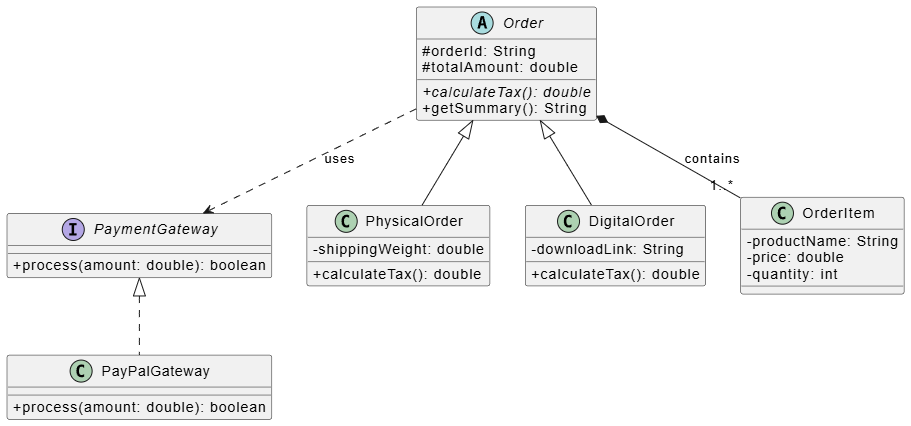
@startuml
skinparam classAttributeIconSize 0
skinparam shadowing false
‘ — INTERFACES —
interface PaymentGateway {
+ process(amount: double): boolean
}
‘ — ABSTRACT CLASSES —
abstract class Order {
# orderId: String
# totalAmount: double
+ {abstract} calculateTax(): double
+ getSummary(): String
}
‘ — CLASSES —
class PhysicalOrder {
– shippingWeight: double
+ calculateTax(): double
}
class DigitalOrder {
– downloadLink: String
+ calculateTax(): double
}
class OrderItem {
– productName: String
– price: double
– quantity: int
}
class PayPalGateway {
+ process(amount: double): boolean
}
‘ — RELATIONSHIPS —
Order <|– PhysicalOrder
Order <|– DigitalOrder
Order *– “1..*” OrderItem : contains
Order ..> PaymentGateway : uses
PaymentGateway <|.. PayPalGateway
@enduml
Part 2: Relationships & Multiplicity
The lines connecting classes define how they interact.
1. Association Types
-
Inheritance (Generalization): Solid line with a hollow triangle. “Is-a” relationship.
-
Example:
CarandMotorcycleinherit fromVehicle.
-
-
Implementation: Dashed line with a hollow triangle. A class fulfills an interface contract.
-
Example:
CarimplementsDrivable.
-
-
Composition (Strong Ownership): Solid line with a filled diamond. The “part” cannot exist without the “whole.”
-
Example:
Restaurant(Whole) ownsMenu(Part). If the restaurant closes, the menu is gone.
-
-
Aggregation: Solid line with a hollow diamond. A “has-a” relationship where parts can exist independently.
-
Example:
OrderaggregatingRestaurant(The restaurant exists even if the order is deleted).
-
2. Multiplicity Legend
Numbers at the ends of lines indicate cardinality:
-
1: Exactly one. -
0..1: Zero or one (Optional). -
1..*: One or more (Mandatory list). -
*: Many (Zero or more).
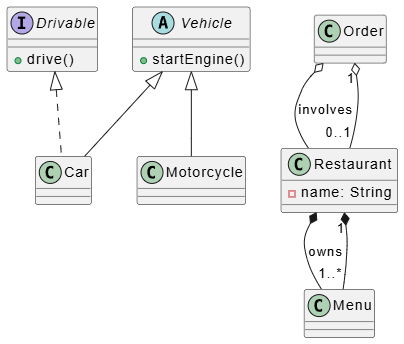
The concepts of inheritance, implementation, composition, and aggregation Example
Part 3: Real-World Case Study: Unified Food Delivery Platform
This section analyzes the central diagram from the cheatsheet, breaking down the architecture of a food delivery application.
1. The User Hierarchy (Inheritance & Composition)
The system starts with a generic User class, marked as Abstract. This ensures no generic “User” objects are created, only specific types.
-
Inheritance:
CustomerandDriverextendUser. -
Composition:
-
Customerhas aShippingAddress(Strong Ownership). -
DriverhasVehicleDetails(Strong Ownership).
-
2. The Restaurant & Menu Ecosystem
This section demonstrates deep nesting and collections.
-
Interface Implementation:
Restaurantimplements<<interface>> Locatable, ensuring every restaurant has location data. -
Composition Chain:
-
Restaurant(1) strongly ownsMenu(1). -
MenucontainsMenuCategory(1..*). -
MenuCategorycontainsMenuItem(*). -
Note: This structure enforces that a Menu Item cannot exist without a Category, which cannot exist without a Menu.
-
3. Order Processing & Payments
-
Order Structure:
-
Orderhas a relationship withRestaurant(Aggregation). -
Orderstrongly ownsOrderLineItem(1..*). -
Orderhas aPayment(0..1), indicating payment is optional during the initial creation phase.
-
-
Payment Strategy (Polymorphism):
-
The system uses an interface
<<interface>> PaymentProcessor. -
Concrete classes
StripeProcessorandPayPalProcessorimplement this interface. This allows the system to switch payment gateways without changing the coreOrderlogic.
-
4. Abstract Class vs. Interface (The Vehicle Example)
The top right of the cheatsheet clarifies a common confusion:
-
Abstract Class (
Vehicle):CarandMotorcycleinherit fromVehicle. This implies they share core data/structure (e.g.,engineType,wheels). -
Interface (
Drivable):CarimplementsDrivable. This impliesCarhas specific behavior (drive()) thatMotorcyclemight not have (or might implement differently).
Part 4: Visualizing with PlantUML
Below is the PlantUML code to generate the core structure of the “Unified Food Delivery Platform” described in the case study. You can copy this into any PlantUML editor to see the diagram.
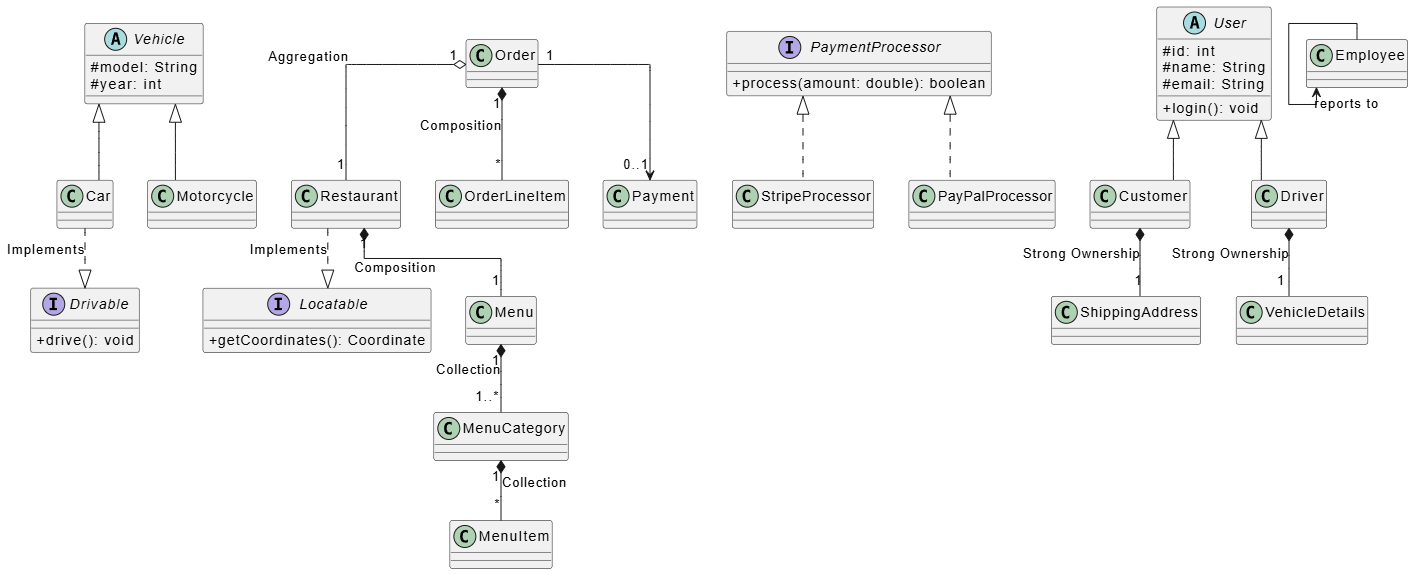
@startuml
' Skinparams for styling to match the cheatsheet vibe
skinparam classAttributeIconSize 0
skinparam linetype ortho
skinparam shadowing false

' --- LEGEND / STEREOTYPES ---
interface "Drivable" as Drivable {
  + drive(): void
}

interface "Locatable" as Locatable {
  + getCoordinates(): Coordinate
}

interface "PaymentProcessor" as PaymentProcessor {
  + process(amount: double): boolean
}

abstract class "User" as User {
  # id: int
  # name: String
  # email: String
  + login(): void
}

abstract class "Vehicle" as Vehicle {
  # model: String
  # year: int
}

class "Car" as Car
class "Motorcycle" as Motorcycle
class "Customer" as Customer
class "Driver" as Driver
class "Restaurant" as Restaurant
class "Menu" as Menu
class "MenuCategory" as MenuCategory
class "MenuItem" as MenuItem
class "Order" as Order
class "OrderLineItem" as OrderLineItem
class "Payment" as Payment
class "StripeProcessor" as StripeProcessor
class "PayPalProcessor" as PayPalProcessor

' --- RELATIONSHIPS ---

' Vehicle Hierarchy
Vehicle <|-- Car
Vehicle <|-- Motorcycle
Car ..|> Drivable : Implements

' User Hierarchy
User <|-- Customer
User <|-- Driver

' Customer/Driver Compositions
Customer *-- "1" ShippingAddress : Strong Ownership
Driver *-- "1" VehicleDetails : Strong Ownership

' Restaurant Ecosystem
Restaurant ..|> Locatable : Implements
Restaurant "1" *-- "1" Menu : Composition
Menu "1" *-- "1..*" MenuCategory : Collection
MenuCategory "1" *-- "*" MenuItem : Collection

' Order Ecosystem
Order "1" o-- "1" Restaurant : Aggregation
Order "1" *-- "*" OrderLineItem : Composition
Order "1" --> "0..1" Payment

' Payment Processors
PaymentProcessor <|.. StripeProcessor
PaymentProcessor <|.. PayPalProcessor

' Specific Associations (Self Association Example from legend)
class "Employee" as Employee
Employee --> "reports to" Employee

@enduml
Conclusion
Mastering UML Class Diagrams is essential for any software architect or developer. As demonstrated in the Unified Food Delivery Platform case study, UML allows us to visualize complex relationships—such as the difference between a Car inheriting from a Vehicle versus implementing a Drivable interface.
By strictly adhering to syntax rules regarding multiplicity (1, , 1..) and ownership (Composition vs. Aggregation), teams can prevent architectural pitfalls, such as orphaned data records or rigid designs that are difficult to extend. Whether you are designing a simple login system or a multi-vendor marketplace, a well-crafted UML diagram remains the most effective tool for communicating your vision.
This post is also available in Deutsche, Español, فارسی, Français, English, Bahasa Indonesia, Polski, Portuguese, Ру́сский, Việt Nam and 简体中文.
