




Architecting Clarity: A Practical Case Study in UML 2.0 Package Design
Introduction
As enterprise software systems evolve from monolithic codebases into distributed, multi-team ecosystems, the challenge of maintaining structural clarity becomes paramount. When hundreds of classes, interfaces, and use cases coexist without defined boundaries, cognitive load spikes, dependency conflicts multiply, and development velocity stalls. UML 2.0 package fundamentals provide the architectural scaffolding needed to tame this complexity.
This case study explores how disciplined package design—rooted in namespace management, exclusive ownership, and logical partitioning—enables engineering teams to scale their systems without sacrificing maintainability. By walking through real-world modeling scenarios, visual notation standards, and proven architectural guidelines, we will demonstrate how to transform chaotic model sprawl into a coherent, navigable blueprint that supports collaborative development and long-term system evolution.
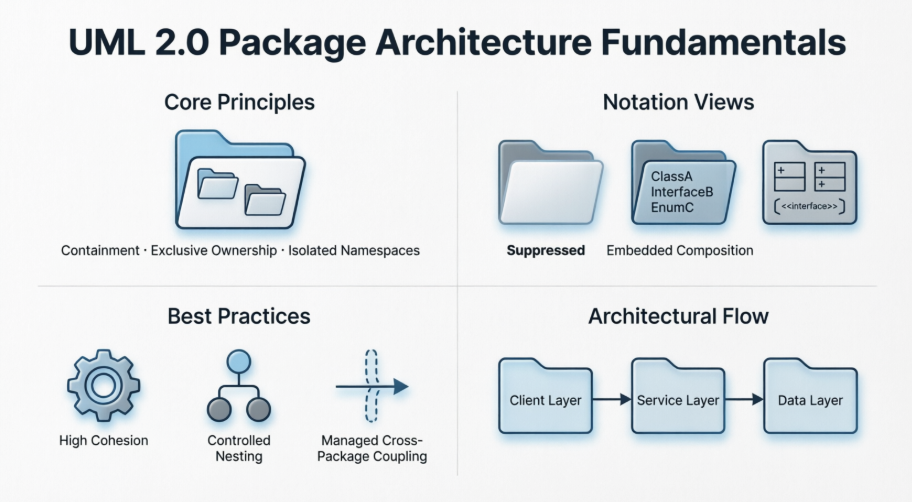
1. Core Principles in Practice: The Four Axioms
In this case study, we examine the architectural refactoring of a mid-to-large enterprise digital platform. The engineering team adopted UML 2.0 packages as the primary organizational mechanism, grounding their implementation in four foundational axioms:
-
Diverse Containment Capabilities: A package functions as a highly versatile container. Within the platform, a single
CheckoutFlowpackage encapsulated not only business classes but also sequence diagrams, component interfaces, and nestedPaymentGatewaysub-packages, forming a logical, tree-like hierarchy. -
The Exclusive Ownership Rule: To prevent ambiguity, the team enforced a strict ownership policy. If the
CatalogServicepackage explicitly defines aProductVariantclass, no other package can claim it. Cross-boundary access is strictly managed through import relationships and dependency lines, eliminating hidden coupling and duplicate definitions. -
The Namespace Boundary Constraint: Each package establishes an isolated naming context. This allowed the
InventoryandShippingmodules to both contain aTrackingEntityclass without identifier collisions. As long as elements remain within their respective package scopes, naming conflicts are naturally avoided at the model level. -
Conceptual vs. Physical Partitioning: The team recognized that packages represent logical groupings of domain concepts rather than direct deployment units. While a
UserManagementpackage guides the architecture, its classes could ultimately compile into separate JARs or microservices based on operational requirements, decoupling design intent from runtime infrastructure.
2. Visualizing Structure: Notation Mechanics
Effective architectural communication requires matching diagram detail to the audience and development phase. UML 2.0 supports three distinct visual presentations for packages, each serving a specific modeling purpose:
-
Suppressed Contents (Members Hidden): Ideal for executive overviews and high-level architecture reviews. The folder displays only the package name, abstracting away internal complexity to highlight system-wide relationships and macro-dependencies.
-
Internal Listing (Members Shown Inside): Used when stakeholders need to verify module contents without rendering full graphical layouts. The package name shifts to the upper tab, while a concise textual inventory of owned elements occupies the main body.
-
Embedded Graphical Composition: Deployed during detailed design sessions. The package boundary expands into a container where full class boxes, interface symbols, and use case nodes are visually nested, explicitly demonstrating internal structure and interactions.
3. Implementation Scenarios & PlantUML Blueprints
The following scenarios demonstrate how the foundational principles translate into executable structural models.
Scenario A: Structural System Segmentation (Suppressed and Internal Views)
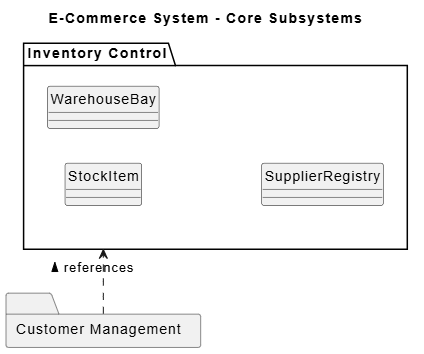
This sample highlights how an enterprise checkout system is logically partitioned into discrete subsystems, utilizing different visual detail levels to balance abstraction with clarity.
@startuml
skinparam style strictuml
left to right direction

title E-Commerce System - Core Subsystems

' 1. Package with hidden members (Suppressed View)
package "Customer Management" as CustomerSubsystem <<Folder>> {
  ' Content is left blank to represent hidden/suppressed components
}

' 2. Package showing internal textual listings
package "Inventory Control" as InventorySubsystem <<Folder>> {
  class "StockItem"
  class "WarehouseBay"
  class "SupplierRegistry"
}

' Basic dependency indicating conceptual interaction
CustomerSubsystem .right.> InventorySubsystem : references >

@endum
Case Analysis: This view allows architects to validate cross-module interactions at a glance. The Customer Management package remains abstracted to reduce visual noise, while Inventory Control explicitly lists its core entities. The dependency arrow confirms that customer workflows reference inventory data without violating ownership boundaries, preserving clean namespace separation.
Scenario B: Explicit Content Embedding & Visibility States
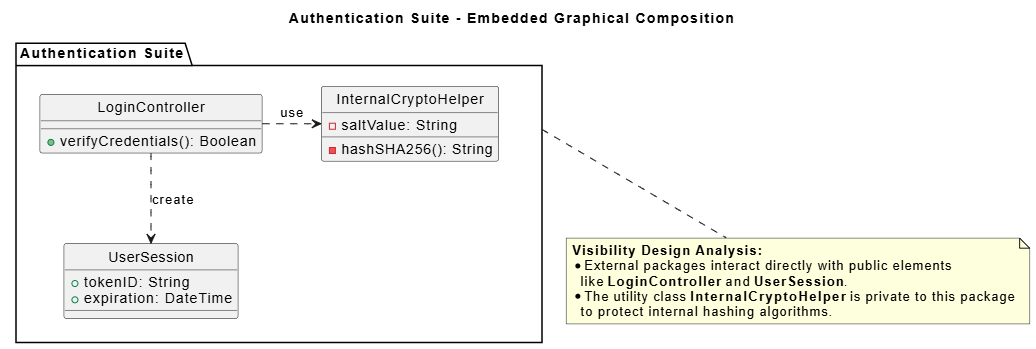
When detailing internal module architecture, graphical nesting becomes essential. This blueprint demonstrates how an authentication package exposes public interfaces while encapsulating sensitive utility logic.
@startuml
skinparam style strictuml

title Authentication Suite - Embedded Graphical Composition

package "Authentication Suite" as AuthSuite <<Folder>> {

  class "LoginController" as Controller {
    +verifyCredentials(): Boolean
  }

  class "UserSession" as Session {
    +tokenID: String
    +expiration: DateTime
  }

  class "InternalCryptoHelper" as Crypto {
    -saltValue: String
    -hashSHA256(): String
  }

  ' Visualizing internal interactions inside the package boundary
  Controller .down.> Session : «create»
  Controller .right.> Crypto : «use»
}

note bottom of AuthSuite
  **Visibility Design Analysis:**
  * External packages interact directly with public elements
    like **LoginController** and **UserSession**.
  * The utility class **InternalCryptoHelper** is private to this package
    to protect internal hashing algorithms.
end note

@endum
Case Analysis: By embedding classes directly within the package boundary, the diagram makes visibility rules explicit. External consumers interact solely with the public LoginController and UserSession, while InternalCryptoHelper remains strictly private. This enforces information hiding, reduces the attack surface of the authentication layer, and ensures internal implementation details can evolve without breaking external consumers.
4. Architectural Best Practices & Implementation Guidelines
Translating UML fundamentals into a resilient architecture requires disciplined execution. The refactoring initiative established the following operational guidelines to maintain long-term system health:
-
Apply High Functional Cohesion: Packages must reflect unified domain responsibilities. Arbitrary grouping dilutes architectural clarity. If a module begins accumulating unrelated business concepts, it should be decomposed into focused, nested sub-packages.
-
Nest Sparingly to Prevent Confusion: While UML permits infinite hierarchical nesting, practical readability degrades beyond two or three layers. Deeply nested structures complicate dependency tracking and generate unwieldy qualified names. Flatten where possible, and promote modularity over deep trees.
-
Track Cross-Boundary Couplings: Internal package cohesion should always outweigh external dependencies. If a single package requires dozens of outgoing dependency lines to another, the boundary is misaligned. Merge cohesive domains or reassign classes to balance the architecture and minimize ripple effects during changes.
-
Leverage Tooling for Clean Visualization: Automated diagram generation must remain intentional. Using the
<<Folder>>stereotype ensures standard UML compliance and consistent folder silhouettes. Directional layout commands maintain logical data-flow alignment, and high-level overviews should suppress granular attributes and operations. Detailed class specifications belong in dedicated diagrams, keeping package views optimized for structural navigation.
Conclusion
Mastering UML 2.0 package fundamentals is not merely an exercise in diagramming; it is a strategic approach to software architecture. By establishing strict namespaces, enforcing exclusive ownership, and aligning logical groupings with team responsibilities, organizations can transform sprawling codebases into navigable, maintainable systems. The visual notation standards and implementation scenarios outlined in this case study demonstrate how clarity can be preserved at every level of abstraction, from high-level subsystem overviews to granular visibility controls.
As development ecosystems continue to scale, disciplined package design will remain a cornerstone of sustainable engineering. When boundaries are drawn intentionally and dependencies are managed proactively, teams gain the structural agility needed to evolve their systems confidently, reduce integration friction, and deliver value consistently over time. Properly architected packages don’t just organize code—they organize thought, collaboration, and long-term technical success.
This post is also available in Deutsche, Español, فارسی, Français, English, Bahasa Indonesia, 日本語, Polski, Portuguese, Ру́сский, Việt Nam, 简体中文 and 繁體中文.
