




Orchestrating Complex Control Flow: A Comprehensive Case Study on UML 2.0 Interaction Fragments
Introduction
Modern software architectures rarely follow simple, linear execution paths. Distributed systems, event-driven microservices, and concurrent data pipelines demand behavioral models that can accurately represent conditional branching, parallel execution, iterative processes, and exception handling. Traditional UML sequence diagrams, constrained by strictly vertical message flows, quickly become inadequate when modeling these dynamic behaviors.
UML 2.0 addressed this limitation by introducing Interaction Fragments—a standardized mechanism for embedding control-flow logic directly into sequence and communication diagrams. This case study examines how development teams can leverage interaction fragments to bridge the gap between high-level architectural design and precise runtime behavior. Through structural analysis, operator semantics, executable modeling examples, and engineering best practices, we will demonstrate how to design scalable, unambiguous, and maintainable behavioral specifications for complex enterprise systems.
Case Study Context & Modeling Challenges
The following case study is framed around the architectural redesign of NexaRetail, a high-volume e-commerce platform handling real-time inventory synchronization, multi-gateway payment routing, and asynchronous logistics dispatch. The engineering team faced three core modeling challenges:
-
Conditional Routing: Payment authorization required mutually exclusive paths based on dynamic account states.
-
Concurrent Execution: Stock deduction and carrier scheduling needed to run in parallel without race conditions.
-
Diagram Maintainability: As workflows expanded, monolithic sequence diagrams became unreadable and difficult to version-control.
To resolve these challenges, the architecture team adopted UML 2.0 Interaction Fragments as the primary behavioral modeling standard.
1. Structural Mechanics of Interaction Fragments
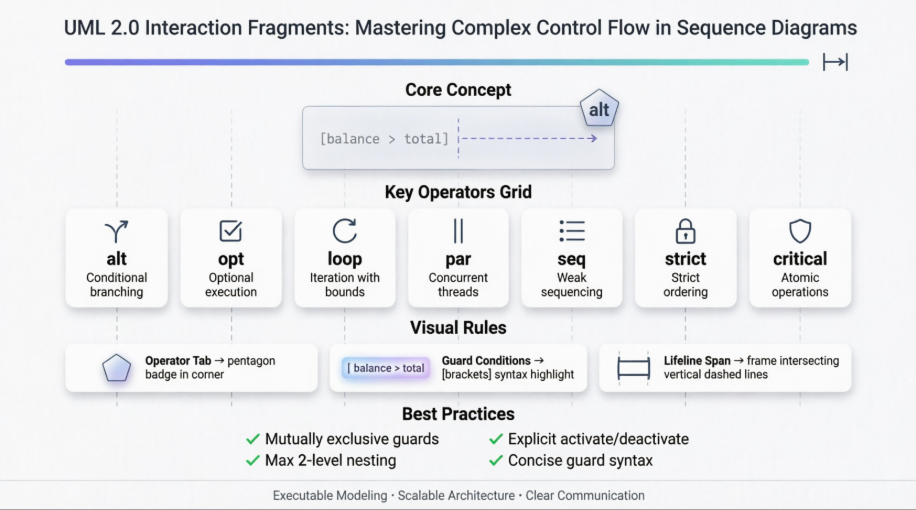
An Interaction Fragment serves as a modular structural unit that encapsulates a specific behavioral segment. It operates within an Interaction Operand, which houses the participating lifelines and execution traces. To orchestrate these operands, UML 2.0 employs a Combined Fragment: a container frame that groups one or more operands under a single Interaction Operator that dictates execution semantics.
Visual Notation & Structural Rules
Combined fragments adhere to strict visual conventions to ensure cross-tool compatibility and developer readability:
-
Operator Tab: A pentagonal label in the top-left corner of the frame containing the operator shortcode (e.g.,
alt,loop,par). -
Operand Guard Conditions: Inline boolean expressions enclosed in square brackets
[ condition ]that determine whether an operand executes. -
Operand Separators: Horizontal dashed lines dividing multiple operands within the same frame.
-
Frame Boundary: A transparent rectangular box that clearly intersects all active lifelines involved in the fragment’s scope.
2. Operator Semantics & Execution Control
UML 2.0 defines twelve standard interaction operators. The following matrix outlines the most critical control-flow operators deployed in the NexaRetail architecture:
| Operator | Full Name | Behavioral Meaning & Execution Rules |
|---|---|---|
alt |
Alternatives | Represents a conditional choice between mutually exclusive paths (analogous to if-else or switch). Only the operand with a true guard executes. |
opt |
Options | Represents a single conditional path that executes entirely or is skipped (analogous to an if without else). |
loop |
Loop | Repeats the encapsulated fragment for a defined sequence. Supports explicit iteration bounds (e.g., loop(1, 10)). |
par |
Parallel | Encloses operands that execute concurrently in separate threads. Message interleaving across operands is permitted. |
seq |
Weak Sequencing | Default behavior. Maintains strict top-to-bottom order within operands, but allows interleaving across independent lifelines. |
strict |
Strict Sequencing | Enforces absolute top-to-bottom sequencing across the entire fragment, regardless of lifeline independence. |
critical |
Critical Region | Marks an atomic execution block. Prevents external interaction traces from interleaving or interrupting the enclosed operations. |
3. Practical Implementation: Executable Sequence Models
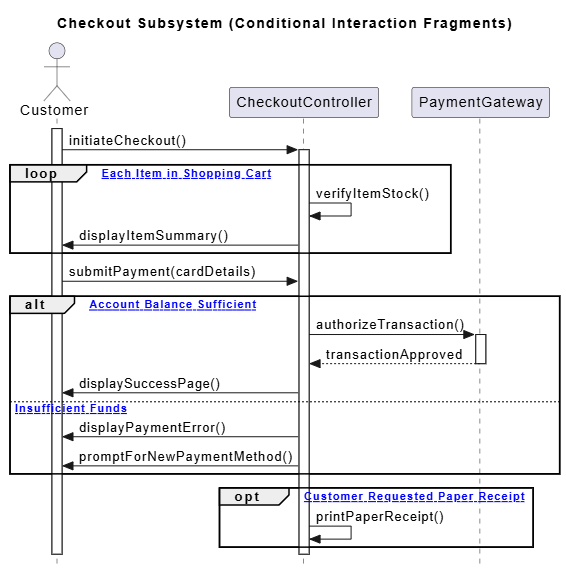
Scenario A: Order Checkout Subsystem (alt, opt, and loop)
The checkout workflow required iterative cart processing, conditional payment routing, and an optional receipt generation step. The following executable specification demonstrates how nested and sequential fragments model this behavior unambiguously.
@startuml
skinparam style strictuml

title Checkout Subsystem (Conditional Interaction Fragments)

actor "Customer" as Cust
participant "CheckoutController" as Ctrl
participant "PaymentGateway" as Gateway

activate Cust
Cust -> Ctrl : initiateCheckout()
activate Ctrl

' 1. Loop Fragment: Processing items in cart
loop [ For Each Item in Shopping Cart ]
    Ctrl -> Ctrl : verifyItemStock()
    Ctrl -> Cust : displayItemSummary()
end

Cust -> Ctrl : submitPayment(cardDetails)

' 2. Alternative Fragment: Mutually exclusive payment paths
alt [ Guard: Account Balance Sufficient ]
    Ctrl -> Gateway : authorizeTransaction()
    activate Gateway
    Gateway --> Ctrl : transactionApproved
    deactivate Gateway
    Ctrl -> Cust : displaySuccessPage()
else [ Guard: Insufficient Funds ]
    Ctrl -> Cust : displayPaymentError()
    Ctrl -> Cust : promptForNewPaymentMethod()
end

' 3. Optional Fragment: Optional behavior path
opt [ Guard: Customer Requested Paper Receipt ]
    Ctrl -> Ctrl : printPaperReceipt()
end

deactivate Ctrl
deactivate Cust
@enduml
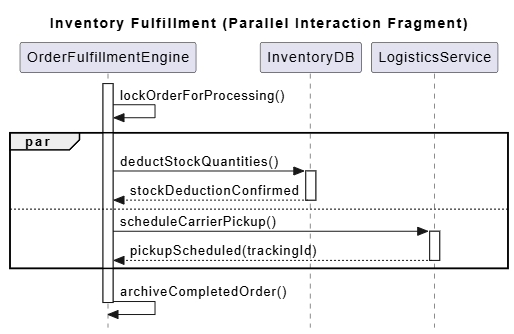
Scenario B: Concurrent Processing Architecture (par)
Post-checkout, the system must synchronize database inventory updates with third-party logistics booking. Since these operations share no common resources beyond the initial order trigger, they are modeled using a parallel fragment to reflect true asynchronous execution.
@startuml
skinparam style strictuml

title Inventory Fulfillment (Parallel Interaction Fragment)

participant "OrderFulfillmentEngine" as Engine
participant "InventoryDB" as Inventory
participant "LogisticsService" as Logistics

activate Engine
Engine -> Engine : lockOrderForProcessing()

' Parallel Fragment: Executing concurrent asynchronous threads
par
    ' Thread 1: Inventory Update
    Engine -> Inventory : deductStockQuantities()
    activate Inventory
    Inventory --> Engine : stockDeductionConfirmed
    deactivate Inventory
else
    ' Thread 2: Logistics Booking
    Engine -> Logistics : scheduleCarrierPickup()
    activate Logistics
    Logistics --> Engine : pickupScheduled(trackingId)
    deactivate Logistics
end

Engine -> Engine : archiveCompletedOrder()
deactivate Engine
@enduml
4. Advanced Topologies for Scalable Architecture
As system complexity grows, interaction fragments enable modularization and exception handling without bloating primary sequence diagrams.
Interaction Occurrences / References (ref)
Large-scale workflows are segmented into focused sub-diagrams. A ref fragment acts as a modular placeholder, spanning relevant lifelines and labeling the external diagram name. This promotes reusability, enforces single-responsibility modeling, and keeps primary diagrams within readable boundaries.
Break Fragments (break)
Exceptional or error flows that disrupt standard execution are modeled using break fragments. When a break fragment’s guard evaluates to true, its internal operations execute, the remainder of the enclosing interaction is immediately abandoned, and control returns to the parent scope. This is essential for modeling transaction rollbacks, timeout handlers, and system-level fault recovery.
5. Engineering Guidelines & Optimization Strategies
To maximize diagram clarity, maintainability, and tool compatibility, the following architectural guidelines are enforced:
-
Enforce Mutually Exclusive Guards in
altFrames
Guard conditions must be logically disjoint (e.g.,[Balance >= Total]vs.[Balance < Total]). Overlapping conditions introduce runtime ambiguity and violate UML execution semantics. -
Limit Fragment Nesting Depth
While UML permits infinite nesting, practical readability degrades beyond two layers. If logic requires deeper nesting, extract the sub-flow into a separate diagram and reference it viaref. -
Align Lifelines with Fragment Boundaries
Only include lifelines that actively participate in messages within the fragment. External or passive lifelines should remain outside the frame to reduce visual clutter and prevent misinterpretation of scope. -
Optimize Tooling & Layout Practices
-
Explicit Activation Control: Pair messages with
activate/deactivatecommands to clearly trace thread ownership across conditional and parallel branches. -
Concise Guard Syntax: Keep bracketed conditions short and declarative. Lengthy predicates distort frame geometry and break automated layout engines.
-
Structured Label Formatting: Use
\nfor line breaks in long titles or comments to enforce vertical stacking and preserve diagram aspect ratios.
-
Conclusion
Interaction fragments transform UML sequence diagrams from static message logs into dynamic, executable behavioral specifications. By mastering combined fragments, operand guards, and execution operators, architects can accurately model the conditional, concurrent, and iterative realities of modern distributed systems. The integration of advanced topologies like ref and break, coupled with disciplined nesting and layout practices, ensures that behavioral documentation remains scalable, unambiguous, and directly aligned with implementation logic. As software systems continue to evolve toward higher concurrency and modular design, interaction fragments will remain an indispensable tool for bridging architectural intent and runtime execution.
This post is also available in Deutsche, Español, فارسی, Français, English, Bahasa Indonesia, 日本語, Polski, Portuguese, Ру́сский, Việt Nam, 简体中文 and 繁體中文.
