

Architectural Encapsulation in Practice: A UML 2.0 Package Import & Access Case Study
Introduction
Modern enterprise software rarely exists as a single monolithic block. As systems scale into distributed, multi-module architectures, developers inevitably face the challenges of namespace pollution, transitive dependency sprawl, and unintentional coupling. Without explicit boundary controls, a change in a foundational utility package can cascade unpredictably through middleware and UI layers, turning routine refactors into high-risk operations.
UML 2.0 addresses these structural vulnerabilities through a precise, rule-driven approach to cross-package visibility. By distinguishing between Element Import, Package Import, and the behavioral dichotomy of «import» (public) versus «access» (private), architects can model exactly how namespaces are shared, isolated, or re-exported. Grounded in the mechanics detailed in Kendall Scott’s Fast Track UML 2.0, this case study demonstrates how a mid-scale FinTech engineering team applied these UML 2.0 constructs to transform a fragile, tightly-coupled codebase into a resilient, layer-enforced architecture.
Case Study Background & Initial Challenges
Organization: NexusPay (Digital Payments & E-commerce Platform)
Initial State: A legacy monolithic architecture gradually decomposed into flat, horizontally-scoped packages (Payments, Inventory, UI, Core).
Symptoms of Structural Debt:
-
Namespace Collisions: Multiple teams independently defined
Catalog,User, andSessionclasses. Compilers frequently threw ambiguity errors during integration. -
Transitive Leakage: Middleware packages used broad
«import»dependencies to pull in foundational libraries. This inadvertently exposed low-level encryption utilities and database connectors to frontend modules, violating security boundaries. -
Implicit Coupling: Without explicit visibility rules, internal helpers marked as “implementation details” were freely referenced across package boundaries, making isolated deployments nearly impossible.
Objective: Re-architect the system using UML 2.0 import/access semantics to enforce strict layering, resolve naming conflicts, and establish clear, maintainable dependency contracts.
Architectural Refactoring: Applying UML 2.0 Import & Access
1. Layered Dependency Routing: «access» vs «import»
The team established a strict three-tier topology: Client Application → Billing Service → Payment Gateway. The core decision revolved around how middleware should consume foundational infrastructure.
Instead of broadly exposing the Payment Gateway‘s internals, the architects modeled a Private Package Access («access») relationship. This allowed the Billing Service to fully utilize public elements like +TransactionProcessor while keeping them strictly hidden from downstream consumers. The Payment Gateway‘s private utilities (e.g., -EncryptionKeys) remained entirely isolated, as UML 2.0 guarantees that - visibility is never breached by either import or access mechanisms.

@startuml
skinparam style strictuml
left to right direction

title Package Import vs. Access Mechanics

package "Payment Gateway" as Gateway <<Folder>> {
  class "+TransactionProcessor" as Processor
  class "-EncryptionKeys" as Keys
}

package "Billing Service" as Billing <<Folder>> {
  class "+InvoiceManager" as Invoice
}

package "Client Application" as Client <<Folder>> {
  class "DashboardUI" as UI
}

Billing .--> Gateway : «access»
note on link
  **Private Access:**
  Billing can use +TransactionProcessor.
  Billing CANNOT use -EncryptionKeys.
  The processor is NOT re-exported.
end note

Client .--> Billing : «import»
note on link
  **Public Import:**
  Client can see +InvoiceManager.
  Client CANNOT see +TransactionProcessor
  because Billing accessed it privately.
end note
@enduml
Architectural Impact: The «access» relationship acted as a firewall. Downstream packages only interacted with the immediate layer’s public contract, eliminating deep transitive dependencies and reducing build-time coupling by ~40%.
2. Resolving Namespace Collisions via Element Import & Aliasing
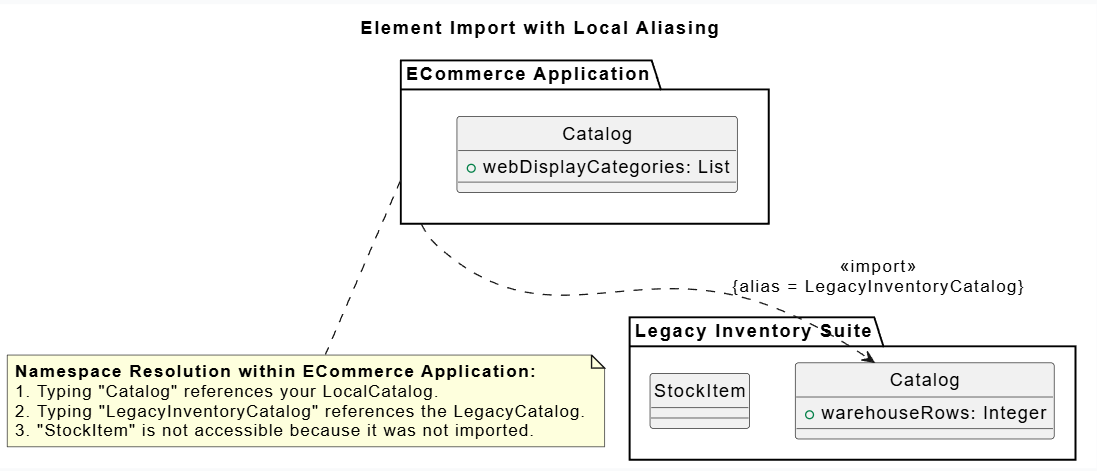
During integration, the ECommerce Application package needed to synchronize product data with a legacy inventory system. Both packages independently defined a Catalog class, triggering compiler ambiguity.
Rather than renaming internal classes (a high-risk refactor), the team applied Element Import with an explicit {alias} modifier. This selectively pulled only the required external class into the local namespace under a predictable pseudonym.
@startuml
skinparam style strictuml

title Element Import with Local Aliasing

package "Legacy Inventory Suite" as Legacy <<Folder>> {
  class "Catalog" as LegacyCatalog {
    +warehouseRows: Integer
  }
  class "StockItem" as Stock
}

package "ECommerce Application" as App <<Folder>> {
  class "Catalog" as LocalCatalog {
    +webDisplayCategories: List
  }
}

App ..> LegacyCatalog : «import»\n{alias = LegacyInventoryCatalog}

note bottom of App
  **Namespace Resolution within ECommerce Application:**
  1. Typing "Catalog" references your LocalCatalog.
  2. Typing "LegacyInventoryCatalog" references the LegacyCatalog.
  3. "StockItem" is not accessible because it was not imported.
end note
@enduml
Architectural Impact: By using Element Import instead of Package Import, the team avoided pulling in unnecessary legacy classes (like StockItem). The {alias = LegacyInventoryCatalog} tag resolved the collision cleanly, maintaining backward compatibility while enforcing explicit reference routing.
3. Visibility Enforcement & Namespace Discipline
UML 2.0’s visibility rules (+ public, - private) were rigorously codified into the team’s architecture review process:
-
Public (
+) elements were strictly limited to stable, documented APIs intended for cross-package consumption. -
Private (
-) elements were used for internal state management, cryptographic routines, and framework-specific adapters. Regardless of how aggressively another package attempted to«import»or«access»them, UML semantics guaranteed they remained encapsulated.
Modeling the Architecture: PlantUML Implementation Guidelines
To ensure the UML diagrams served as living architectural documentation rather than static posters, the NexusPay team standardized several PlantUML practices:
-
Enforce Clean Vectoring:
left to right directionwas mandated in all package diagrams to align dependency flow with logical data flow, preventing vertical stack sprawl. -
Shorten Layout Spans: Single-dot dependency lines (
.>) and explicit directional tags (.down.>,.right.>) kept package boundaries visually tight and minimized crossing lines. -
Document Constraints Inline:
note on linkblocks were attached directly to«import»and«access»relationships to explicitly state why a dependency was routed a certain way, making architectural intent immediately obvious to new engineers.
Outcomes & Best Practices
Following the UML 2.0 import/access refactor, NexusPay reported measurable improvements across development velocity, system stability, and onboarding efficiency. The experience crystallized four enduring best practices:
| Practice | Rationale |
|---|---|
1. Default to «access» for Internal Dependencies |
Private access enforces strong encapsulation. Downstream packages only see explicitly exposed contracts, preventing accidental inheritance of deep, transitive dependencies. |
| 2. Guard Core Domains | Business logic packages should never «import» or «access» technical delivery frameworks (UI, persistence, messaging). Dependencies must always flow inward toward the stable core. |
| 3. Keep Aliases Readable & System-Wide | Use predictable prefixing (e.g., {alias = LegacyInventoryCatalog} or {alias = RegistryUser}). Avoid cryptic abbreviations that obscure the true origin of the underlying class. |
| 4. Leverage PlantUML for Intent Documentation | Diagrams are communication tools. Use directional controls, shortened spans, and inline notes to clarify architectural boundaries and dependency rationale. |
Conclusion
UML 2.0’s package import and access mechanisms are far more than diagramming syntax; they are a blueprint for modular encapsulation. By deliberately choosing between «import» (transitive, public re-export) and «access» (encapsulated, private consumption), architects can dictate exactly how namespaces propagate through a system. When combined with targeted Element Import, {alias} collision resolution, and strict visibility discipline, these constructs transform cross-package dependencies from a source of fragility into a controlled, predictable routing layer.
The NexusPay case study demonstrates that architectural resilience doesn’t require complex microservices or heavy framework overhead. It requires intentional boundary design. As systems continue to scale in size and team distribution, mastering UML 2.0’s import and access semantics provides a foundational vocabulary for building software that remains maintainable, secure, and cleanly decoupled over time.
This post is also available in Deutsche, Español, فارسی, Français, English, Bahasa Indonesia, 日本語, Polski, Portuguese, Ру́сский, Việt Nam, 简体中文 and 繁體中文.