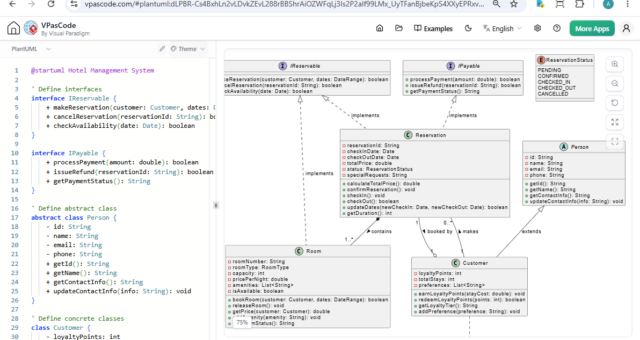
Beyond Isolated Classes: Architecting System Structure Through UML Relationships & PlantUML

Beyond Isolated Classes: Architecting System Structure Through UML Relationships & PlantUML

Introduction In object-oriented architecture, classes define the vocabulary of a system, but they remain structurally silent until connected. The true architectural integrity of any software model emerges not from isolated entities, but from the relationships that bind them. Drawing from Kendall Scott's Fast Track UML 2.0, this guide distills the foundational mechanics of class relationships and translates them into executable PlantUML workflows. While beginners often focus heavily on class attributes and operations, experienced modelers know that relationships dictate lifecycle coupling, navigability constraints, inheritance taxonomies, and dependency boundaries. Through a cohesive case study of a…continue reading →

Mastering UML Class Diagrams: A Practical Case Study in System Design with PlantUML

Introduction In today's complex software development landscape, clear communication and precise system modeling are paramount to project success. Among the most powerful tools in a software architect's toolkit is the UML Class Diagram—a visual language that bridges the gap between abstract requirements and concrete implementation. This case study explores how class diagrams serve as the backbone of object-oriented design, enabling teams to model static system structure, define relationships between entities, and establish clear contracts for development. Through a practical e-commerce order management system example, we'll demonstrate how to progressively refine class diagrams across three…continue reading →
Foundations of Modeling & UML

Foundations of Modeling & UML

1. What Are Models? A model is a complete description of a system from a particular perspective and acts as a simplified representation of reality. You build models because complex systems cannot be fully comprehended in their entirety. Four Core Aims of Modeling: Visualize a system as intended. Specify the structure or behavior of a system. Provide a template to guide system construction. Document design decisions. Four Principles of Modeling The model you choose directly influences how a problem is approached. Every model can be expressed at varying levels of precision. The most effective models remain tightly connected to reality.…continue reading →

A SysML v2 Case Study on Model-Based Systems Engineering

Introduction Modern systems engineering faces an increasingly complex challenge: maintaining traceability and coherence between stakeholder needs and technical implementations while managing cross-cutting concerns across multiple architectural viewpoints. Traditional documentation approaches often create silos between requirements, behavior, and structure, leading to inconsistencies, gaps in coverage, and costly rework during system development. SysML v2 emerges as a transformative solution to these challenges, offering a rigorous, executable modeling language that bridges the gap between abstract problem spaces and concrete solution implementations. This case study demonstrates how SysML v2's modernized approach enables engineers to create seamlessly integrated…continue reading →
The Definitive Guide to SysML v2 Textual Notation

The Definitive Guide to SysML v2 Textual Notation

Systems Modeling Language version 2 (SysML v2) marks a massive shift in systems engineering. By moving away from the rigid, UML-based graphical constraints of SysML v1, SysML v2 introduces a language-driven, textual syntax. This syntax treats structure, behavior, requirements, and analysis as deeply integrated text elements. This comprehensive guide breaks down the core pillars, concepts, and syntax of SysML v2 using a concrete AutonomousDrone design example. 1. The Core Paradigm: Definitions vs. Usages The single most important architectural concept in SysML v2 is the strict separation between Definitions (blueprints) and Usages (contextual instances). The def Keyword: Indicates a reusable definition, type, or element…continue reading →
Transforming Enterprise Architecture: A Case Study on AI-Enhanced TOGAF ADM Implementation with Visual Paradigm

Transforming Enterprise Architecture: A Case Study on AI-Enhanced TOGAF ADM Implementation with Visual Paradigm

Introduction In today's rapidly evolving digital landscape, organizations face unprecedented pressure to align their technology investments with strategic business objectives. Enterprise Architecture (EA) has emerged as a critical discipline for bridging this gap, yet many organizations struggle with the complexity, documentation overhead, and collaborative challenges inherent in traditional EA frameworks. This case study explores how a global financial services organization successfully implemented The Open Group Architecture Framework (TOGAF®) Architecture Development Method (ADM) by leveraging AI-powered tooling through Visual Paradigm. By combining TOGAF's proven methodology with intelligent automation, the organization achieved significant improvements in…continue reading →
TOGAF ADM Guide-Through: A Case Study on AI-Powered TOGAF ADM Implementation with Visual Paradigm

TOGAF ADM Guide-Through: A Case Study on AI-Powered TOGAF ADM Implementation with Visual Paradigm

Introduction In today's rapidly evolving digital landscape, organizations face mounting pressure to align their IT infrastructure with strategic business objectives while maintaining agility, compliance, and scalability. Enterprise Architecture (EA) frameworks like TOGAF® (The Open Group Architecture Framework) provide structured methodologies to bridge this gap, yet their implementation often proves daunting due to complexity, resource intensity, and steep learning curves. This case study explores how Visual Paradigm's AI-enhanced TOGAF ADM (Architecture Development Method) Guide-Through Process addresses these challenges, enabling organizations to accelerate architecture development, ensure standards compliance, and foster cross-functional collaboration. Through a detailed…continue reading →
Precision Through Partnership: A Case Study on the AI-Assisted UML Class Diagram Generator

Precision Through Partnership: A Case Study on the AI-Assisted UML Class Diagram Generator

📘 Introduction In modern software engineering, UML class diagrams serve as the foundational blueprint for system architecture, yet their creation remains a bottleneck. Traditional modeling tools often require manual, error-prone syntax entry, lack contextual alignment with business requirements, and offer little built-in validation. As systems grow in complexity, architects need a way to translate high-level concepts into structurally sound, production-ready diagrams without sacrificing design rigor. The AI-Assisted UML Class Diagram Generator addresses this gap by introducing a structured, 10-step wizard that merges natural language processing with strict object-oriented design principles. Rather than replacing human architects,…continue reading →

How Visual Paradigm’s AI Chatbot Revolutionizes Diagram Creation

Introduction In an era where digital transformation accelerates business innovation, the ability to quickly visualize complex ideas has become a critical competitive advantage. Teams across software development, business analysis, and enterprise architecture constantly face the challenge of translating abstract concepts into clear, actionable diagrams. Traditional diagramming tools, while powerful, often require significant time investment in manual layout, syntax compliance, and iterative refinement. Visual Paradigm's AI Chatbot represents a paradigm shift in visual modeling. By combining conversational AI with deep domain expertise in industry-standard modeling languages, this intelligent assistant empowers users to transform natural…continue reading →

A Case Study on Accelerating UML Class Diagram Development with Visual Paradigm’s AI Ecosystem

Introduction In today's fast-paced software development landscape, the ability to rapidly translate abstract system requirements into clear, actionable architectural models is a critical competitive advantage. Traditional UML class diagram creation—often a manual, time-intensive process of sketching classes, defining attributes, mapping relationships, and ensuring standards compliance—can become a bottleneck in agile workflows. This case study explores how Visual Paradigm's integrated AI-powered ecosystem transforms this challenge into an opportunity for acceleration, collaboration, and precision. We examine a real-world scenario: a mid-sized fintech startup, "PayFlow Solutions," tasked with designing the core domain model for a new…continue reading →