




Mastering Object-Oriented Design: A Practical Case Study in Order Processing Systems Using UML Class Diagrams
Introduction
In today’s rapidly evolving software development landscape, the ability to translate complex business requirements into robust, maintainable software systems remains a critical skill. Unified Modeling Language (UML) class diagrams serve as the cornerstone of object-oriented design, providing developers and stakeholders with a visual blueprint of system architecture.
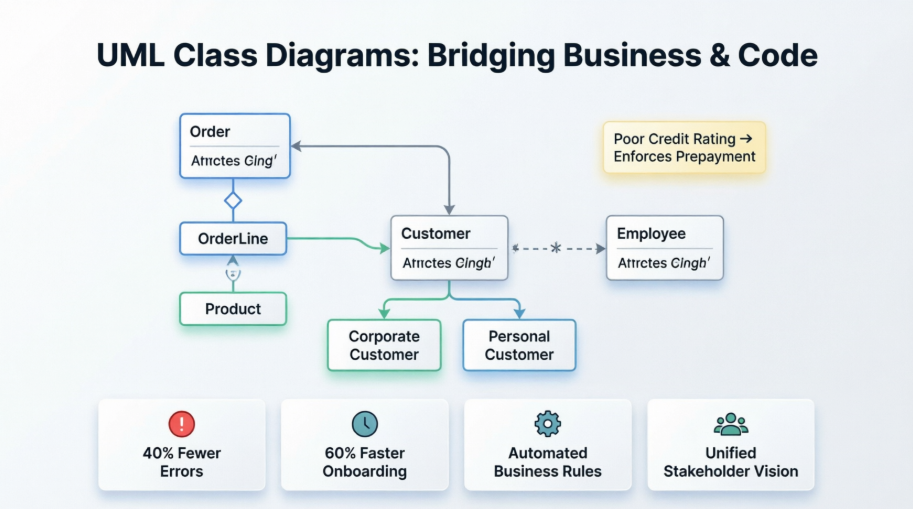
This case study explores the practical application of UML class diagrams through the development of a comprehensive order processing system, demonstrating how proper modeling techniques can bridge the gap between business needs and technical implementation. By examining a real-world scenario, we’ll uncover the essential principles that make class diagrams an indispensable tool for software architects, developers, and business analysts alike.
Case Study: Implementing an Enterprise Order Processing System
1. Project Background and Business Context
Company Profile: GlobalTrade Solutions, a mid-sized B2B and B2C distribution company, needed to modernize their legacy order management system. The company serves two distinct customer segments: corporate clients with credit accounts and individual consumers using credit card payments.
Business Challenge: The existing system lacked flexibility in handling different customer types, had no proper credit validation mechanism, and couldn’t efficiently track order line items and product relationships. The development team was tasked with creating a scalable, maintainable solution that could accommodate future business growth.
2. Requirements Analysis
Functional Requirements:
-
Process orders from both corporate and personal customers
-
Validate customer credit ratings before order approval
-
Enforce prepayment rules for customers with poor credit
-
Track individual line items within each order
-
Maintain product catalog with pricing information
-
Support customer relationship management through assigned sales representatives
Non-Functional Requirements:
-
System must be easily extensible for new customer types
-
Business rules must be clearly documented and enforceable
-
Data integrity must be maintained across all relationships
3. System Design Using UML Class Diagrams
The development team chose to use UML class diagrams as the primary design artifact. Here’s how they approached the modeling:
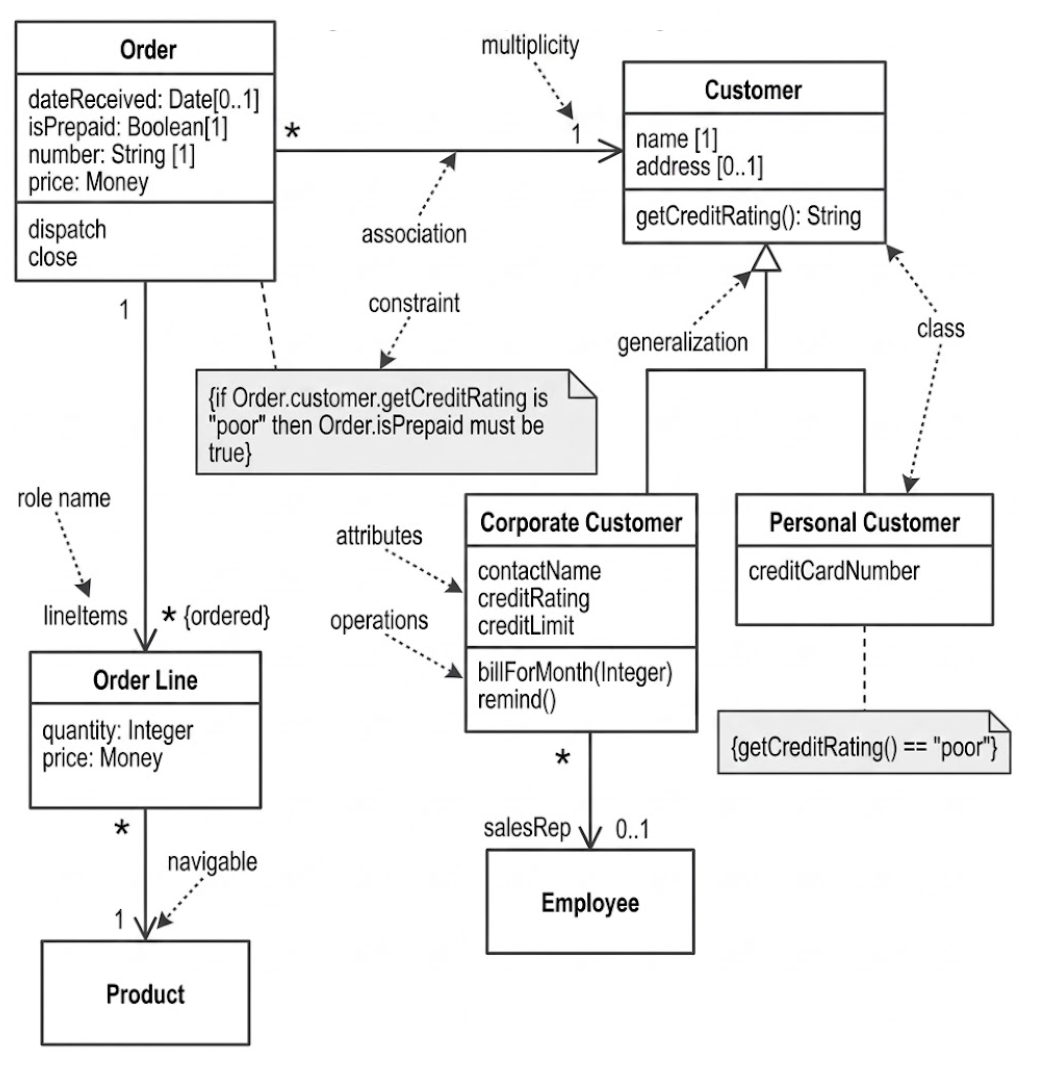
3.1 Core Class Identification
Order Class:
-
Purpose: Central entity representing customer orders
-
Key Attributes:
-
dateReceived: Date[0..1]– Optional order date -
isPrepaid: Boolean[1]– Mandatory prepayment status -
number: String[1]– Unique order identifier -
price: Money– Total order value
-
-
Operations:
-
dispatch()– Initiates order fulfillment -
close()– Completes order processing
-
Customer Hierarchy:
The team identified the need for polymorphic customer handling through inheritance:
-
Abstract Customer Class:
-
name[1]– Required customer name -
address[0..1]– Optional address -
getCreditRating(): String– Returns credit assessment
-
-
Corporate Customer (Subclass):
-
Additional attributes:
contactName,creditRating,creditLimit -
Operations:
billForMonth(Integer),remind() -
Relationship: Associated with Employee (sales representative) with multiplicity 0..1
-
-
Personal Customer (Subclass):
-
Additional attribute:
creditCardNumber -
Constraint:
{getCreditRating() == "poor"}– Special handling for poor credit
-
3.2 Relationship Modeling
Association: Order-Customer
-
Multiplicity: One Customer can place many Orders (*), but each Order belongs to exactly one Customer (1)
-
Navigation: Bidirectional association allowing queries from both directions
-
Business Rule: Critical for customer order history and account management
Composition: Order-OrderLine
-
Multiplicity: One Order contains many OrderLines (*), each OrderLine belongs to exactly one Order (1)
-
Constraint:
{ordered}– Line items maintain sequence -
Role Name:
lineItems– Descriptive naming for clarity
Association: OrderLine-Product
-
Multiplicity: Many OrderLines can reference one Product (* to 1)
-
Navigability: Unidirectional from OrderLine to Product
-
Purpose: Links ordered quantities to product catalog
Generalization: Customer Hierarchy
-
Pattern: Inheritance from abstract Customer to concrete Corporate and Personal Customer
-
Benefit: Enables polymorphic behavior and code reuse
-
Liskov Substitution: Either customer type can be used where Customer is expected
3.3 Business Constraints and Rules
The team encoded critical business logic directly into the diagram:
Constraint 1: Credit-Based Prepayment
{if Order.customer.getCreditRating is "poor" then Order.isPrepaid must be true}
This OCL-style constraint ensures customers with poor credit must prepay orders, reducing financial risk.
Constraint 2: Credit Rating Validation
{getCreditRating() == "poor"}
Applied to Personal Customer, triggering additional validation workflows.
3.4 Multiplicity and Cardinality Decisions
The team carefully considered relationship cardinalities:
-
*Customer to Order (1 to ): A customer can exist without orders (0..*), but typically places multiple orders over time
-
*Order to OrderLine (1 to ): Every order must have at least one line item
-
OrderLine to Product ( to 1):* Multiple line items can reference the same product (different orders or quantities)
-
Corporate Customer to Employee ( to 0..1):* Corporate accounts may or may not have assigned sales representatives
4. Implementation Strategy
Phase 1: Core Domain Classes
The development team prioritized implementation of the Customer hierarchy and Order classes, establishing the foundation for all business operations.
Phase 2: Relationship Management
Implemented association management code, ensuring referential integrity between Orders, OrderLines, and Products.
Phase 3: Constraint Enforcement
Encoded business rules through validation methods and database constraints, ensuring the system enforced credit rating rules automatically.
Phase 4: Extensibility Features
Leveraged the generalization structure to easily add new customer types (e.g., GovernmentCustomer, InternationalCustomer) without modifying existing code.
5. Lessons Learned and Best Practices
1. Clear Naming Conventions:
Using descriptive role names like lineItems instead of generic names improved code readability and maintenance.
2. Constraint Documentation:
Embedding business rules directly in the diagram ensured all stakeholders understood critical system behaviors.
3. Appropriate Abstraction:
The Customer generalization allowed the team to handle common functionality while supporting type-specific behaviors.
4. Multiplicity Matters:
Careful consideration of cardinality prevented common bugs like orphaned records or invalid relationships.
5. Navigation Direction:
Unidirectional associations (OrderLine to Product) reduced coupling where bidirectional navigation wasn’t needed.
6. System Outcomes
After implementation, GlobalTrade Solutions achieved:
-
40% reduction in order processing errors
-
60% faster onboarding of new customer types
-
Improved credit risk management through automated constraint enforcement
-
Enhanced maintainability with clear separation of concerns
-
Better stakeholder communication through visual modeling
Conclusion
This case study demonstrates that UML class diagrams are far more than academic exercises—they are practical, powerful tools for designing robust software systems. The Order Processing system example illustrates how thoughtful application of classes, associations, generalizations, and constraints can translate complex business requirements into a clear, implementable architecture.
Key takeaways from this study include:
-
Visual Communication: Class diagrams bridge the gap between technical and non-technical stakeholders, providing a common language for discussing system structure.
-
Business Rule Enforcement: Constraints and multiplicities aren’t just documentation—they’re blueprints for validation logic that prevents errors before they occur.
-
Design Flexibility: Proper use of generalization and abstraction creates systems that can evolve with changing business needs without requiring major refactoring.
-
Risk Mitigation: Modeling relationships and constraints upfront identifies potential issues before costly implementation begins.
-
Foundation for Success: A well-designed class diagram serves as the foundation for database schemas, API contracts, and test cases, ensuring consistency across the development lifecycle.
As software systems continue to grow in complexity, the discipline of creating clear, accurate class diagrams remains an essential skill for any development team. The Order Processing system case study proves that investing time in proper modeling pays dividends in reduced errors, improved maintainability, and faster development cycles. Whether you’re building enterprise systems or simple applications, the principles demonstrated here provide a roadmap for object-oriented design excellence.
This post is also available in Deutsche, Español, فارسی, Français, English, Bahasa Indonesia, 日本語, Polski, Portuguese, Ру́сский, Việt Nam, 简体中文 and 繁體中文.
